



Table of contents: Removal ↓ Inspection ↓
Note: Cylinder head overhaul is described in Section 1B.
Removal
1. Disconnect the negative cable from the battery.
2. Remove the upper engine cover and the lower engine compartment shield (see illustrations). If necessary, temporarily jack up the front of the vehicle.
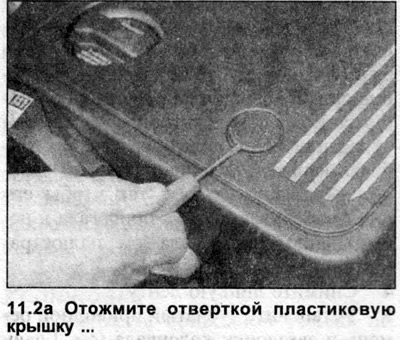
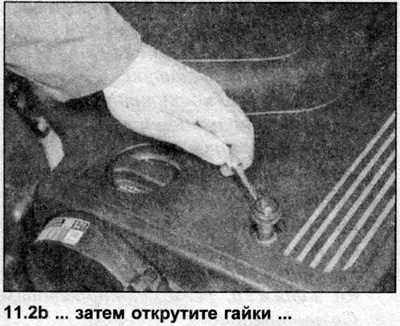
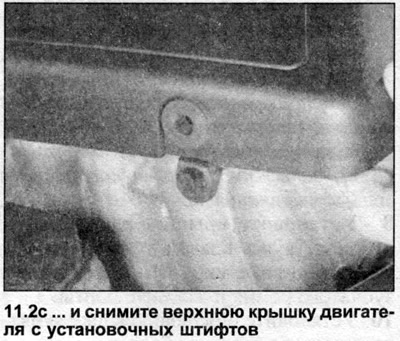
3. Drain the engine oil.
4. Drain the fluid from the cooling system.
5. Loosen the clamps and disconnect all hoses from the cylinder head, remembering their location.
6. Remove the accessory drive belt as described in Chapter 7.
7. Remove the timing belt tensioner and camshaft sprocket (see Chapter 6). This procedure involves setting the engine to the TDC position.
8. Unscrew the bolts of the lower toothed belt cover. Where necessary, first remove the fan unit with the heat-viscous coupling (see Section 2).
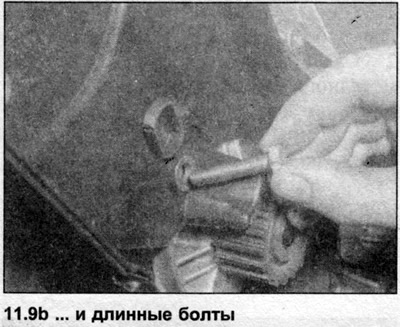
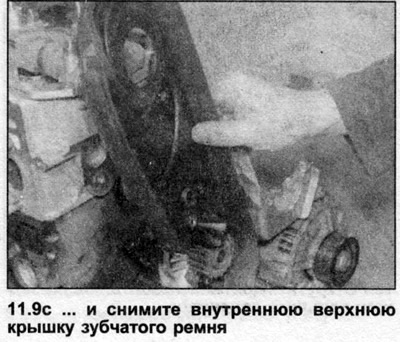
9. Unscrew the bolts and remove the inner upper timing belt cover (see illustrations).
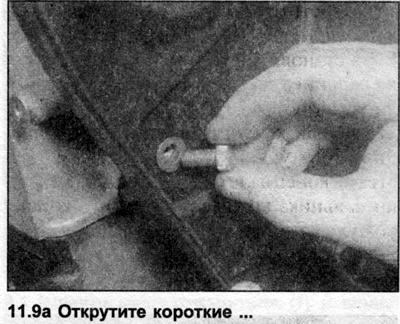
10. Remove the camshaft cover as described in Chapter 8.
11. Remove the fuel pump drive belt (see Chapter 5).
12. Disconnect and remove the injector fuel supply lines as described in Section FOR. Disconnect the outlet hoses from the injectors.
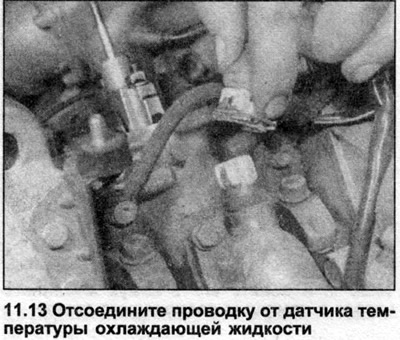
13. Disconnect all fuel and cooling system wiring, labeling each connector to simplify subsequent installation (see illustration). Disconnect the power wires from the glow plugs.
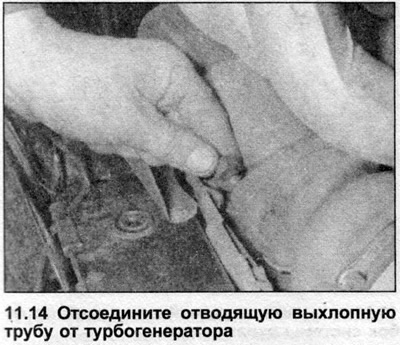
14. On DE, NC and 1T engines, remove the turbo generator as described in Section 3B. Where access to the turbogenerator is limited, remove it together with the exhaust manifold. In this case, it is necessary to unscrew the nuts and disconnect the exhaust outlet pipe from the turbogenerator (see illustration).
15. On 3D engines, disconnect the exhaust outlet pipe from the exhaust manifold (Section 3B). Support the outlet pipe with an axial support and remove the gasket.
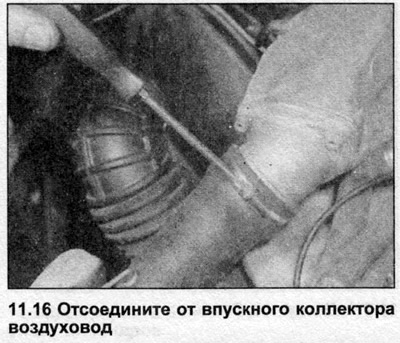
16. See Sections 3A and 3B and remove the intake and exhaust manifolds (see illustration).
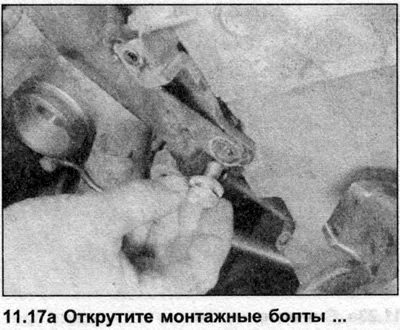
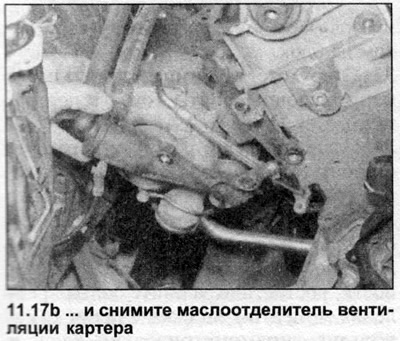
17. Unscrew the bolts and remove the crankcase ventilation oil separator from the right side of the engine (see illustrations).
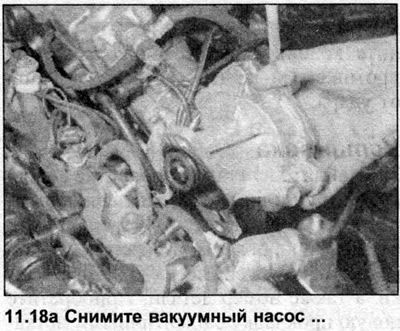
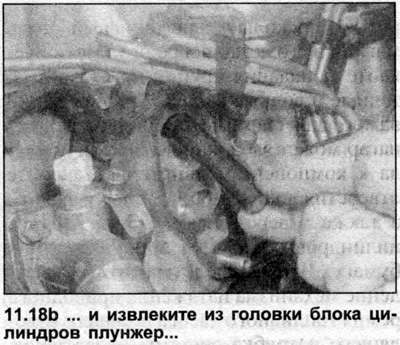
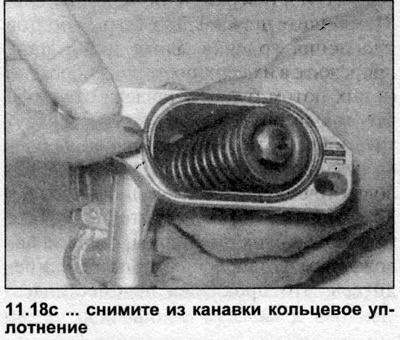
18. Remove the vacuum pump and plunger from the left side of the cylinder head (see Section 9). The plunger must be removed to gain access to one of the cylinder head mounting bolts. Remove the O-ring from the groove in the vacuum pump housing (see illustrations).
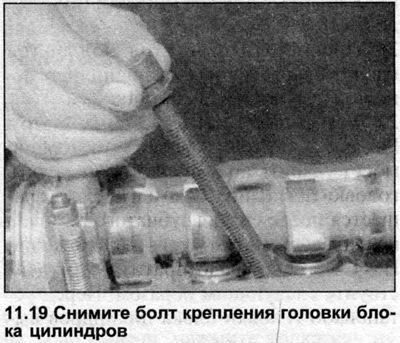
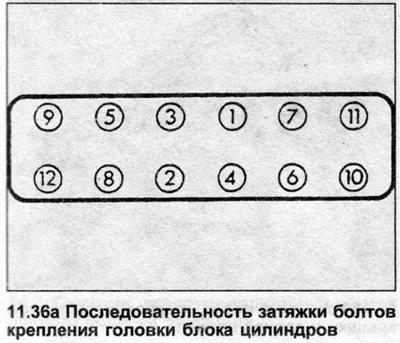
19. In the reverse order to that shown in Illustration 11.36a, gradually loosen the cylinder head mounting bolts (half a turn per reception), unscrew them manually and remove them together with the washers. Throw away the bolts - they are subject to replacement (see illustration).
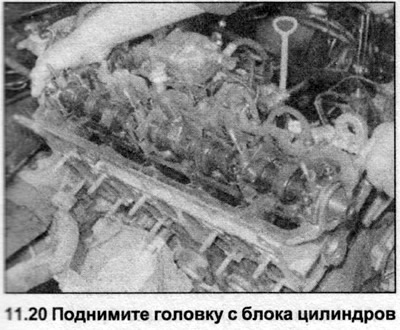
20. Make sure nothing else is connected to the cylinder head, then lift the head off the block (see illustration). It is recommended to do this with two people, as the head is heavy.
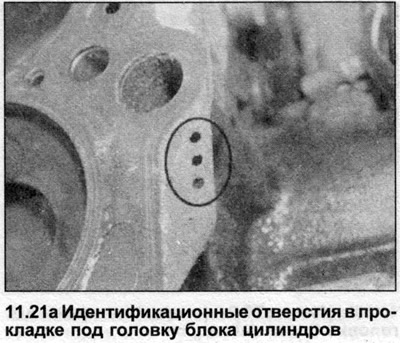
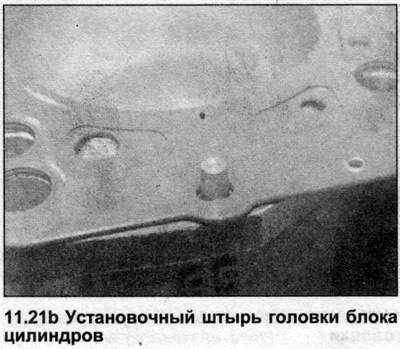
21. Remove the gasket from the top of the block, paying attention to the identification holes located on its right edge. If the mounting pins are loose, remove them and store them with the head so as not to lose them (see illustrations). Don't throw away the gasket yet, you will need it as a sample.
22. If the cylinder head needs to be disassembled, see. Section 1B.
Inspection
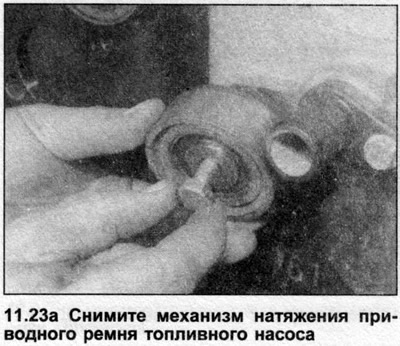
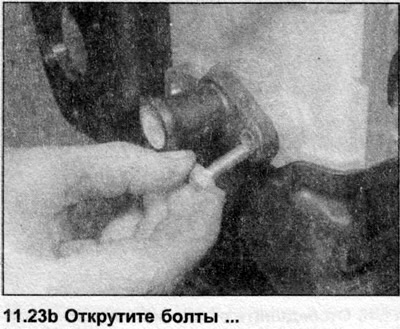
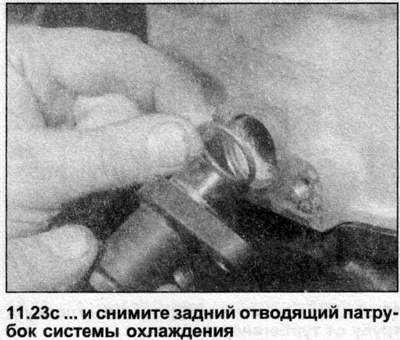
23. Clean the mating surfaces of the head and cylinder block/crankcase. Using a plastic or wooden scraper, remove gasket residue and carbon deposits; clean the piston crowns as well. Be very careful, as the aluminum alloy is soft and easily damaged. Avoid getting carbon deposits into the oil and water passages - this is especially important for the lubrication system, as carbon deposits can block the flow of oil to engine components. Cover the water and oil passage openings, as well as the bolt holes in the cylinder block, using adhesive tape and paper. To prevent damage to the fuel pump drive belt tensioner and the rear coolant outlet pipe, temporarily remove them from the rear of the cylinder head (see illustrations).
24. Check the contact surfaces of the cylinder block and head for unevenness, deep scratches and other damage. Small depressions can be carefully removed with emery cloth. Please note that regrinding the head is not possible - see. Section 1B.
25. Check the cylinder head seating surface for deformation using the edge of a ruler (see Section 1B).
26. Clean the holes for the cylinder head mounting bolts using a suitable tap.
27. The design of all engines described in this Section is such that the pistons can strike the valves and damage the heads of the latter if the camshaft is rotated after the toothed belt has been removed, and the crankshaft is at TDC. To prevent this, proceed as follows. Before installing the cylinder head, bring piston No.1 to TDC, then turn the crankshaft a few degrees counter-clockwise to move the pistons away from the impact.
Installation
28. Locate the manufacturer's identification marks on the old cylinder head gasket. These may be either punched holes or notches located on the edge of the gasket, as well as the part number. Purchase a new gasket with identical marks (unless new pistons were installed).
29. If new pistons were installed during engine rebuild, refer to Section 1B and measure the piston protrusion height before purchasing a new cylinder head gasket. Select a new gasket according to the measurement (see Section 1B Specifications).
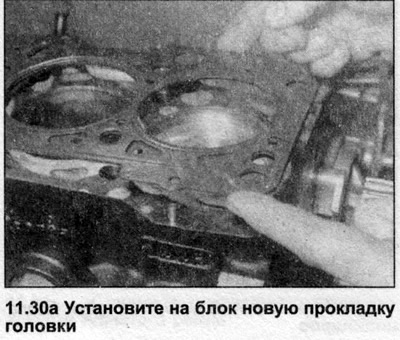
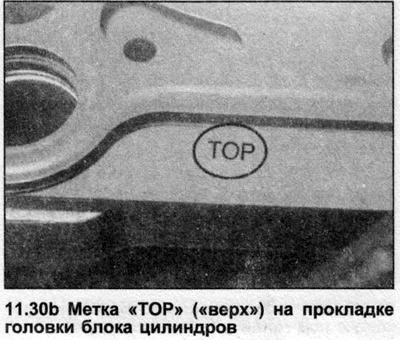
30. Place the new gasket on the cylinder block, pushing it onto the dowel pins. Make sure the gasket is facing up with the side with the manufacturer's mark "TOP" ("top") and the part number.
31. File off the heads of two old cylinder head bolts and cut grooves in their upper ends (a screwdriver will then be inserted into them to unscrew and remove the bolts) and screw them into opposite ends of the cylinder block so that when installed, the head sits precisely on the cylinder block.
32. With the help of an assistant, place the head on the cylinder block, paying attention to the position of the dowel pins. Make sure that the gasket has not moved before lowering the head with all its weight onto the block.
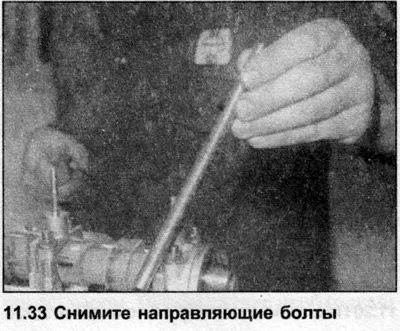
33. Unscrew and remove the homemade guide bolts (see illustration).
34. Lightly lubricate the threads and the back of the heads of the new cylinder head bolts with oil.
35. Carefully insert each bolt into the hole and tighten them by hand.
36. Working in the sequence shown, gradually tighten the mounting bolts to Stage 1 torque using a torque wrench and suitable socket (see illustration). Tighten them in the same sequence to Stage 2 tightening torque.
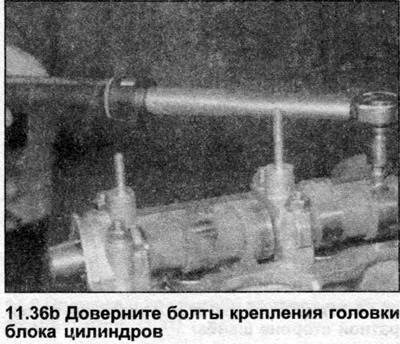
37. In the same sequence, tighten the bolts to the angle specified in the Specifications (Stage 3), using the socket and extension rod. It is recommended to use an angle template to ensure accuracy. If a template is not available, paint alignment marks on the bolts and head, tighten the bolts and check the angle using the marks.
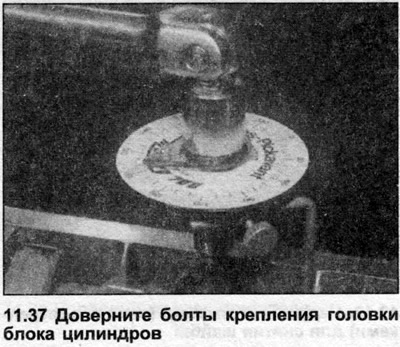
Note: Specifications provide information on re-tightening the bolts after the engine has warmed up to normal operating temperature.
38. Install the vacuum pump as described in Section 9.
39. Install the intake and exhaust manifolds (Sections FOR and 3B).
40. On DE, NC and 1T engines where removed, install the turbogenerator as described in Section 3B.
41. On 3D engines, attach the exhaust outlet pipe to the exhaust manifold using a new gasket (Section 3B).
42. Reconnect all electrical wiring disconnected prior to removal.
43. Connect the fuel outlet and supply lines to the injectors as described in Section FOR.
44. Install the fuel pump drive belt (see Chapter 5).
45. Install the camshaft cover (see Chapter 8).
46. Install the inner upper timing belt cover and tighten the bolts. Note that the threads of the bolt installed below the camshaft must first be coated with a locking compound.
47. Install the lower timing belt cover and tighten the bolts. Where necessary, install the fan unit with the heat-viscous coupling.
48. Bring the engine to TDC position and install the timing belt tensioner, camshaft sprocket and the timing belt itself (see Chapter 6).
49. Install the auxiliary drive belt (see Chapter 7).
50. Connect the cooling system hoses to the cylinder head and tighten the clamps.
51. Fill the cooling system.
52. Fill the engine with the required amount of clean oil of the specified grade.
53. Install the lower shield and lower the vehicle to the ground.
54. Connect the negative cable to the battery.
55. Start the engine and warm it up to normal operating temperature.
56. Turn off the engine and remove the camshaft cover as described in Chapter 8.
57. Working in the sequence shown, tighten the cylinder head mounting bolts to the specified angle (Stage 5).
Note: On models with 1T, CN, NC and DE engines, the cylinder head mounting bolts must be tightened by 90° after the vehicle has traveled 1000 km.
58. Install the camshaft cover (see Chapter 8).
This article was copied from an online resource: AUDIMANUAL