



Table of contents: Removal ↓ Inspection ↓
Removal
Note: If the pistons/connecting rods do not need to be rebuilt, there is no need to remove the cylinder head and pistons. It is only necessary to push the pistons far enough into the cylinders to clear the connecting rods from the crankshaft journals. It is highly recommended that a special stand designed for engine rebuilding be used.
1. Guided by Section 1A, do the following:
- a) Remove the crankshaft sprocket and timing belt.
- b) Remove the clutch components and flywheel or drive disc (depending on the model).
- c) Remove the sump, its partition, oil pump and suction pipe.
- d) Remove the rear crankshaft oil seal and its housing.
2. Remove the pistons and connecting rods or disconnect them from the crankshaft as described in Chapter 7 (see note above).
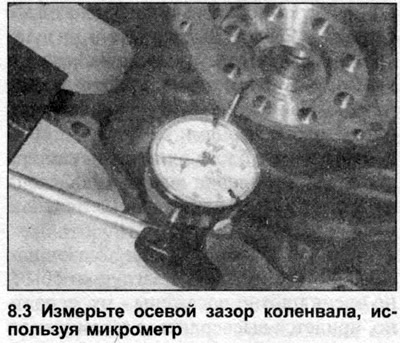
3. Turn the cylinder block over on the workbench and check the crankshaft end clearance as follows. Set the micrometer so that its probe is located on the crankshaft axis and touches the end of the shaft. Move the crankshaft to the stop in one direction and set the micrometer pointer to zero. Move the crankshaft to the stop in the opposite direction and record the resulting end clearance value (see illustration). Comparing the result with the figure stated in the Specifications will indicate whether new thrust washers are required.
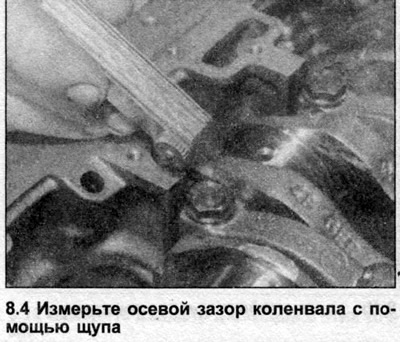
4. If a micrometer is not available, feeler gauges can be used. First, move the crankshaft as far as it will go against the flywheel, then select a feeler gauge whose thickness corresponds to the clearance between the counterweight of the crank pin of cylinder No.4 (5-cylinder engines) and the main bearing thrust washer (see illustration). Compare the results with the data given in the Specifications.
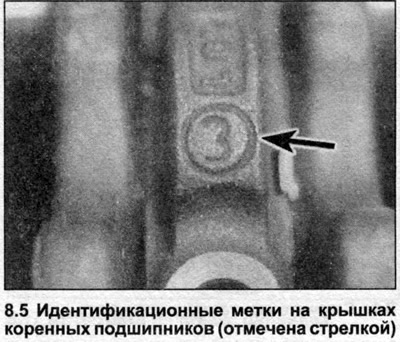
5. Pay attention to the marks on the main bearing caps. The number indicates the position of the cap in the crankcase, cap No.1 is located closest to the toothed drive belt (see illustration).
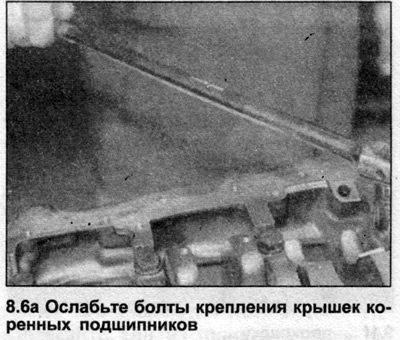
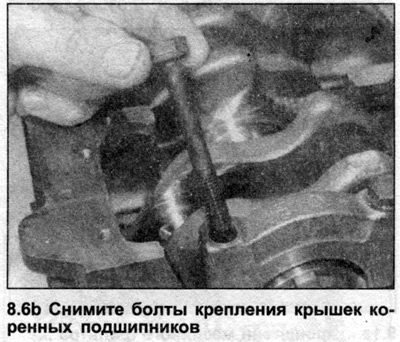
6. Loosen the main bearing cap bolts by turning them half a turn at a time and remove them (see illustrations). Tap the caps lightly with a mallet to loosen them from the crankcase. Remove the lower main bearing shells, securing them to the appropriate cap with adhesive tape for safekeeping. Mark them to avoid confusion, but do not scratch or nick them.
7. Carefully lift the crankshaft out of the crankcase, being careful not to displace the upper main bearing shells (see illustration).
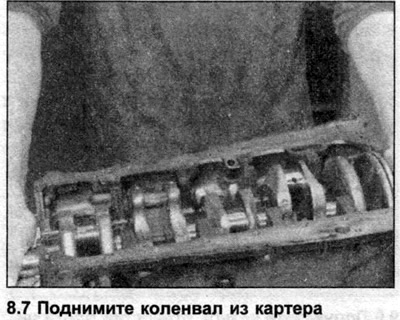
8. Remove the upper bearing shells from the crankcase and tape them to their respective bearing caps. Remove the two thrust washers from bearing #4 (5-cylinder engines).
9. Remove the bearing shells and note the recesses in the bearing caps and housing intended for the mounting protrusions of the bearing shells.
Inspection
10. Wash the crankshaft in a suitable solvent and allow it to dry. Clean the oil holes thoroughly, using a suitable brush if necessary.
11. Inspect the main and connecting rod bearing journals. If signs of uneven wear, cracks, scratches or pitting are found, have a specialist regrind the crankshaft and install it on the engine together with oversize liners.
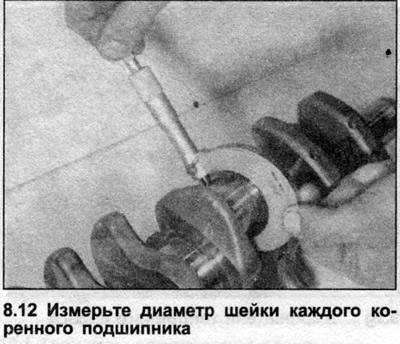
12. Using a micrometer, measure the journal diameter of each main bearing (see illustration). Measure several points around each journal to determine if it is out of round. Measure at the ends of the journal, near the counterweights, to determine if the journal is tapered. If such wear is detected, have the crankshaft reground by a specialist and purchase oversize bearings.
13. Check the seal contact areas on both ends of the crankshaft. If they are worn or damaged, the new seals will be damaged during engine assembly and will therefore leak. It may be possible to regrind the end of the shaft - contact your Audi dealer.
14. Measure the crankshaft runout by placing a micrometer probe on the 3rd and 4th main bearings (5-cylinder engines) and rotating the shaft on V-shaped supports. The maximum deviation of the micrometer needle corresponds to the runout. Do not damage the bearing journals and the contact surfaces with the seals during this procedure. Manufacturers do not specify the maximum permissible runout value, but it is approximately 0.03 mm. If the runout exceeds this value, consult an Audi dealer about replacing the crankshaft.
15. Inspection of main and connecting rod bearings is described in Chapter 10.