



Table of contents: Inspection ↓ Selection of main and connecting rod… ↓
Inspection
1. Although the main and connecting rod bearing shells should be replaced during an engine overhaul, save the old shells for detailed inspection as they can provide valuable information regarding the condition of the engine (see illustration).
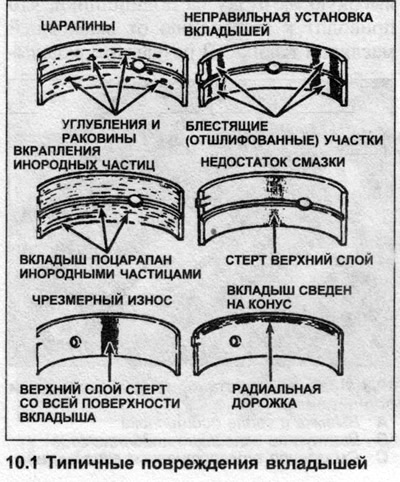
2. Bearing damage may be caused by insufficient lubrication, foreign particles, engine overload, or corrosion. Regardless of the cause, it must be corrected before reassembling the engine.
3. Remove all main and connecting rod bearing shells and lay them out on a clean work surface in the same order as they were installed in the engine. This will allow you to associate the bearing damage with the corresponding crankshaft journal. Do not touch the inner surface of the bearings, you can damage it.
4. Foreign particles enter the engine in various ways. They can be left in the engine during assembly or penetrate through filters or the crankcase ventilation system. Often, metal grains are found that are left over from regrinding or formed during normal engine wear. Foreign particles that enter the bearings are embedded in the soft working layer of the liners, where they are easy to detect. Large particles do not sink into the material of the liners, but scratch the liners and journals. The best way to prevent bearing failure due to this cause is to thoroughly clean all components and maintain impeccable cleanliness during engine assembly. In addition, frequent and regular changes of engine oil and filter are recommended.
5. Lack of lubrication has many interrelated causes. These may include: overheating (makes the oil less viscous, which causes its layer on the bearings to become thinner), overload (squeezes oil from the bearing surface) or leaks (bearing clearances are excessive, oil pump is worn out or engine speed is high). Blockage of the lubrication passages, which is usually the result of misalignment of the bearing lubrication holes, also leads to a lack of lubrication and causes bearing failure. When a bearing fails due to lack of lubrication, the bearing layer will be worn away or peel off from its steel backing. Temperatures can rise to the point where the steel backing turns blue from overheating.
6. Driving style also affects bearing life. Full throttle and long-term operation at low speeds (engine overload) put a very high load on the bearings, which causes the oil film to be pushed away from the liners. As a result, the liners bend and a network of small cracks forms on them (a "fatigue" failure). Ultimately, the working layer of the bearing liner will disintegrate into pieces and break away from the steel base.
7. Short trips cause bearing corrosion because the engine does not heat up enough to repel compressed water vapor and corrosive gases. The vapors are adsorbed by the engine oil, forming acid and sludge. When this oil gets into the engine bearings, the working layer of their bearings oxidizes.
8. Incorrect selection of the bearing shell will also cause bearing failure. Too large shells that fit tightly into the bearing leave insufficient working clearance, which leads to a lack of lubrication.
9. When assembling, do not touch the working surface of the inserts with your fingers - this may scratch it.
10. As mentioned at the beginning of this Chapter, the liners should be changed after each removal.
Selection of main and connecting rod bearings
11. We sell main and connecting rod bearing shells of both nominal and repair sizes (see Specifications).
12. After installing new liners, check the operating clearances of the crankshaft bearings (see Chapter 12).
(A link to the original source is available on the website: «AUDIMANUAL.RU»)