
Repair Chevrolet Repair Toyota Repair Honda Repair AvtoVAZ Repair Mercedes-Benz Repair BMW Repair Opel
Home  |  Contacts  |  Sitemap  |    
English Русский
Български
Беларускі
Український
Српски
Hrvatski
Română
Polski
Slovenský
Magyar
AudiManual.ru


  • AUDI 80
  • AUDI 100
  • AUDI A3
  • AUDI A4
  • AUDI A6
  • AUDI A8
  • AUDI Q
  • OTHER
  • ARTICLES
C4 (1990-1994) C4 (1990-1994, petrol) C3 (1982-1990) C3 (1982-1990, petrol) C3 (1982-1990, diesel)

Crankshaft — installation and checking of working clearance (Audi 100 C3)

  • Home
  • Audi 100
  • C3 (1982-1990, diesel)
  • Power unit
  • Engine removed
  • Crankshaft — installation and checking of working clearance
            0
Table of contents: Checking the working clearance ↓ Crankshaft - final installation ↓
1. Installing the crankshaft is the first stage of engine assembly. At this stage, the crankshaft, cylinder block, crankcase and bearings should be cleaned, inspected and restored or replaced. Where removed, install the oil jets and tighten their mounting bolts with the tightening force specified Specifications.

2. Place the cylinder block on a clean, level work surface with the crankcase facing up. Wipe the inside surfaces of the main bearing caps and the corresponding recesses in the crankcase with a clean cloth - they must be spotlessly clean.

3. Clean the back surface of the new bearing shells with a cloth and place them in their working position in the crankcase. Make sure that the locating tabs on the shells fit into the corresponding recesses in the crankcase and that the oil holes are properly aligned (see illustration). Do not hammer or force the bearing shells into place. It is critical not to damage or contaminate the bearing surfaces.
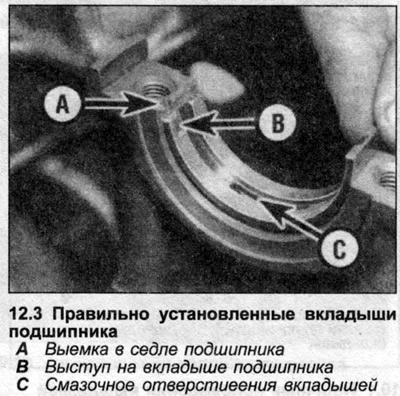
3. Clean the back surface of the new bearing shells with a cloth and place them in their working…


4. Install thrust washers on each side of bearing #4 (5-cylinder engines). Apply a small amount of grease to hold the washers in place. Make sure they are seated correctly in the grooves, with the grease tips facing outward (see illustration).
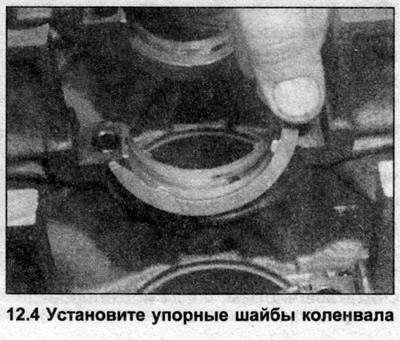


4. Install thrust washers on each side of bearing #4 (5-cylinder engines). Apply a small amount of…


5. Wipe the installed main bearing shells and crankshaft journals again with a clean cloth. Make sure that the oil holes in the crankshaft are not clogged, as any grains left here will fall on the new shells when the engine is first started.

6. Carefully place the crankshaft into the crankcase, being careful not to displace the bearing shells.

Checking the working clearance


7. There must be a gap between the crankshaft and the bearing shells to allow the grease to circulate. This gap cannot be checked with a feeler gauge, so a special tool called Plastigage is required. The tool consists of a scale and plastic threads of round cross-section. Proceed as follows.

8. Cut several pieces of Plastigage slightly shorter than the crankshaft journal length. Place one piece on each journal, parallel to the crankshaft axis (see illustration).
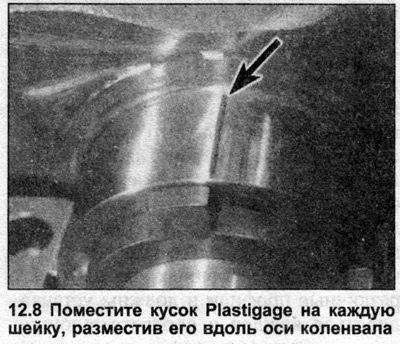
8. Cut several pieces of Plastigage slightly shorter than the crankshaft journal length. Place one…


9. Wipe the back surfaces of the new lower main bearing shells and install them into the caps so that the mounting protrusions fit into the corresponding recesses (see illustration).
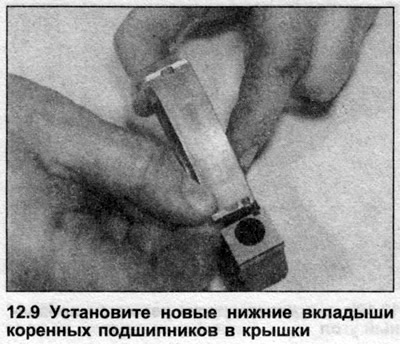


9. Wipe the back surfaces of the new lower main bearing shells and install them into the caps so…


10. Wipe the bearing surfaces clean and, if possible, lightly coat them with silicone repellent to prevent the Plastigage from sticking. Install the caps, each one exactly in its original position, using the manufacturer's marks for orientation. The caps should be installed so that the recesses for the bearing locating protrusions are on the same side as in the bearing seat.

11. Working from the center bearing cap outward, tighten the bolts by turning them half a turn at a time to the first stage tightening torque (see Specifications). Do not move the crankshaft while the Plastigage is under the bearings. Gradually unscrew the bearing cap bolts and remove them, being careful not to displace the Plastigage.

12. Measure the width of the Plastigage thread using the tool scale (see illustration). This measurement is equal to the bearing operating clearance - compare it with the data given in the Specifications. If the clearance is outside the permissible deviations, the cause may be foreign particles trapped under the liners; try cleaning them and rechecking. If the results are still unsatisfactory, remeasure the neck diameters and check the insert sizes. If one end of the Plastigage is thicker than the other, the necks may be tapered and need to be resharpened.
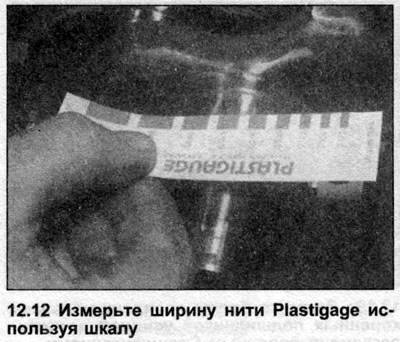


12. Measure the width of the Plastigage thread using the tool scale (see illustration). This…


13. If the clearance is within specification, carefully scrape away any remaining Plastigage from the journals and bearings. Use a soft plastic or wooden scraper to avoid scratching the surfaces.

Crankshaft - final installation


14. Lift the crankshaft out of the crankcase. Wipe the bearing seating surfaces in the crankcase and covers.

15. Generously lubricate the bearing shells in the crankcase with clean, specified grade motor oil (see illustration).
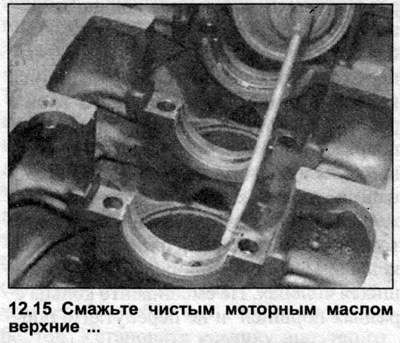
15. Generously lubricate the bearing shells in the crankcase with clean, specified grade motor oil…


16. Lower the crankshaft to the working position so that the connecting rod journal of cylinder No.1 is at BDC.

17. Lubricate the lower shells in the main bearing caps with clean engine oil, then install thrust washers on both sides of the bearing cap No.3 or No.4 (depending on the model), remembering that the protrusions of the washers must fit into the recesses in the bearing cap (see illustrations). Make sure the locating tabs on the inserts are still seated in the corresponding grooves in the covers.
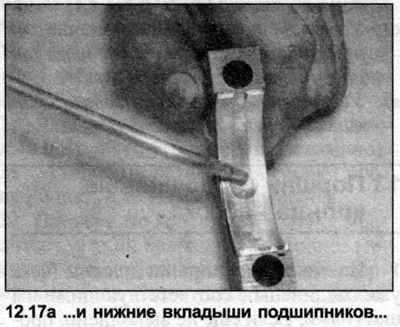
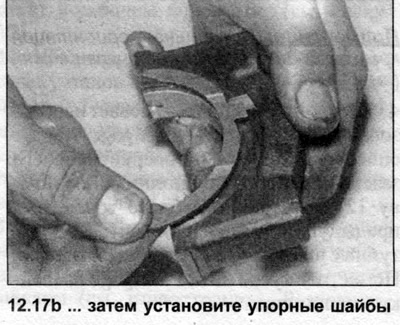

17. Lubricate the lower shells in the main bearing caps with clean engine oil, then install thrust…


17. Lubricate the lower shells in the main bearing caps with clean engine oil, then install thrust…


18. Install the main bearing caps, observing their order and orientation - bearing cap No.1 should be located at the front end of the engine, and the grooves for the mounting protrusions of the liners in the bearing seats and caps should be facing the same way (see illustrations). Insert the bearing cap mounting bolts and tighten them by hand only for now.
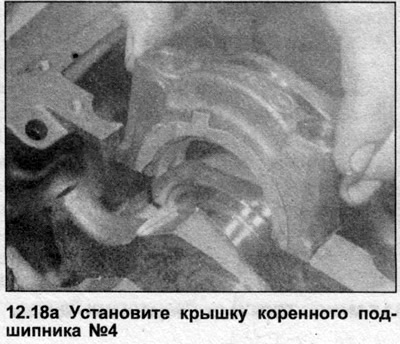
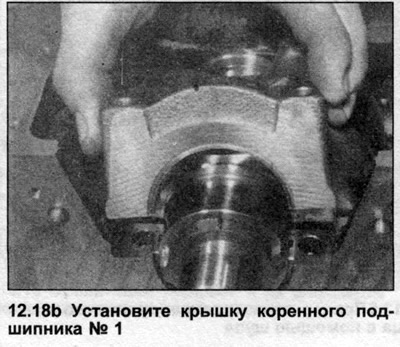
18. Install the main bearing caps, observing their order and orientation - bearing cap No.1 should…


18. Install the main bearing caps, observing their order and orientation - bearing cap No.1 should…


19. Moving from the central bearing cover to the outer covers, tighten the bolts of their fastening with the tightening force specified Specifications. Where tightening is divided into several stages, tighten all bolts to the force of the first stage, then repeat the action in the same sequence for the next stage, etc. (see illustrations).
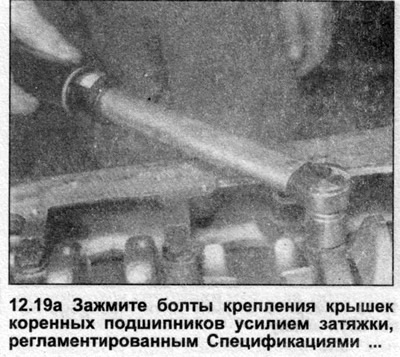
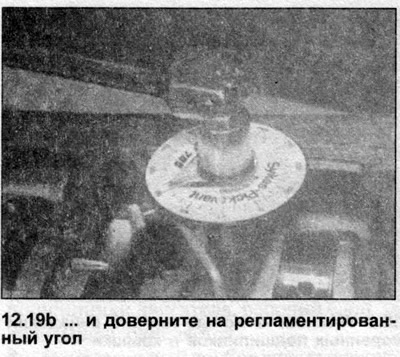

19. Moving from the central bearing cover to the outer covers, tighten the bolts of their fastening…


19. Moving from the central bearing cover to the outer covers, tighten the bolts of their fastening…


20. Check that the crankshaft rotates freely by turning it by hand. If resistance is felt, check the running clearances as described above.

21. Perform a crankshaft end clearance check as described at the beginning Chapters 8.

22. Install the pistons and connecting rods or connect them to the crankshaft (see Chapter 14).

23. See. Section 1A and do the following:
  • a) Install the crankshaft rear oil seal housing together with the new oil seal (Section 1A).
  • b) Install the oil pump and suction pipe, the sump partition and the sump itself (Section 1A).
  • c) Install the flywheel and clutch or drive disc (depending on the clothes) (Section 1A).
  • d) Install the crankshaft sprocket and timing belt (Section 1A).
The article was checked by auto expert Nikita Rudakov
This article is available at russian, bulgarian, belarusian, ukrainian, serbian, croatian, romanian, polish, slovak, hungarian

Share information:
Previous articles
Audi 100 C3: Engine removed
Next articles

Engine assembly sequence
Main and connecting rod bearings — inspection and selection of…
Cylinder block/crankcase — cleaning and inspection
Crankshaft — removal and inspection
Pistons and piston rings — assembly
Piston/Connecting Rod Assemblies — Installing and Checking…
Engine — Starting after Overhaul


Similar articles on other Audi car models:
Crankshaft — removal, inspection and installation Audi 80 B3 (1986-1991, petrol)
Removal, installation and checking the clutch Audi A3 Type 8L (1996-2003)
Crankshaft — checking clearances in main bearings and… Audi A4 B5 (1994-2001)
Thermostat — Removal, Installation and Checking Audi A6 C5 Allroad (1999-2005)
Installation of mirrors Audi A8 D2 (1994-2002)
Removal and installation the drive disc and crankshaft seals Audi Q7 Typ 4L (2005-2015, diesel)
Removal and installation the crankshaft belt drive pulley Audi A2 (1999-2005)
Link to this page in different formats


Visitor comments

No comments yet


How much will 47 + 30 =


100(C4, 1990-1994) 
  • General information
  • User manual
  • Power unit
  • Engine repair
  • Ignition system
  • Fuel system (gasoline)
  • Fuel system (diesel)
  • Lubrication system
  • Cooling system
  • Exhaust system
  • Transmission
  • Clutch
  • Car gearbox
  • Drive shafts
  • Chassis
  • Car suspension
  • Steering
  • Wheels and tires
  • Brake system
  • Body
  • Ventilation and heating
  • Body repair
  • Electrical equipment
  • Power devices
  • Lighting and appliances
  • Electrical circuits
 
100(C4, 1990-1994, petrol) 
  • General information
  • Operation and maintenance
  • Power unit
  • Engine repair
  • Exhaust system
  • Cooling system
  • Supply system
  • Air filter
  • Mono-Motronic injection system
  • Digifant injection system
  • KE-III-Jetronic and KE-Motronic
  • MPI and MPFI injection system
  • Transmission
  • Clutch
  • Car gearbox
  • Chassis
  • Suspension and steering
  • Brake system
  • Wheels and tires
  • Body
  • Exterior
  • Interior
  • Electrical equipment
  • Fuses and relays
  • Power devices
  • Ignition system
  • Lighting and signaling
  • Equipment and devices
  • Electrical circuits
 
100(C3, 1982-1990) 
  • General information
  • User manual
  • Maintenance
  • Specifications
  • Power unit
  • Engines 4-cylinder
  • Engines 5-cylinder
  • Diesel engine
  • Cooling system
  • Power system (carburetor)
  • Power system (injector)
  • Fuel system (diesel)
  • Transistor ignition system
  • Electronic ignition system
  • Transmission
  • Clutch
  • 4 speed gearbox 014
  • 5 speed gearbox 013 and 093
  • 5 speed gearbox 016 and 012
  • Shift mechanism KP 016
  • Automatic transmission
  • Front wheel drive
  • Chassis
  • Front suspension
  • Rear suspension
  • Steering
  • Brake system
  • Body
  • Body elements
  • Electrical equipment
  • Lighting and appliances
  • Power devices
  • Electrical circuits
 
100(C3, 1982-1990, petrol) 
  • General information
  • Maintenance and operation
  • 4 cylinder engine
  • Engine repair
  • Cooling and lubrication system
  • Supply system
  • Ignition system
  • 5 cylinder engine
  • Engine repair
  • Cooling and lubrication system
  • Supply system
  • Ignition system
  • Transmission
  • Clutch and drive shafts
  • 4 speed gearbox 014
  • 5 speed gearbox 013 and 093
  • 5 speed gearbox 016 and 012
  • Automatic gearbox
  • Chassis
  • Steering
  • Front suspension
  • Rear suspension
  • Brake system
  • Body
  • Body elements
  • Doors, locks and windows
  • Body repair
  • Electrical equipment
  • Equipment and devices
  • Power devices
  • Electrical circuits
 
100(C3, 1982-1990, diesel) 
  • General information
  • User manual
  • Maintenance
  • Troubleshooting
  • Power unit
  • Engine in a car
  • Engine removed
  • Cooling system
  • Fuel system
  • Exhaust system
  • Starting and charging
  • Preheating
  • Transmission
  • Clutch
  • Mechanical gearbox
  • Automatic gearbox
  • Drive shafts
  • Chassis
  • Brake system
  • Suspension
  • Steering
  • Body
  • Exterior
  • Interior
  • Electrical equipment
  • Equipment and devices
  • Electrical circuits
 
AudiManual.ru © 2017-2026 · Mobile version · Feedback · Sitemap: EN BG BY UA RS HR RO PL SK HU · Site search · News and articles
80 B2 · 80 B3 petrol · 80 B3 · 80 B4 · 100 C3 diesel · 100 C3 petrol · 100 C3 · 100 C4 petrol · 100 C4 · A3 Type 8L · A4 B5 petrol · A4 B5 · A4 B6 petrol · A4 B6 · A4 B7 · A4 B8 · A6 C4 · A6 C5 · A6 C5 Allroad · A8 D2 · Q5 Type 8R · Q7 Typ 4L · Audi A2 ·
This site uses cookies 🍪. Click the button to accept this fact.