



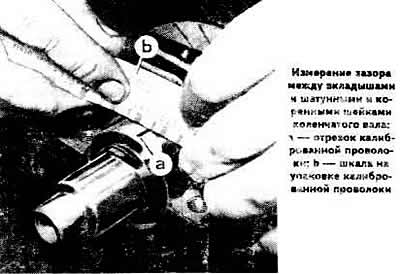
Thoroughly clean the working surfaces of the bearings and the corresponding crankshaft journal. Place a piece of calibrated plastic wire equal in width to the bearing on the surface of the journal.
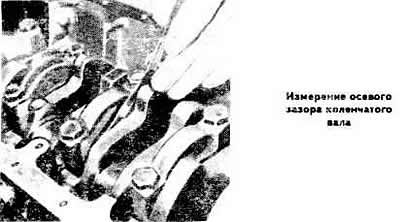
3 Depending on the type of journal being checked, install a connecting rod with a cap or a main bearing cap on the journal and tighten the fastening nuts or bolts accordingly; tighten the connecting rod bolt nuts to a torque of 3.5 kgf·m, and the main bearing cap fastening bolts to a torque of 6.5 kgf·m. Do not allow the engine crankshaft to turn.
Carefully remove the lid and use the scale on the package to determine the gap size by flattening the wire. More detailed information is provided in the accompanying documentation from the manufacturer of the calibrated wire.
The nominal design clearance is 0.030-0.080 mm (maximum allowable 0.17 mm; for root and 0.015-0.062 mm (maximum permissible 0.12 mm) for connecting rod journals.
If the gap is greater than the maximum, then replace the liners on these journals with new ones. If the crankshaft journals are worn and ground to the repair size, then replace the liners with repair ones (increased thickness).
Checking the dimensions of pistons and piston rings
Determine the degree of piston wear by measuring the diameter 15 mm from the edge of the piston skirt perpendicular to the axis of the piston pin. The piston is subject to replacement if its diameter differs by more than 0.04 mm from the permissible values (see subsection "Design and technical characteristics").
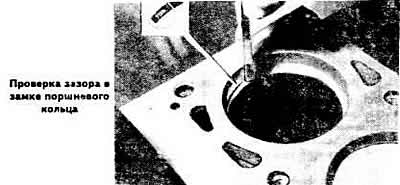
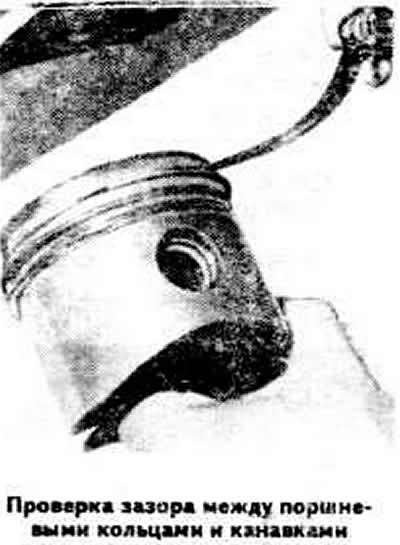
Replace piston rings or pistons if the clearances between piston rings and grooves exceed the permissible values (see subsection "Design and technical characteristics").
The original text of the material can be found on the website: AudiManual.ru