



2. Clamp the crankshaft between lathe centers (or place the bearing journals in prisms) and using a dial indicator, measure the runout on the middle journal. The runout should not exceed 0.06 mm. Otherwise, the shaft should be replaced.
3. Measure the clearances in the main and connecting rod bearings.
4. Clean the bearing shells thoroughly and place them in the bearing beds of the cylinder block or in the connecting rods.
5. Place a piece of material on each "Plastigage" (plastic "wire") on the journal of each main bearing and on the cap of each main bearing with inserted liners. Tighten the bolts with a tightening torque of 65 Nm. Do not turn the shaft after this.
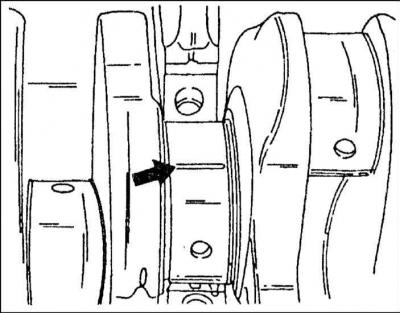
6. To check the clearances of the connecting rod bearings, you need to put the connecting rod to the crank journal and put a piece "Plastigage" on the top of the crank pin (arrow). Install the bearing cap with the liner and tighten the nuts to a tightening torque of 30 Nm. Since the shaft cannot be turned any further, measurements are taken on two connecting rod bearings located at BDC.
7. Unscrew the caps on the main bearings; on the connecting rod bearings, unscrew both caps one by one.
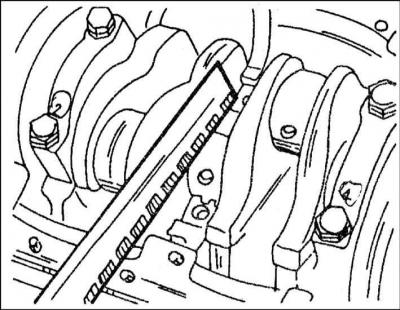
8. Using the measuring ruler included in the kit "Plastigage" measure the crushed strips of material at the widest point. If this value exceeds 0.17 mm for main bearings, the bearing caps must be replaced with new ones, and it must be taken into account whether the journals were previously ground.
9. To check the clearances of the remaining bearings, you need to check the crankshaft and take measurements on the other two connecting rod bearings. If there is no set "Plastigage", but you can use a dial bore gauge, you can measure the clearances of the main and connecting rod bearings in the manner described below.
10. Install the bearing caps with inserted liners according to the bearing numbers on the cylinder block and tighten the bolts with a tightening torque of 65 Nm. It is imperative to pay attention to the fact that the liners are in their original places. If the clearances of the connecting rod bearings are measured, it is necessary to insert the liners into the connecting rods and into the caps and screw the caps with the same nuts, tightening them with a torque of 30 Nm.
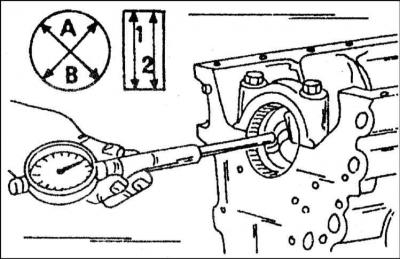
11. Measure the inner diameters of the bearings. In doing so, observe the direction of measurements A and B and the locations of measurements 1 and 2. In this way, you can determine the deviation from the circle (A and B) and the taper value (1 and 2). Record the results obtained for each bearing.
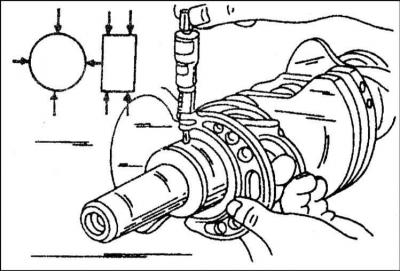
12. Measure the diameters of all bearing journals in order using a micrometer. Again, take measurements at specific locations, which are indicated by arrows. Record the measurement results for all bearing journals.
13. Subtract the measurements for the bearing diameters from the measurements for the inside diameters. The result is the bearing clearance (main or connecting rod) and must correspond to the value specified in the Specifications.
[The article is a reprint of material from «AudiManual»]