



Table of contents: Removal ↓ Installation ↓
The ribbed V-belt is wider than the regular V-belt and has several longitudinal ribs. The ribbed V-belt drives the generator, power steering oil pump, radiator fan and, depending on the equipment, also the air conditioning compressor.
Removal
1. Remove the lower engine compartment cover, refer to subsection Removal and installation the lower engine compartment cover.
2. Turbodiesel (TDI): Remove the connecting pipe between the intercooler and turbocharger. To do this, loosen the clamps.
3. If the belt is to be installed again, it is necessary to mark the direction of its rotation. To do this, an arrow in the direction of its rotation is applied to the belt with a felt-tip pen. The engine, looking from the right side of the car, rotates to the right, that is, clockwise.
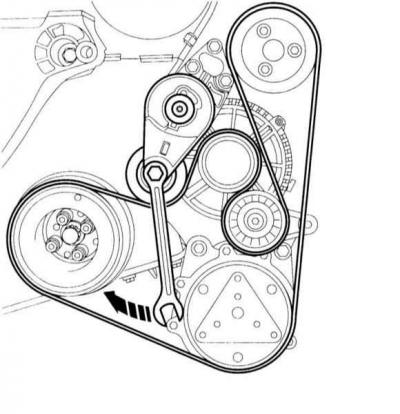
4. Loosen the belt tension. To do this, turn the tensioner with a 16 mm open-end wrench in the direction of the arrow. First remove the V-belt from the alternator pulley. The alternator pulley is located on the right next to the tension roller.
Installation
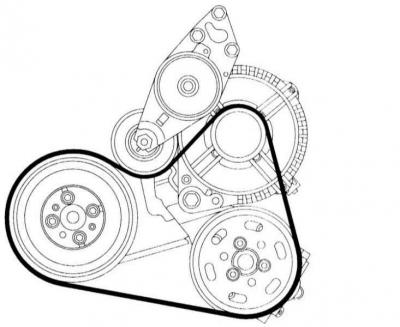
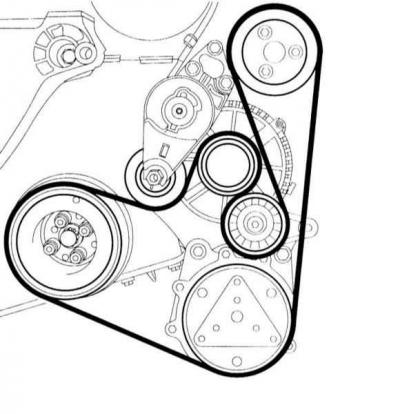
5. Tighten the tensioner with a 16mm open-end wrench and fit the V-belt onto the pulleys. Lastly, fit the belt onto the alternator pulley (on the right side of the tension roller).
Warning: When installing a used belt, pay attention to its direction of rotation. The engine, when viewed from the right side of the car, rotates to the right, i.e. clockwise. Installing the belt in the opposite direction will result in increased belt wear.
6. Then slowly release the tensioner. At the same time, make sure that the V-belt is positioned correctly on the pulleys. The belt tension is set automatically.
7. Turbodiesel (TDI): Insert the connecting pipe between the intercooler and turbocharger and secure it with clamps.
8. Start the engine and visually check the operation of the belt.
9. Install the lower engine compartment cover, refer to subsection Removal and installation the lower engine compartment cover.