Repair Chevrolet Repair Toyota Repair Honda Repair AvtoVAZ Repair Mercedes-Benz Repair BMW Repair Opel
Home  |  Contacts  |  Sitemap  |    
English Русский
Български
Беларускі
Український
Српски
Hrvatski
Română
Polski
Slovenský
Magyar
AudiManual.ru


  • AUDI 80
  • AUDI 100
  • AUDI A3
  • AUDI A4
  • AUDI A6
  • AUDI A8
  • AUDI Q
  • OTHER
  • ARTICLES
B8 (2007-2015) B7 (2004-2008) B6 (2000-2006) B6 (2000-2006, petrol) B5 (1994-2001) B5 (1994-2001, petrol)

Crankshaft — Removal and Inspection (Audi A4 B5)

  • Home
  • Audi A4
  • B5 (1994-2001)
  • Power unit
  • Engine overhaul
  • Crankshaft — Removal and Inspection
            0
Note: If only the crankshaft is removed, there is no need to remove the pistons and cylinder head. It is sufficient to repair the connecting rod bearing caps and move the connecting rods with pistons towards the head. It is highly recommended to use an engine mount stand for this operation.


As described in the chapter 2A or 2B, do the following:
  • a) Remove the timing belt and crankshaft sprocket.
  • b) Remove the clutch components and flywheel/faceplate.
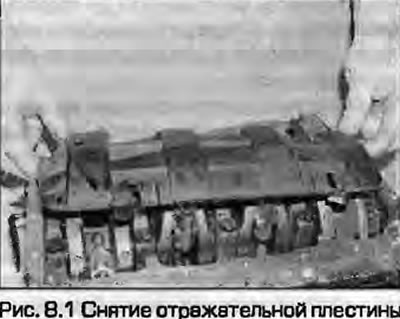
  • c) Remove the pan, deflector plate (Fig. 8.1), oil pump and oil receiver.
  • d) Remove the front and rear oil seal housings.
d) Remove the front and rear oil seal housings.


2. Remove the pistons with connecting rods or disconnect them from the crankshaft as described in paragraph 7 (see note above).

3. After removing the crankshaft, check its axial clearance using a dial indicator.

Note: This can only be done if the crankshaft is installed in the block and has the ability to move along the axis.


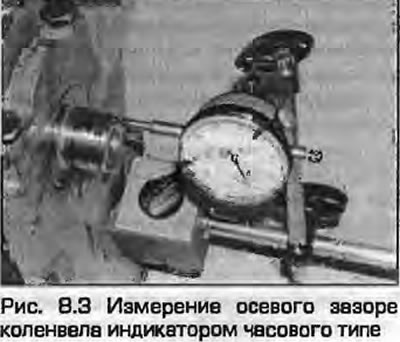
Set the dial indicator so that its measuring leg rests against the end of the crankshaft. Move the crankshaft as far as it will go and reset the indicator. Move the crankshaft to the other extreme position and measure the clearance (Fig. 8.3). Compare the result with Specifications. This will indicate the need to replace the thrust half rings.


Set the dial indicator so that its measuring leg rests against the end of the crankshaft. Move the…


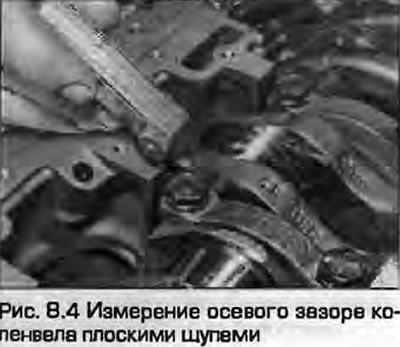
4. If there is no indicator, you can use a set of flat feeler gauges. The feeler gauges should be inserted between the side surface of the third crankpin and the half ring in the central support of the crankshaft (Fig. 8.4). Compare the results obtained with those given in Specifications.
4. If there is no indicator, you can use a set of flat feeler gauges. The feeler gauges should be…


5. Identification marks must be cast on the crankshaft bearing caps. The caps are numbered starting from the timing belt side. If there are none, apply your own using a punch (Fig. 8.5).
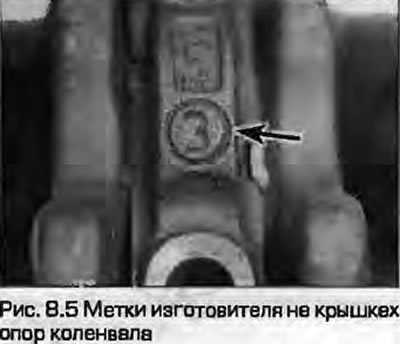
5. Identification marks must be cast on the crankshaft bearing caps. The caps are numbered starting…


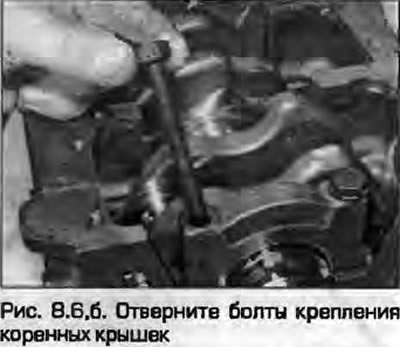
6. Loosen the bolts securing the support caps by half a turn per pass until you can unscrew them by hand and remove the caps together with the inserts (fig. 8.6, a, b). If the caps are tight, gently push them off with a brass or wooden mallet. If there are no numbers, apply your own, but do not scratch them.
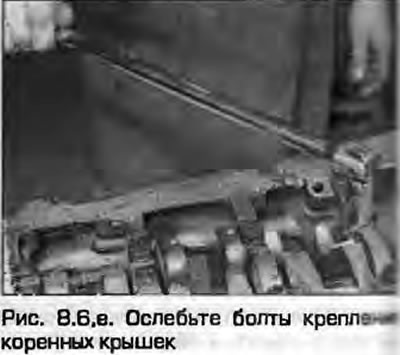


6. Loosen the bolts securing the support caps by half a turn per pass until you can unscrew them by…

7. Carefully lift the crankshaft up from the inverted cylinder block (Fig. 8.7).
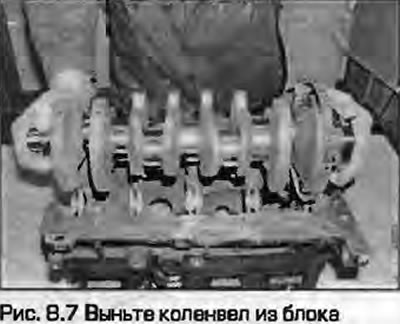
7. Carefully lift the crankshaft up from the inverted cylinder block (Fig. 8.7).


8. Remove the support half rings from both sides of the central support, remove the upper liners from the block. If you are going to install the liners back, put them together with the corresponding support covers.

9. After removing the liners, inspect the condition of the grooves for the protrusions (locks) of the liners, which allow the liners to be installed in only one position.


Examination


10. Wash the crankshaft with a suitable solvent and dry thoroughly. Flush the oil passages thoroughly to ensure that they are not clogged with dirt.

11. Carefully inspect the shaft journals. If there are obvious scratches, grooves or burrs, the shaft must be reground and new repair-size liners installed.

12. Using a micrometer, measure the diameter of all main journals (Fig. 8.12). Take several measurements at different points and angles to ensure that there is no ovality or taper. If the ovality or taper of the journals is outside the prescribed limits, Specifications, the shaft must be ground in a specialized auto repair shop.
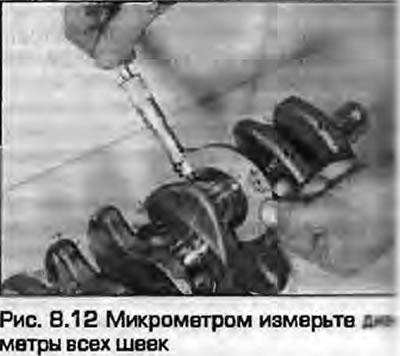
12. Using a micrometer, measure the diameter of all main journals (Fig. 8.12). Take several…


13. Inspect the surfaces of the shaft journals under the seals. If the journals are heavily worn, the new seal may leak. The journals can be ground - ask the dealer's service center for advice.

14. Mount the shaft on the prisms and measure its runout on the central support journal using a dial indicator by "rolling" the shaft. When doing this, do not damage the journals resting on the prism. The maximum permissible runout is not prescribed by the manufacturers, however, a runout of 0.03 mm is usually considered acceptable. If the runout exceeds the permissible limit, the crankshaft may need to be replaced - consult your dealer or engine repair specialists for advice.

15. In paragraph 15 welding of crankshaft journals is described in detail.
The article was checked by auto expert Timur Bazhenov
This article is available at russian, bulgarian, belarusian, ukrainian, serbian, croatian, romanian, polish, slovak, hungarian

Share information:
Previous articles
Audi A4 B5: Engine overhaul
Next articles

Pistons and connecting rods — removal and inspection
Cylinder head — disassembly, cleaning, inspection and assembly
Engine Overhaul — Disassembly Procedures
Diesel engine — removal and installation
Auxiliary shaft — removal and installation
Cylinder Block — Cleaning and Checking
Crankshaft bearings — inspection and selection
Engine Repair — Assembly Sequence


Similar articles on other Audi car models:
Crankshaft — removal, inspection and installation Audi 80 B3 (1986-1991, petrol)
Crankshaft — removal and inspection Audi 100 C3 (1982-1990, diesel)
Visual inspection of the gearbox for leaks Audi A3 Type 8L (1996-2003)
Clutch — removal, installation and inspection Audi A6 C5 Allroad (1999-2005)
Visual inspection of gearbox tightness Audi A8 D2 (1994-2002)
Removal and installation the drive disc and crankshaft seals Audi Q7 Typ 4L (2005-2015, diesel)
Removal and installation the crankshaft belt drive pulley Audi A2 (1999-2005)
Link to this page in different formats


Visitor comments

No comments yet


How much will 41 + 13 =


A4(B8, 2007-2015) 
  • General information
  • Operating instructions
  • Power unit
  • Petrol engines 1.8 l
  • Petrol engines 1.8/2.0 l
  • Petrol engines 3.0 l
  • Petrol engines 3.2 l
  • Fuel system (petrol)
  • Diesel engines 2.0 l (CA*)
  • Diesel engines 2.0 l (CJCB)
  • Diesel engines 2.7/3.0 l
  • Diesel engines 3.0 l
  • Fuel system (diesel)
  • Transmission
  • Manual gearbox 0B1
  • Manual gearbox 0B2
  • Manual gearbox 0B3
  • Manual gearbox 0B4
  • Automatic transmission 0B5
  • Automatic transmission 0B6
  • Automatic transmission 0AW
  • All-wheel drive system
  • Chassis
  • Front suspension
  • Rear suspension
  • Brake system
  • Steering system
  • Body
  • Exterior
  • Interior
  • Seats
  • Doors, locks and windows
  • Security system
  • Heating and air conditioning
  • Electrical equipment
  • Audio system
  • Power devices
  • Equipment and devices
  • Lighting and lamps
  • Electrical circuits
 
A4(B7, 2004-2008) 
  • General information
  • Introduction to manual
  • Troubleshooting
  • Operating instructions
  • Maintenance
  • Power unit
  • Petrol engines 2.0 (ALT)
  • Petrol engines 2.0 (TFSI)
  • Petrol engines 1.8 (MPI)
  • Diesel engines
  • Cooling system
  • Air conditioner
  • Fuel and exhaust system
  • Ignition system
  • Starting and charging
  • Transmission
  • Clutch
  • Manual gearbox
  • Automatic gearbox
  • Drive shafts
  • Chassis
  • Brake system
  • Front suspension
  • Rear suspension
  • Steering
  • Body
  • Exterior
  • Interior
  • Electrical equipment
  • Equipment and devices
  • Lighting and signaling
  • Windscreen wipers and washers
  • Electrical diagrams
  • Electrical diagrams (since 2007)
 
A4(B6, 2000-2006) 
  • General information
  • Vehicle Description
  • User manual
  • Maintenance
  • Power unit
  • Gasoline engine
  • Diesel engine
  • Lubrication system
  • Cooling system
  • Supply system
  • Injection system
  • Exhaust system
  • Ignition and control
  • Transmission
  • Gear box
  • Clutch and drive shafts
  • Chassis
  • Brake system
  • Car suspension
  • Steering
  • Body
  • Heating and ventilation
  • Exterior (external elements)
  • Interior (internal elements)
  • Electrical equipment
  • Power devices
  • Lighting and appliances
  • Electrical circuits
 
A4(B6, 2000-2006, petrol) 
  • General information
  • Introduction to the guide
  • Car care
  • Power unit
  • Engine repair
  • Lubrication system
  • Cooling system
  • Injection and control system
  • Ignition system
  • Power and exhaust system
  • Transmission
  • Clutch and drive shafts
  • Car gearbox
  • Chassis
  • Suspension and wheels
  • Steering
  • Brake system
  • Body
  • Interior
  • Exterior
  • Electrical equipment
  • Equipment and devices
  • Lighting and signaling
  • Power devices
  • Electrical circuits
 
A4(B5, 1994-2001) 
  • General information
  • Introduction to the guide
  • Car care
  • Maintenance (gasoline)
  • Maintenance (diesel)
  • Power unit
  • Gasoline engines
  • Diesel engines
  • Engine overhaul
  • Cooling system
  • Fuel injection (gasoline)
  • Fuel system (diesel)
  • Exhaust system
  • Ignition system
  • Transmission
  • Clutch
  • Mechanical gearbox
  • Automatic gearbox
  • Drive shafts
  • Chassis
  • Brake system
  • Car suspension
  • Steering
  • Body
  • Exterior
  • Interior
  • Doors, locks and windows
  • Heating and ventilation
  • Electrical equipment
  • Power devices
  • Equipment and devices
  • Electrical circuits
 
A4(B5, 1994-2001, petrol) 
  • General information
  • Vehicle description
  • Maintenance
  • Power unit
  • Engine repair
  • Turbocharging
  • Exhaust system
  • Cooling system
  • Ignition system
  • Fuel system
  • Motronic injection system
  • MPI and MPFI injection system
  • Transmission
  • Clutch
  • Gearbox and shafts
  • Chassis
  • Steering
  • Car suspension
  • Brake system
  • Wheels and tires
  • Body
  • Heating and ventilation
  • Body parts
  • Electrical equipment
  • Fuses and relays
  • Power devices
  • Lighting and lamps
  • Tools and devices
  • Electrical circuits
 
AudiManual.ru © 2017-2026 · Mobile version · Feedback · Sitemap: EN BG BY UA RS HR RO PL SK HU · Site search · News and articles
80 B2 · 80 B3 petrol · 80 B3 · 80 B4 · 100 C3 diesel · 100 C3 petrol · 100 C3 · 100 C4 petrol · 100 C4 · A3 Type 8L · A4 B5 petrol · A4 B5 · A4 B6 petrol · A4 B6 · A4 B7 · A4 B8 · A6 C4 · A6 C5 · A6 C5 Allroad · A8 D2 · Q5 Type 8R · Q7 Typ 4L · Audi A2 ·
This site uses cookies 🍪. Click the button to accept this fact.