



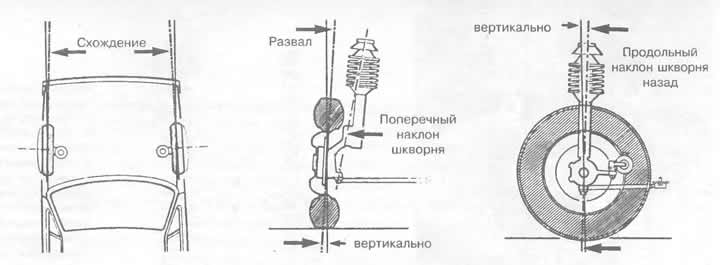
To better understand some of the basic concepts involved in wheel alignment, these illustrations are provided.
Toe-in: in the Audi-100, the front wheels are slightly closer together at rest at the front than at the rear. In these cases, they say: toe-in is "positive". The friction between the wheel and the road pushes the left wheel to the left, and the right wheel to the right. This is compensated by the forces arising in the front drive, which tend to compress the front wheels at the front. When the car enters a turn, positive toe-in changes to negative toe-in (discrepancy) wheels. This is due to the trapezoidal arrangement of the steering rods: the inner wheel leans more than the outer wheel when turning. This is necessary because the inner wheels describe a narrower circle when turning than the outer ones.
Camber: this is the name given to the slight inward tilt of the front wheels - in the Audi 100, they are located closer to each other at the top of the wheel well than at the bottom, this is called "negative camber".
Kingpin inclination: This is related to camber. Kingpin inclination is a slight tilt of the pivot axis around which the entire rack rotates when steering. The two pivot axis are closer together at the top than at the bottom. Camber and kingpin inclination additionally prevent wheel vibration and make it easier to turn the wheels.
Kingpin tilt: This refers to the tilt of the steering axle in the longitudinal direction of the vehicle. It also helps stabilize the inertial movement of the vehicle and prevent wheel vibration. In addition, the tilt helps to return the steering control after cornering.
This article was previously published on the resource AUDImanual