
Repair Chevrolet Repair Toyota Repair Honda Repair AvtoVAZ Repair Mercedes-Benz Repair BMW Repair Opel
Home  |  Contacts  |  Sitemap  |    
English Русский
Български
Беларускі
Український
Српски
Hrvatski
Română
Polski
Slovenský
Magyar
AudiManual.ru


  • AUDI 80
  • AUDI 100
  • AUDI A3
  • AUDI A4
  • AUDI A6
  • AUDI A8
  • AUDI Q
  • OTHER
  • ARTICLES
C4 (1990-1994) C4 (1990-1994, petrol) C3 (1982-1990) C3 (1982-1990, petrol) C3 (1982-1990, diesel)

Adjusting the suspension level (Audi 100 C4)

  • Home
  • Audi 100
  • C4 (1990-1994, petrol)
  • Chassis
  • Suspension and steering
  • Adjusting the suspension level
            0
Table of contents: Replacing the rear wheel bearing.… ↓ Adjusting the rear wheel hub… ↓ Wheel hub bearings for all-wheel… ↓
When cornering with a loaded vehicle, the rear suspension level is adjusted hydraulically. In vehicles with adjustable suspension level, the power steering pump supplies the working fluid under high pressure to a special rear shock absorber until the body is raised to the normal level again. The amount of fluid needed is determined by a hydraulic level valve, which reads an electrical signal in the rear axle stabilizer bar, how much the rear of the vehicle is tilted. The more the rear of the vehicle is tilted, the more the valve opens. To avoid the risk of overloading the trunk, the valve only adjusts the level until the maximum load on the rear axle is reached. Therefore, when overloaded, the rear of the vehicle is lowered in spite of the level adjustment.

To prevent the body from lowering immediately after the engine stops, a hydraulic or pneumatic accumulator is connected to the shock absorbers, which increases the pressure in the shock absorber using compressed nitrogen. This hydraulic or pneumatic accumulator also acts to accept in working condition the working fluid that is displaced when the piston rod of the shock absorber is raised.

Note: The hydraulic level control system is still under high pressure even after the engine has stopped. Therefore, do not loosen the connections of the level control lines and hoses.


Replacing the rear wheel bearing. Front-wheel drive vehicles


When replacing a bearing, a new cotter pin, inner and outer bearing, and sealing ring are used.


Remove the brake drum (chapter "Brakes").

For cars with disc brakes, the rear brake discs are removed, including the wheel hub. To do this, remove the disc wheel brake bracket (chapter "Brakes"). The rest of the removal occurs in the same way as for brake drums.

Remove the sealing ring at the rear of the wheel hub, take out the bearings and wipe off the old grease from the bushing.

Knock the outer races of both bearings out of the wheel hub. To do this, use a brass punch, which is placed on the inside of the bearing race and knocked out with a hammer. Note that the races are not connected.

Install new outer bearing races into the wheel hub (thick side inward), so that no damage occurs during adjustment.
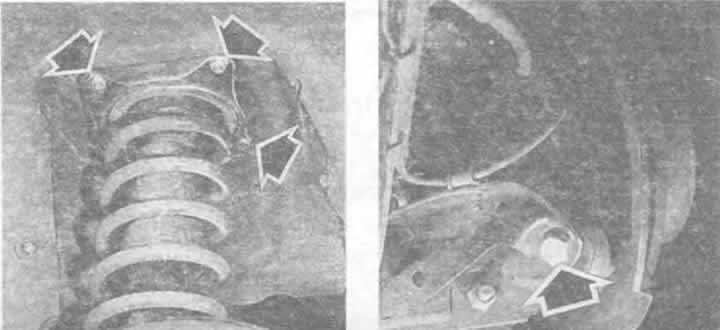
The rear shock absorber mounting points are almost identical for front-wheel drive and all-wheel…

The rear shock absorber mounting points are almost identical for front-wheel drive and all-wheel drive vehicles.

Left: Shown here are the three upper mounting bolts (arrows).

Right: Shows the lower mounting bolt (arrow) for front-wheel drive vehicles.
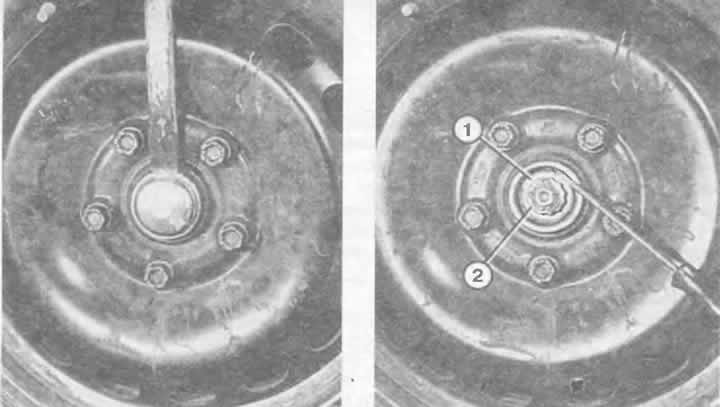

Installing rear wheel bearings on front wheel drive vehicles.

Installing rear wheel bearings on front wheel drive vehicles.

Left: Removing the protective cap. Carefully insert the chisel behind the ring of the protective cap. Using careful hammer blows, knock the cap forward. Change the position of the chisel and do this several more times. Do not bend the cap.

Right: thrust washer (1) under nut (2) (here with the slotted stopper still installed) when the bearing clearance is adjusted correctly using a screwdriver, it should move slightly forward. The screwdriver slot should not rest on the brake disc.


Press the bearing races in until they stop, using the old race.


Now remove the old bearing race that was put on for protection.

Lubricate the gap between both bearing races, fill the races and bearings with grease.

Install the inner bearing.

Use a rubber hammer to evenly install the sealing ring on the inside.

Install the brake drum and disc accordingly.

Install the outer wheel bearing and thrust washer.

Tighten the lock nut by hand 1/8 turn; while doing this, constantly rotate the wheel so that the bearing does not jam.

Adjust the wheel bearing (see next section).

For vehicles with disc brakes, install the disc brake calipers at the rear. Then press the brake pedal repeatedly.

Adjusting the rear wheel hub bearings. Front-wheel drive models


Raise the rear of the vehicle and support it.

Remove the wheel cap, cotter pin and crown cap using the method described in the section "Removing the brake drum" in the chapter "Brake system".

Models with rear drum brakes: Press the adjusting wedge upwards as described in the above section. The brake drum will then rotate completely freely.

Tighten the hex nut without applying excessive force, while rotating the wheel to avoid jamming the bearings.

Loosen the nut slightly again.

The clearance is set correctly if you can slightly move the thrust washer behind the nut by lightly pressing with a screwdriver. The blade of the screwdriver should not rest against the edge of the wheel hub.

If it is still not possible to insert the locking pin into the locking retainer, then the nut needs to be turned slightly in the "close" direction.


Put on the wheel cap, tapping it with a rubber hammer, if necessary, put a tight roll of rags underneath.

Wheel hub bearings for all-wheel drive models


All-wheel drive models also have pressed-in double ball bearings on the rear axle. Although they do not need to be adjusted, due to the lack of press molds, they cannot be replaced independently.
The article was checked by auto expert Nikita Rudakov
This article is available at russian, bulgarian, belarusian, ukrainian, serbian, croatian, romanian, polish, slovak, hungarian

Share information:
Previous articles
Audi 100 C4: Suspension and steering
Next articles

Rear suspension repair
Front suspension repair
Chassis and steering repair
List of faults. Incorrect wheel alignment
Steering system
Amplification system
Steering gear work
Steering repair


Similar articles on other Audi car models:
Adjusting the seat headrests Audi 80 B3 (1986-1991, petrol)
Checking the condition of suspension and steering components Audi A3 Type 8L (1996-2003)
Checking and adjusting the oil level in the front final drive Audi A4 B8 (2007-2015)
Checking the oil level and filling Audi A6 C5 (1997-2004)
Checking the oil level in a manual transmission Audi A8 D2 (1994-2002)
Replacing the coolant, checking and adjusting its level,… Audi Q7 Typ 4L (2005-2015, diesel)
Engine — Checking Oil Level Audi A2 (1999-2005)
Link to this page in different formats


Visitor comments

No comments yet


How much will 12 + 10 =


100(C4, 1990-1994) 
  • General information
  • User manual
  • Power unit
  • Engine repair
  • Ignition system
  • Fuel system (gasoline)
  • Fuel system (diesel)
  • Lubrication system
  • Cooling system
  • Exhaust system
  • Transmission
  • Clutch
  • Car gearbox
  • Drive shafts
  • Chassis
  • Car suspension
  • Steering
  • Wheels and tires
  • Brake system
  • Body
  • Ventilation and heating
  • Body repair
  • Electrical equipment
  • Power devices
  • Lighting and appliances
  • Electrical circuits
 
100(C4, 1990-1994, petrol) 
  • General information
  • Operation and maintenance
  • Power unit
  • Engine repair
  • Exhaust system
  • Cooling system
  • Supply system
  • Air filter
  • Mono-Motronic injection system
  • Digifant injection system
  • KE-III-Jetronic and KE-Motronic
  • MPI and MPFI injection system
  • Transmission
  • Clutch
  • Car gearbox
  • Chassis
  • Suspension and steering
  • Brake system
  • Wheels and tires
  • Body
  • Exterior
  • Interior
  • Electrical equipment
  • Fuses and relays
  • Power devices
  • Ignition system
  • Lighting and signaling
  • Equipment and devices
  • Electrical circuits
 
100(C3, 1982-1990) 
  • General information
  • User manual
  • Maintenance
  • Specifications
  • Power unit
  • Engines 4-cylinder
  • Engines 5-cylinder
  • Diesel engine
  • Cooling system
  • Power system (carburetor)
  • Power system (injector)
  • Fuel system (diesel)
  • Transistor ignition system
  • Electronic ignition system
  • Transmission
  • Clutch
  • 4 speed gearbox 014
  • 5 speed gearbox 013 and 093
  • 5 speed gearbox 016 and 012
  • Shift mechanism KP 016
  • Automatic transmission
  • Front wheel drive
  • Chassis
  • Front suspension
  • Rear suspension
  • Steering
  • Brake system
  • Body
  • Body elements
  • Electrical equipment
  • Lighting and appliances
  • Power devices
  • Electrical circuits
 
100(C3, 1982-1990, petrol) 
  • General information
  • Maintenance and operation
  • 4 cylinder engine
  • Engine repair
  • Cooling and lubrication system
  • Supply system
  • Ignition system
  • 5 cylinder engine
  • Engine repair
  • Cooling and lubrication system
  • Supply system
  • Ignition system
  • Transmission
  • Clutch and drive shafts
  • 4 speed gearbox 014
  • 5 speed gearbox 013 and 093
  • 5 speed gearbox 016 and 012
  • Automatic gearbox
  • Chassis
  • Steering
  • Front suspension
  • Rear suspension
  • Brake system
  • Body
  • Body elements
  • Doors, locks and windows
  • Body repair
  • Electrical equipment
  • Equipment and devices
  • Power devices
  • Electrical circuits
 
100(C3, 1982-1990, diesel) 
  • General information
  • User manual
  • Maintenance
  • Troubleshooting
  • Power unit
  • Engine in a car
  • Engine removed
  • Cooling system
  • Fuel system
  • Exhaust system
  • Starting and charging
  • Preheating
  • Transmission
  • Clutch
  • Mechanical gearbox
  • Automatic gearbox
  • Drive shafts
  • Chassis
  • Brake system
  • Suspension
  • Steering
  • Body
  • Exterior
  • Interior
  • Electrical equipment
  • Equipment and devices
  • Electrical circuits
 
AudiManual.ru © 2017-2026 · Mobile version · Feedback · Sitemap: EN BG BY UA RS HR RO PL SK HU · Site search · News and articles
80 B2 · 80 B3 petrol · 80 B3 · 80 B4 · 100 C3 diesel · 100 C3 petrol · 100 C3 · 100 C4 petrol · 100 C4 · A3 Type 8L · A4 B5 petrol · A4 B5 · A4 B6 petrol · A4 B6 · A4 B7 · A4 B8 · A6 C4 · A6 C5 · A6 C5 Allroad · A8 D2 · Q5 Type 8R · Q7 Typ 4L · Audi A2 ·
This site uses cookies 🍪. Click the button to accept this fact.