



In addition to the hydraulic drive via the brake pedal, the disc brake mechanism can also be serviced by a cable drive of the parking brake system. The lever, to which the corresponding cable is attached, activates the pusher, which presses the brake piston against the pads.
Front-wheel drive and all-wheel drive models have different disc brake caliper housings, which, however, differ mainly in the type of cable connection.
Automatic regulation
The designs of disc brake mechanisms in cars are always self-adjusting: with increasing wear of the brake pads, the brake piston simply moves further out of the caliper of the disc brake mechanism, thereby ensuring a tight fit of the brake pads to the brake disc. Due to the filling of the added volume in the cylinder with brake fluid, the formation of play is impossible.
This happens differently in the mechanical drive of the parking brake system: here the drive pusher at some point in time simply would not be able to reach the piston coming out, if there were no adjusting device. It "lengthens" the pusher as needed.
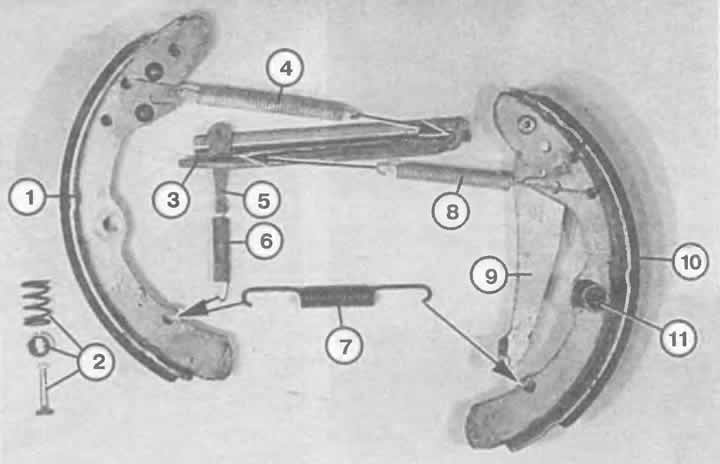
Parts of the removed drum brake mechanism. The arrows show where the springs should be hung. The numbers indicate:
1 - front brake shoe;
2 - clamp with spring, spring plate and mounting pin;
3 - push rod;
4 - return spring;
5 - adjusting wedge;
6 — tension spring of the adjusting wedge;
7 - lower return spring;
8 - main spring;
9 — parking brake lever;
10 - friction lining on the rear brake shoe;
11 — clamp.
The main part of the adjustment is the thread, onto which, depending on the wear of the pads, the part of the pusher is screwed further forward. The pressure device thus becomes longer. Therefore, when replacing the pads, you cannot simply push the brake piston back, it is unscrewed back on the adjustment device.