



TO No.31
The action of the parking brake should begin from the third locking groove of the lever.
When the fourth tooth is locked, the rear wheels should be locked.
If the lever stroke is longer than usual, this indicates worn brake pads on the rear wheels or stretched brake cables. This is evidence that the parking brake was pulled hard every time you parked.
Adjusting the parking brake is usually only necessary after replacing the brake cable.
Replacing the brake cable
Raise the car from behind and secure it.
Release the parking brake on the vehicle.
Remove the exhaust system heat shield in the area of the parking brake balance bracket.
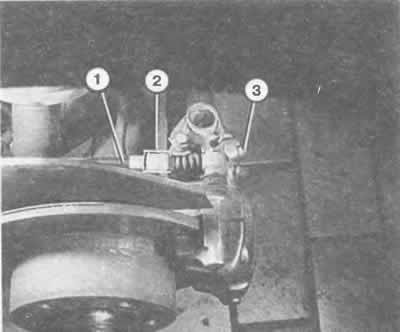
Replacing the parking brake cable, shown here on a front-wheel drive vehicle with rear disc brakes. Key:
1 - Parking brake cable sheath;
2 - spring bracket;
3 — brake cable tip.
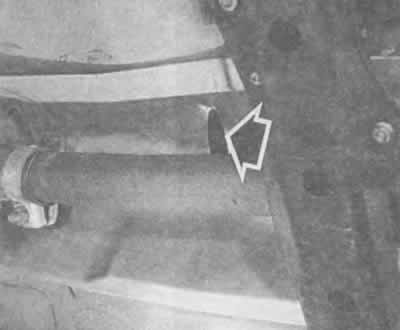
Adjusting the parking brake. By turning the adjusting nut (arrow) on the threaded section of the brake cable, the brake cables are tensioned towards the wheels. The illustration shows approximately the middle of the bottom of the car at the level of the rear seat.
This may require disassembling part of the exhaust system.
Loosen the adjusting nut on the rocker arm until the cable becomes noticeably slack.
Vehicles with drum brakes on the rear wheels: remove the brake drum, remove the brake shoes and remove the rear end of the cable from the parking brake system engagement lever.
If your vehicle has disc brakes on the rear wheels, you should pry up the spring clip at the end of the cable sheath and remove the brake cable tip from the drive lever.
Hang and remove the drive cable from the various fasteners on the rear axle and on the bottom of the car.
When assembling, install the retainer on the front end of the cable drive casing.
The position of the balance bracket on the parking brake lever is as follows: the long side points to the right.
Hanging the parking brake cable on the drive lever of the drum brake mechanism can be problematic. Therefore, you should move the coil spring on the cable with side cutters and prevent it from sliding by gently squeezing the side cutters on the cable. Now hang the cable on the lever.
Models with disc brakes on the rear wheels must be adjusted!
All vehicles require adjustment of the parking brake system.
Adjusting the parking brake system
Thanks to the automatic adjustment devices available on both drum and disc brake models, the parking brake system only needs to be adjusted after work has been done on the parking brake system mechanics or after replacing the brake pads.
Raise the vehicle and secure it.
Models with rear drum brakes: Release the parking brake.
Unscrew the adjusting nut (illustration above) to the end of the threaded rod.
Press the brake pedal hard once.
Raise the parking brake lever to the three locking notches.
Tighten the adjusting nut so much that both wheels can be turned by hand with great difficulty.
Release the parking brake and check the free play of the wheels.
Models with rear disc brakes: carry out adjustment.
Tighten the adjusting nut until both parking brake actuator levers on the right and left brake calipers are slightly lifted off the stop.
Loosen the adjusting nut two turns.
To check, press the parking brake system engagement lever to the brake calipers on the right and left in turn to the corresponding stop. If the caliper lever of the other wheel also moves, then the brake drive cables are too tight.
In this case, loosen the brake cable adjusting nut so that both levers are near the stop.
Tighten and release the parking brake again; check the free play of the rear wheels.
The original version of the article is posted on the website: AUDIMANUAL