
Repair Chevrolet Repair Toyota Repair Honda Repair AvtoVAZ Repair Mercedes-Benz Repair BMW Repair Opel
Home  |  Contacts  |  Sitemap  |    
English Русский
Български
Беларускі
Український
Српски
Hrvatski
Română
Polski
Slovenský
Magyar
AudiManual.ru


  • AUDI 80
  • AUDI 100
  • AUDI A3
  • AUDI A4
  • AUDI A6
  • AUDI A8
  • AUDI Q
  • OTHER
  • ARTICLES
C4 (1990-1994) C4 (1990-1994, petrol) C3 (1982-1990) C3 (1982-1990, petrol) C3 (1982-1990, diesel)

Brake booster (Audi 100 C4)

  • Home
  • Audi 100
  • C4 (1990-1994, petrol)
  • Chassis
  • Brake system
  • Brake booster
            0
Disc brakes do not act in a self-amplifying manner, like drum brakes, for example. A significantly higher braking force is required. Therefore, the Audi 100 is equipped with a pneumatic brake booster, which adds about 60% of the braking force. Despite this, the brake pedal is directly connected to the brake piston in the main brake cylinder, so that it is possible to brake even if the booster fails. But the required pressure on the pedal in this case must be increased several times.

Additional force is provided by the reduced pressure from the intake manifold. The brake booster is connected by a hose to the exhaust manifold. When braking, the difference in pressure between the external air pressure and the reduced pressure in the exhaust manifold moves a large elastic diaphragm and additionally presses on the piston in the main brake cylinder. If the engine is not running, the booster cannot develop any (additional) braking force. If the engine suddenly stalls, there is still a small reserve for a certain amount of braking; but then you will have to rely only on the strength of your legs.
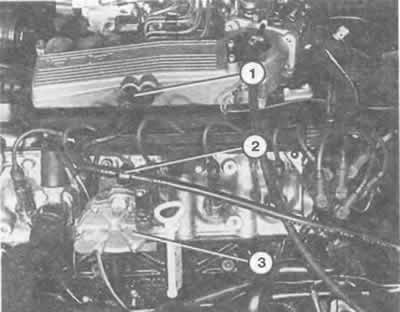
The five-cylinder engine has an additional vacuum pump (3), which increases the vacuum in the hose…

The five-cylinder engine has an additional vacuum pump (3), which increases the vacuum in the hose from the intake pipe (1). Thus, it is possible that in the hose from the pump to the brake booster there is always enough force to support the brakes. To prevent the reduced pressure from disappearing, a check valve (2) is installed before the branch to the pump.
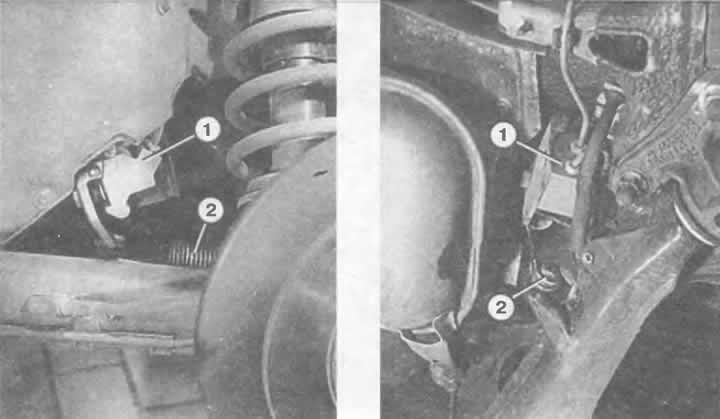

Depending on the vehicle's loading condition, the brake force regulator (1) applies more or less…

Depending on the vehicle's loading condition, the brake force regulator (1) applies more or less pressure to the rear axle wheel cylinders. How much the rear axle is loaded - this information is supplied to the regulator via the connection to the rear axle, which consists of a small spring (2). The illustration on the left shows the brake force regulator for front-wheel drive vehicles, the picture on the right shows the regulator for a four-wheel drive vehicle.


Vacuum pump


To improve braking force maintenance, the engine versions are equipped with an additional vacuum pump driven by the camshaft. Thanks to it, the underpressure in the hoses to the brake booster is increased.


The following engines have this pump:

All cars with 5-cylinder engines. The pump is installed on the left side of the cylinder head.

All cars with 6-cylinder engines. Here it is located behind the right cylinder head (then the vacuum pump is installed only in cars with automatic transmission).

Since 3/92, a jet pump has been installed in cars with 6-cylinder engines and automatic transmission. The mechanical pump has ceased to exist.
The article was checked by auto expert Nikita Rudakov
This article is available at russian, bulgarian, belarusian, ukrainian, serbian, croatian, romanian, polish, slovak, hungarian

Share information:
Previous articles
Audi 100 C4: Brake system
Next articles

Master brake cylinder
Checking the free travel of the parking brake lever
Parking brake system
Measuring the thickness of rear disc brake pads
Checking the brake booster
Brake force regulator
Repair of hydraulic brake drive
Bleeding the brake system


Similar articles on other Audi car models:
Checking the brake booster Audi 80 B2 (1979-1986)
Checking the brake booster Audi A3 Type 8L (1996-2003)
Brake booster — general information Audi A4 B5 (1994-2001, petrol)
Checking the brake booster Audi A6 C5 (1997-2004)
Parking brake Audi A8 D2 (1994-2002)
Disconnecting and connecting the brake pedal and brake booster Audi Q5 Type 8R (2008-2017)
Brake pads — thickness check Audi A2 (1999-2005)
Link to this page in different formats


Visitor comments

No comments yet


How much will 41 + 23 =


100(C4, 1990-1994) 
  • General information
  • User manual
  • Power unit
  • Engine repair
  • Ignition system
  • Fuel system (gasoline)
  • Fuel system (diesel)
  • Lubrication system
  • Cooling system
  • Exhaust system
  • Transmission
  • Clutch
  • Car gearbox
  • Drive shafts
  • Chassis
  • Car suspension
  • Steering
  • Wheels and tires
  • Brake system
  • Body
  • Ventilation and heating
  • Body repair
  • Electrical equipment
  • Power devices
  • Lighting and appliances
  • Electrical circuits
 
100(C4, 1990-1994, petrol) 
  • General information
  • Operation and maintenance
  • Power unit
  • Engine repair
  • Exhaust system
  • Cooling system
  • Supply system
  • Air filter
  • Mono-Motronic injection system
  • Digifant injection system
  • KE-III-Jetronic and KE-Motronic
  • MPI and MPFI injection system
  • Transmission
  • Clutch
  • Car gearbox
  • Chassis
  • Suspension and steering
  • Brake system
  • Wheels and tires
  • Body
  • Exterior
  • Interior
  • Electrical equipment
  • Fuses and relays
  • Power devices
  • Ignition system
  • Lighting and signaling
  • Equipment and devices
  • Electrical circuits
 
100(C3, 1982-1990) 
  • General information
  • User manual
  • Maintenance
  • Specifications
  • Power unit
  • Engines 4-cylinder
  • Engines 5-cylinder
  • Diesel engine
  • Cooling system
  • Power system (carburetor)
  • Power system (injector)
  • Fuel system (diesel)
  • Transistor ignition system
  • Electronic ignition system
  • Transmission
  • Clutch
  • 4 speed gearbox 014
  • 5 speed gearbox 013 and 093
  • 5 speed gearbox 016 and 012
  • Shift mechanism KP 016
  • Automatic transmission
  • Front wheel drive
  • Chassis
  • Front suspension
  • Rear suspension
  • Steering
  • Brake system
  • Body
  • Body elements
  • Electrical equipment
  • Lighting and appliances
  • Power devices
  • Electrical circuits
 
100(C3, 1982-1990, petrol) 
  • General information
  • Maintenance and operation
  • 4 cylinder engine
  • Engine repair
  • Cooling and lubrication system
  • Supply system
  • Ignition system
  • 5 cylinder engine
  • Engine repair
  • Cooling and lubrication system
  • Supply system
  • Ignition system
  • Transmission
  • Clutch and drive shafts
  • 4 speed gearbox 014
  • 5 speed gearbox 013 and 093
  • 5 speed gearbox 016 and 012
  • Automatic gearbox
  • Chassis
  • Steering
  • Front suspension
  • Rear suspension
  • Brake system
  • Body
  • Body elements
  • Doors, locks and windows
  • Body repair
  • Electrical equipment
  • Equipment and devices
  • Power devices
  • Electrical circuits
 
100(C3, 1982-1990, diesel) 
  • General information
  • User manual
  • Maintenance
  • Troubleshooting
  • Power unit
  • Engine in a car
  • Engine removed
  • Cooling system
  • Fuel system
  • Exhaust system
  • Starting and charging
  • Preheating
  • Transmission
  • Clutch
  • Mechanical gearbox
  • Automatic gearbox
  • Drive shafts
  • Chassis
  • Brake system
  • Suspension
  • Steering
  • Body
  • Exterior
  • Interior
  • Electrical equipment
  • Equipment and devices
  • Electrical circuits
 
AudiManual.ru © 2017-2026 · Mobile version · Feedback · Sitemap: EN BG BY UA RS HR RO PL SK HU · Site search · News and articles
80 B2 · 80 B3 petrol · 80 B3 · 80 B4 · 100 C3 diesel · 100 C3 petrol · 100 C3 · 100 C4 petrol · 100 C4 · A3 Type 8L · A4 B5 petrol · A4 B5 · A4 B6 petrol · A4 B6 · A4 B7 · A4 B8 · A6 C4 · A6 C5 · A6 C5 Allroad · A8 D2 · Q5 Type 8R · Q7 Typ 4L · Audi A2 ·
This site uses cookies 🍪. Click the button to accept this fact.