



Note: If the vehicle is equipped with EDS (Electronic differential lock), then the return pump must work to pump out air, for this you should connect the ABS tester. Work for a car repair shop.
Audi recommends pumping out air while the engine is running. If this happens in a garage, make sure there is ventilation, as high CO levels are dangerous to life.
Fill the receiver with new brake fluid, and also during bleeding, make sure that the fluid is topped up to a certain level in a timely manner. Otherwise, air will get into the tank again.
Remove the dust cap from the bleed valve (work sequence: rear right; back left; front right; front left).
Put on a transparent spandex (for example, like a windshield washer hose) onto a cleanly wiped valve and lower its free end into a container partially filled with brake fluid.
Have an assistant pressurize the system by pressing the brake pedal.
Open the ventilation valve on the corresponding wheel, approximately 1.5 turns, and release the pressure. The assistant presses and releases the pedal with his foot.
Close the valve and re-create the pressure.
Open the valve as already done.
Repeat this process until no more air bubbles are visible in the hose. (If the hydraulic system is significantly empty, bleed it twice.) Thus, brake fluid and, of course, air are pumped through the valve.
If no more air bubbles are visible, have an assistant hold the brake pedal fully depressed while you close the valve. Tighten carefully, otherwise you may strip the threads!
Bleed the brakes of the other wheels in the same way.
To remove air from the rear wheel brake system, press the lever on the brake pressure regulator firmly in the direction of the brake spring.
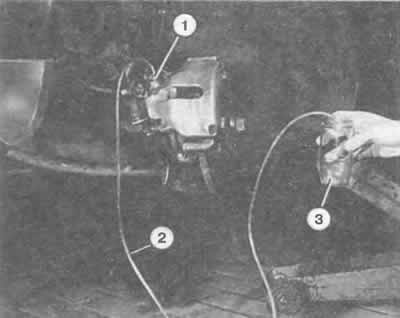
Bleeding the brake system in the front disc brake caliper: the bleed valve (1) is opened with a 7 mm key. A transparent hose (2) is put on the valve, which drains the pumped out fluid into a prepared container (3).