



At a service station, air is removed from the brake system and the system is filled with liquid, usually using special devices.
Warning: When using this device, the filling pressure of the system must not exceed 1 bar.
Air can be removed from the system without using the above devices. In this case, air is removed from the system by rocking movements of the brake pedal. This requires the help of an assistant.
If it is necessary to bleed the entire system, it is removed separately from each wheel cylinder. This is done if air penetrates into each brake cylinder. If only one caliper is replaced or repaired, it is enough to bleed the air from the corresponding cylinder.
Warning: If the brake fluid reservoir is completely empty of fluid (for example, due to a leak in the system or as a result of air being removed when you forgot to add liquid to an empty tank) air enters the ABS pump. In this case, for safety reasons, air should be removed from the system at a service station using a special device. If there is an EDS, it is additionally necessary to perform an adjustment using a tester. When installing a new brake hose, it is also necessary to remove air from the system using a special device.
The procedure for removing air is as follows:
- 1. Rear right support,
- 2. Rear left support,
- 3. Front right support,
- 4. Front left support.
Warning: The bleed nipples should be opened carefully so as not to twist them. It is recommended to spray the nipples with a rust dissolving agent 2 hours before unscrewing. If the nipples still cannot be opened, it is recommended to contact a service station.
Warning: While bleeding air, monitor the fluid level in the reservoir. The level should not drop significantly. Otherwise, air may enter the system. Be sure to fill the system with new brake fluid only!
Execution order
1. Remove the cap from the air bleed nipple on the caliper. Clean the nipple, put a clean hose on it. Lower the other end of the hose into a container half filled with liquid.
2. Have an assistant press the brake pedal as many times as necessary to create pressure in the system, which is felt by the resistance on the pedal.
3. When the pressure is reached, press the pedal to the floor and do not release it.
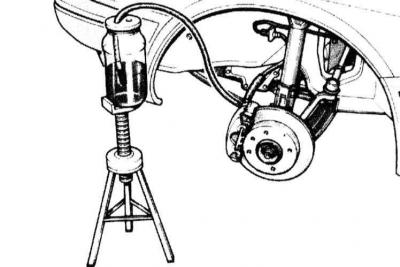
4. Loosen the air bleed nipple on the caliper by about half a turn using a spanner. Collect the leaked fluid in a container. As a result of opening the brake system, the pedal pressure weakens.
5. As soon as the liquid pressure drops, the nipple should be closed.
6. Press the brake pedal a few more times to restore fluid pressure. Press the pedal. Do not remove your feet from the pedal. Keep the bleeder valve open until the pressure begins to drop. Close the bleeder valve.
7. Repeat the above operation until the liquid flowing from the system into the container does not contain air bubbles.
8. After completing the operation, remove the hose from the fitting and put on the cap.
9. Air from other wheel cylinders is released in a similar manner, observing the appropriate sequence.
10. After removing the air, add brake fluid to the reservoir up to the Max mark.
Warning: Please perform a reliability check:
- Are the brake hose fasteners tightened securely?
- Is the brake hose secured in the holder?
- Are the air bleed nipples tightened?
- Is there enough brake fluid in the reservoir?
- With the engine running, check the tightness of the system. To do this, press the brake pedal with a force of 200-300 N (20-30 kg) for 10 s. The pedal should not move. Check all connections for tightness.
11. Finally, check the operation of the braking system on a road with light traffic. At least one strong braking with ABS must be performed (can be felt by the pulsation of the brake pedal).
Warning: Keep a close eye on traffic behind you.
Warning: Brake fluid must be disposed of in a special manner. It should never be disposed of with household waste. Local authorities inform drivers of possible disposal sites for hazardous materials.