



Warning: Individual characteristics are also given in the text of the Chapter and, if their implementation is mandatory, are highlighted in bold
| General parameters | |||
| Design | Disc brakes on the front and rear wheels. Front brake discs – blown. Electronic-hydraulic anti-lock braking system. Hydraulic system – dual-circuit, diagonal. Brake linings - asbestos-free | ||
| Disc brake | Front | Front | Rear |
| Manufacturer | FS– III | FN– 3 | – |
| Brake pad thickness, mm | |||
| new | 14 | 14 | 11.5 |
| wear limit (with back plate) | 7 | 7 | 7 |
| wear limit (without back plate) | 2 | 2 | – |
| Brake disc thickness, mm | |||
| diameter | 256/280 | 288 | 232 |
| thickness of the new | 22 | 25 | 9 |
| wear limit | 19 | 22 | 7 |
| Brake fluid | 1.5L DOT 4 FMVSS 116 spec | ||
| Electronic Control Diagnostic Trouble Codes braking and stability control systems are given in the Specifications to Chapter 5. | |||
| Tightening forces of threaded connections | |||
| The tightening torques for fasteners are also given in the text of the Chapter and on
some illustrations*. *Tightening torques highlighted in bold in the text are subject to precise compliance; efforts not in bold are only approximate | |||
| Front Brake Caliper Guide Bolts | 28 Nm | ||
| Brake caliper holder to hub | |||
| Front wheels | 28 Nm | ||
| Rear wheels | 65 Nm | ||
| Rear brake caliper to bracket | 30 Nm | ||
| Mudguard, front | 10 Nm | ||
| Parking brake lever on the body floor | 25 Nm | ||
| Brake hose on the caliper | 35 Nm | ||
| Wheel bolts | 120 Nm | ||
Elements of the electronic-hydraulic system of stabilization of dynamic stability ABS/EBV/EDS
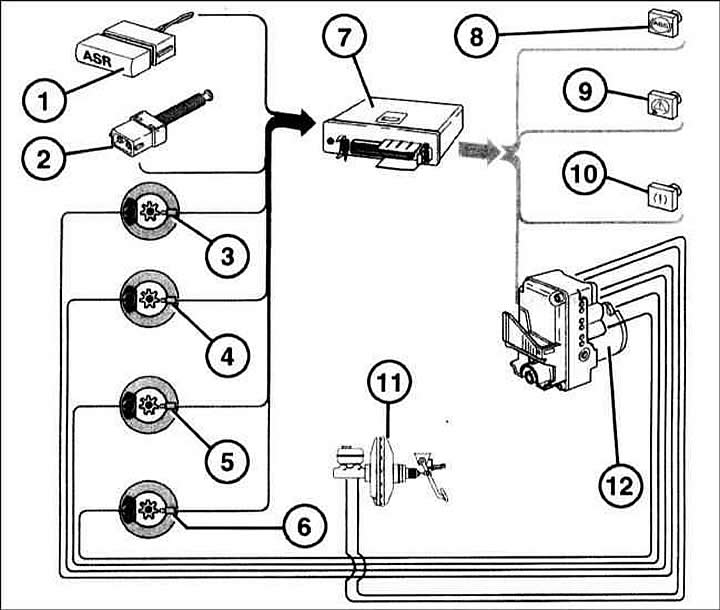
- 1 - ASR switch
- 2 - brake light switch
- 3 - rear left speed sensor
- 4 - rear right speed sensor
- 5 - front right speed sensor
- 6 - Front left speed sensor
- 7 - ABS/EBV/EDS/ASR control unit. Built into the hydraulic control unit
- 8 - ABS/EDS indicator lamp
- 9 - ASR control lamp
- 10 - brake fluid level indicator lamp
- 11 - master brake cylinder, brake booster, brake pedal
- 12 - hydraulic block
ABS/EDS control system components
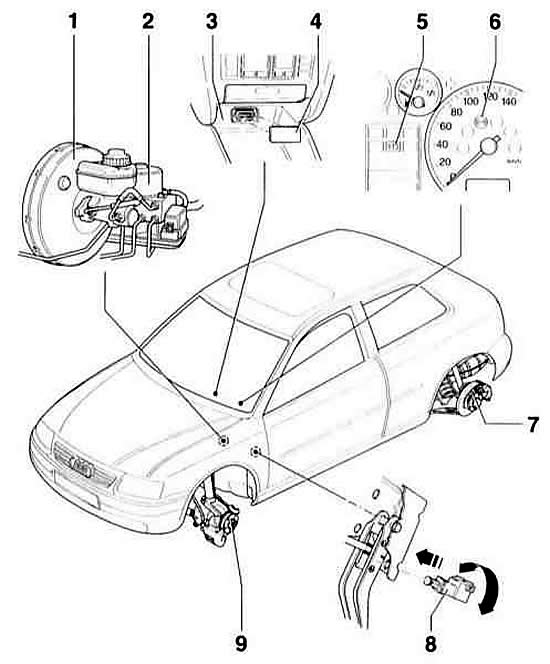
- 1 - master brake cylinder and brake booster
- 2 - hydraulic control unit
- 3 - diagnostic connector. In the center console under the ashtray.
- 4 - lid
- 5 - brake fluid reserve indicator lamp
- 6 - ABS/EDS indicator light
- 7 - Speed sensor/wheel sensor. Rear axle
- 8 - brake light switch. Above the brake pedal
- 9 - Speed sensor/wheel sensor. Front axle
The brake system consists of a brake booster, a master brake cylinder with a connected ABS hydraulic unit, and front and rear disc brakes. The brake system has two circuits acting diagonally. One circuit acts on the front right/rear left, the other on the front left/rear right brakes. If one of the circuits fails, the car is braked by one front and one rear brake. Fluid pressure in both circuits is created in the dual master cylinder by acting on the brake pedal.
The brake fluid reservoir is located in the engine compartment above the master cylinder and supplies fluid to the entire brake system.
The front wheels are equipped with disc brakes, which are ventilated for better heat dissipation. The rear wheels are braked by solid disc brakes.
The engine brake booster accumulates part of the vacuum created in the engine intake manifold. When the brake pedal is pressed, the force on the pedal is increased through the brake booster due to the vacuum action.
Disc brakes are equipped with so-called rigid calipers. These calipers require only one piston to press on the brake pads.
The parking brake acts through cables on the rear wheel brakes.
Warning: Working with the brake system requires special cleanliness and strict adherence to instructions. If you do not have the necessary experience, it is advisable to contact a service station.
Brake pads are designed for use in a specific vehicle model. It is recommended to use brake pads approved by the manufacturer or the Federal Motor Vehicle Authority. Such brake pads are marked accordingly by KBA.
Warning: When driving on wet roads, it is necessary to periodically press the brake pedal to dry the disc brakes. As the wheel rotates, moisture is thrown off the brake discs by centrifugal force, but a film of silicone, rubber abrasion product, grease and other contaminants remain, reducing the effectiveness of the brakes.
Warning: Dirt deposits on the brake pad surface and rain grooves cause grooves on the brake disc surface, resulting in reduced braking performance.
Warning: Cleaning the brake system produces dust that may be harmful to human health, so do not inhale brake dust.
ABS/EBV/EDS/ASR
ABS: Anti-lock braking system, prevents wheels from locking during sudden braking. This helps maintain control during braking and increases driving reliability.
EBV: Electronic Brakeforce Distribution, distributes the braking force to the rear wheels with the help of ABS hydraulics. Since EBV regulation is much more sensitive than a mechanical brake force regulator, a significantly larger adjustment range is used.
When driving straight ahead, the braking force is transferred completely to the rear wheels. In order to also ensure stability when braking on bends, the braking force on the rear wheels must be reduced. The system uses the ABS speed sensors to determine whether the vehicle is driving straight ahead or turning. When driving on bends, the braking force on the rear wheels is reduced. This allows the rear wheels to receive maximum lateral steering force.
EDS: Electronic differential lock, brakes the spinning wheels when the car starts moving. Thanks to this, the torque is transmitted to the drive wheels.
The electronic differential lock operates when starting off and is automatically switched off when the speed reaches 80 km/h. The special advantages of this system are that it does not have a negative impact on the dynamic qualities of the car or on the comfort of control.
Recommendations for ABS/EBV/EDS systems
A special switch in the electronic control unit ensures that the system is not damaged if there is any (for example, a cable break) or when the voltage of the on-board network drops below 10 V, it is switched off. The situation is displayed on the instrument panel by the control lamps lighting up. The normal braking system, however, remains operational. During braking, the car behaves as if the ABS system is absent.
Warning: If the ABS and brake system warning lights come on while driving, the rear wheels may lock up under heavy braking because the brake force distribution is not effective.
Warning: If one or more indicator lights on the instrument panel come on while driving, please note the following:
Execution order
1. Stop the car briefly, turn off the engine and start it again.
2. Check the battery voltage. If the voltage is less than 10.5 V, charge the battery.
Warning: If the indicator lamps light up when you start driving and then go out after a while, this indicates that the battery voltage was initially too low and then increased again during driving as a result of charging by the generator.
3. Check that the battery terminals are securely fastened and have good contact.
4. Place the vehicle on jack stands, remove the wheels and check the electrical wires leading to the wheel speed sensors for external damage (grinding). A more detailed check of ABS/EBV/EDS should be carried out at a service station.
Warning: Before performing electric welding work, it is necessary to disconnect the control unit connector. The connection is disconnected only when the ignition is off. When performing paintwork, it is allowed to briefly heat the control unit to a temperature of no more than + 95°C, and for a long time to a temperature of no more than + 95°C (max 2 hours) up to a temperature of +85°C.