



Table of contents: Front airbags ↓ Side airbags ↓
Front airbags
The front airbag system, in conjunction with the seat belts, provides additional protection for the heads and upper bodies of the driver and front passenger in the event of a serious frontal collision.
Warning: The maximum protective effect of seat belts and air bags is achieved only if the seats are correctly adjusted.
The front airbag system does not deploy:
- in side impacts;
- impacts to the rear of the car;
- capsizing;
- weak frontal impacts.
Airbags are not a replacement for any kind of safety equipment seat belts and are one of the important elements of passive safety of the car. It should be borne in mind that the greatest efficiency of the airbags is achieved only when used together with seat belts.
The airbag system includes:
- electronic device for controlling the system and monitoring its functional readiness (control unit);
- two airbags (air cushions with gas generator) for the driver (in the steering wheel) and the front passenger (in the instrument panel);
- indicator light in the instrument cluster.
The functional readiness of the system is monitored by an electronic device.
Each time the ignition is turned on, the airbag system indicator light comes on for a few seconds (self-check).
The following indicates a violation of the functional readiness of the system:
- when the ignition is turned on, the control lamp does not light;
- approximately 3 seconds after the ignition is turned on, the control lamp does not go out;
- after turning on the ignition, the control lamp goes out and then starts to light again;
- while driving the indicator lamp lights up or flickers.
Warning: In each case of a malfunction of the system described above, it is essential that it be checked by a Volkswagen service partner. Otherwise, there is a risk that the airbags will not deploy properly if necessary.
The airbag system is activated in severe frontal collisions.
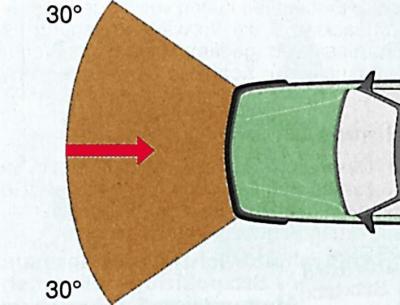
Fig. 1–14. Dimensions of the sector of the frontal collision direction in which the airbag system is deployed
The dimensions of the frontal impact direction sector at which the system is triggered are shown in Fig. 1–14.
When the system is activated, the air cushions are filled with working gas and, as they inflate, deploy in front of the driver and passenger.
When the driver and front passenger rest against fully inflated air bags, their forward momentum is dampened and the risk of head and upper body injuries is significantly reduced.
The air bag is designed so that during a frontal impact, the body load of the driver or passenger sitting next to him causes a controlled release of gas from the bag to soften the blow to the head and upper body. After the collision, the air bag becomes empty and does not obstruct the view.
The cushion inflates at high speed in a matter of seconds, which ensures reliable protection in the event of an accident.
The appearance of a large amount of fine dust in the passenger compartment when the airbags inflate is considered normal and should not be a cause for concern.
Side airbags
The side airbags are located in the front seat back cushions. You can recognize them by the AIRBAG inscription on the upper part of the rear side of the seat backs.
The side airbag system, in conjunction with the seat belts, provides additional protection for the upper body of the driver and front passenger in the event of a serious side collision.
The side airbag system does not deploy:
- in frontal impacts;
- weak side impacts;
- impacts to the rear of the car;
- overturning.
The side airbag system is in no way a replacement for seat belts and is an important element of the vehicle's passive safety.
The side airbag system includes:
- electronic device for controlling the system and monitoring its functional readiness (control unit);
- airbags on the sides of the rear side of the front seat backs;
- indicator light in the instrument cluster.
In case of severe side impacts, the airbag on the side of the collision is deployed.
In special, combined types of collisions, both front and side airbags may deploy.
Warnings: All work related to side airbags, as well as installation and dismantling of devices of this system when carrying out other work (for example, when removing the front seats) must only be performed at a Volkswagen service centre.
There should be no people, animals or objects between the front passenger and the cushion location. Also, accessories such as cup holders should not be attached to the doors.
Only small and light items can be hung on clothes hooks.
Do not store heavy or sharp-edged items in pockets for small items.
The sides of the seat backs must not be subjected to strong forces, such as strong impacts or pressure, as this could damage the side airbag system.
Under no circumstances should you use covers on the front seats that are not recommended by the manufacturer. Otherwise, when the side airbags deploy, their protective effect will be limited.
Airbags that have been subjected to critical stress in an accident must be replaced.