



Table of contents: Front airbags ↓ Side airbags ↓ Head pillows (SIDEGUARDS) ↓ Disabling airbags ↓ Airbag system control ↓ Disabling the front passenger airbag… ↓ Car with front passenger airbag… ↓
In the event of a serious frontal collision, the front airbag system, together with the three-point seat belts, provides additional protection for the head and chest area of the driver and front passenger.
In severe side impacts, side and head airbags reduce the risk of injury to passengers in the impact zone.
The airbag system is not a replacement for the seat belt, but is part of the overall concept of passive safety of the car. You should always keep in mind that the maximum protective effect of the airbag system is achieved only in cooperation with fastened seat belts. Therefore, always fasten your seat belts not only for traffic regulations, but also for safety reasons.
Seat belts, in addition to their traditional protective function, must, in the event of an accident, hold the driver and front passenger in such a position that the airbags can inflate properly and provide additional protection.
The readiness of the airbag system function is monitored electronically and indicated by the "AIRBAG" control lamp.
The following indicates a system malfunction:
- when the ignition is turned on, the control lamp does not light,
- the control lamp does not go out approximately 3 seconds after the ignition is turned on,
- after turning on the ignition, the control lamp goes out and lights up again,
- the indicator light comes on or flashes while driving.
Attention
- The protective action of the airbag system is sufficient for only one accident. After a single activation, the system must be replaced.
- No more than 14 years after the date of manufacture, the airbag system must be replaced with a new one at a specialized enterprise.
The airbag system will not deploy in the following cases:
- with ignition off
- in minor frontal collisions
- in minor side impacts
- in rear-end collisions
- when the car rolls over
Front airbags
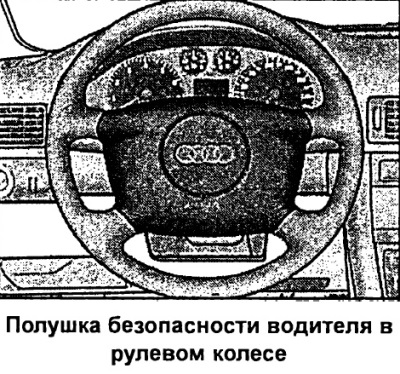
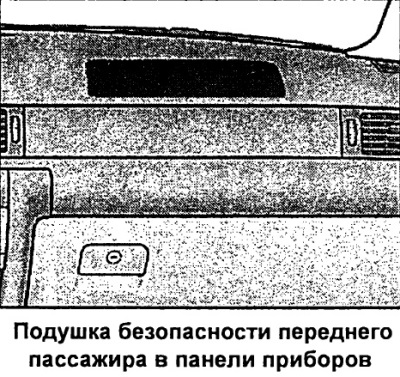
The driver's front airbag is located in the steering wheel trim panel. The front passenger's front airbag is located above the storage compartment on the right side of the instrument panel. The location of the airbags is marked with the inscription "AIRBAG".
In the event of a serious frontal collision, the front airbag system, together with the three-point seat belts, provides additional protection for the head and chest area of the driver and front passenger.
In addition to their traditional protective function, seat belts must, in the event of a frontal collision, hold the driver and front passenger in such a position that the airbag can deploy correctly and provide additional protection.
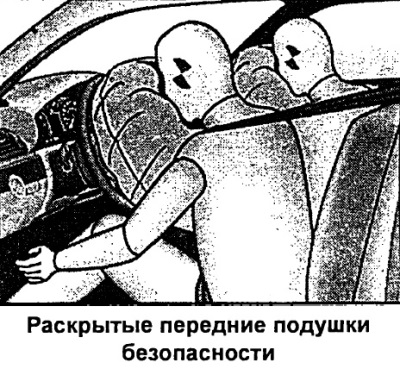
The airbag system is designed to deploy the driver and front passenger airbags in dangerous frontal collisions. In special emergency situations, both the front and head and side airbags may deploy.
When the system is activated, the air bags are filled with working gas and deploy in front of the driver and front passenger. The air bags inflate in hundredths of a second and at high speed to provide additional protection in an accident. When contact is made with a fully inflated air bag, the forward movement of the driver and front passenger is dampened and the risk of injury to the head and upper body is reduced.
The specially designed design of the inflatable cushion provides for a controlled release of the working gas under the influence of the driver or passenger in order to soften the reception of the head and body. As a result, the cushion is deflated after its deployment, and as a result, the forward view is again freed.
Attention
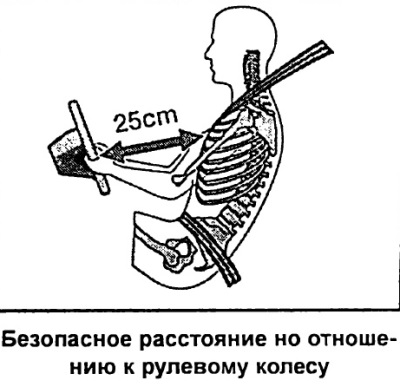
- The driver and front passenger must maintain a minimum distance of 25 cm from the steering wheel/dashboard. Otherwise, the airbag system will not protect you - life-threatening! In addition, the front seats and headrests must always be installed exactly according to your height.
- There should be no other persons, animals or objects between the occupants in front and the airbag's effective area.
- The steering wheel trim panel and the surface of the airbag module in the front passenger instrument panel must not be pasted over, covered with fabric or treated in any other way. Wipe it only with a dry or damp cloth. It is also not allowed to attach any objects to the trim of the airbag modules, such as cup holders or a phone holder.
Side airbags
The side airbags are located in the upholstery of the front and side rear seats. The location of the airbags is indicated by the inscription "AIRBAG".
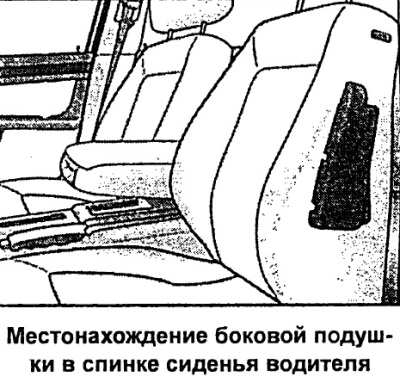
In the event of a serious side impact, the side airbag system, together with the three-point seat belts, provides additional protection for the entire upper body (chest, abdomen and pelvis) driver and passengers.
In dangerous side impacts, side airbags reduce the risk of injury from the door. In addition to their traditional protective function, seat belts should hold the occupants of the vehicle in such a position that the airbag deploys correctly and provides additional protection in the event of a side impact.
When the side airbags are deployed, in order to increase the level of protection for passengers, the head airbags (SIDEGUARD) on the corresponding side are always also deployed.
In the event of a dangerous side collision, the side airbag on the corresponding side of the vehicle deploys.
In extreme emergency situations, front, head and side airbags may deploy.
When the system is activated, the air cushions are filled with working gas.
The airbags inflate in hundredths of a second and at high speed to provide additional protection in an accident. When the airbag inflates, fine dust is formed. This is normal and does not indicate a car fire.
Contact with a fully inflated airbag dampens the movement of passengers and reduces the risk of injury to the entire upper body (chest, abdomen and pelvis) from the door side.
Attention
- Your head should never be in the side airbag deployment area. Otherwise, you could be seriously injured in an accident. This is especially true for children who are not transported in the appropriate child seat.
- Under no circumstances may covers or upholstery be used that are not specifically approved for use on Audi seats with a side airbag. The airbag deploys from the seat back. Therefore, if you have unapproved covers or upholstery, the protective function of your side airbag is significantly impaired.
Note: When the front passenger airbag is deactivated, the front passenger side airbag is also deactivated.
Head pillows (SIDEGUARDS)
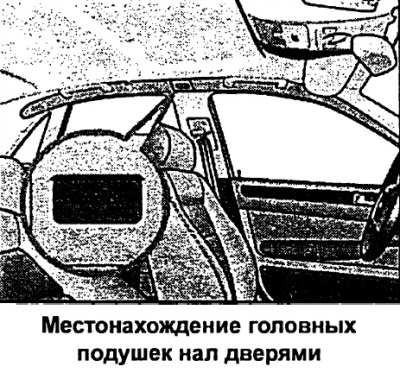
The head airbags are located on both sides of the passenger compartment above the doors. The location is indicated by the inscription "AIRBAG".
In dangerous side impacts, the head airbag system, together with the three-point seat belts and side airbags, provides additional protection for the head and neck area of the driver and passengers. In addition to their traditional protective function, the seat belts must hold the occupants of the vehicle in such a position in the event of a side impact that the airbag can deploy correctly and provide additional protection.
Together with other structural components (for example, seat crossbars, stable structure of the car) SIDEGUARD is a consistent improvement in occupant protection in side impacts.
Disabling airbags
Disabling airbags is only provided in certain cases, for example:
- if it is necessary, in exceptional cases, to install a child seat on the front passenger seat, in which the child is positioned with his or her back to the direction of travel.
- if, despite the driver's seat being correctly positioned, the minimum distance (25 cm) between the centre of the steering wheel and the sternum is not maintained.
- if it is necessary to install special devices in the steering wheel area for physical disabilities,
- when installing other seats (for example, orthopedic seats without side airbags).
Airbag system control
- Each time after the ignition is turned on, the "AIRBAG" indicator lamp lights up for a few seconds.
- If at least one airbag is deactivated, the indicator lamp flashes for about 12 seconds and then goes out.
Disabling the front passenger airbag when installing a child seat
Deactivate the front passenger airbag if it is necessary, in exceptional cases, to install a child seat on the front passenger seat, in which the child is positioned with his or her back to the direction of travel.
However, we recommend that you only install the child seat in the rear seat to ensure that the front passenger airbag remains functional.
Car with front passenger airbag switch
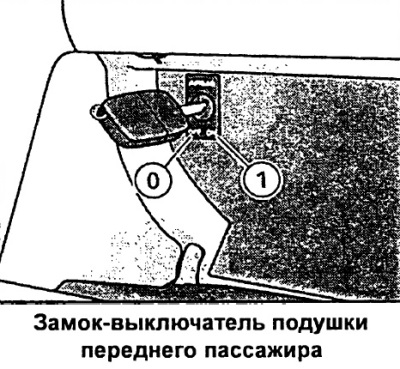
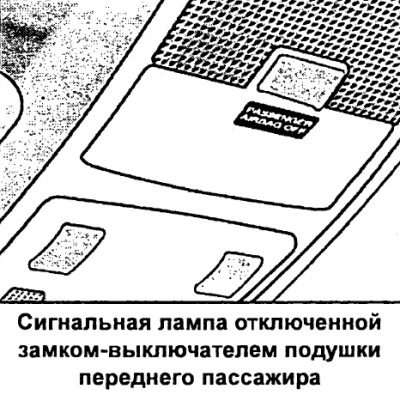
The front passenger airbag deactivation switch is located in the glove compartment.
- To deactivate the front passenger airbag, turn the vehicle key to position 0.
- The airbag is activated by turning the key to position 1.
The constant lighting of the warning light reminds you that the front passenger airbag has been disabled by the key switch "PASSENGER AIRBAG OFF". Please also monitor the "AIRBAG" indicator light in the instrument cluster.
Note
- The constant lighting of the warning light reminds you that the front passenger airbag has been disabled by the key switch "PASSENGER AIRBAG OFF".
- When the front passenger airbag is deactivated, the side airbag on the front passenger side is also deactivated. All other airbags in the vehicle are in working mode.