



Table of contents: Operating principle ↓ Shutdown ↓
The electronic dynamic stabilization system increases the vehicle's stability while driving.
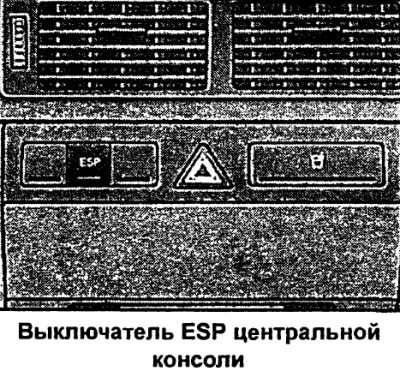
ESP increases the effectiveness of control over the vehicle's driving dynamics in unusual situations, such as when accelerating and cornering. ESP reduces the risk of skidding under all driving conditions and thus improves vehicle stability while driving across the entire speed range.
The electronic dynamic stabilization system includes an anti-lock braking system (ABS), an electronic differential lock (EDS) and an automatic steering control (ASR).
Operating principle
Along with the data obtained from these devices, the ESP control unit requires additional parameters obtained from highly sensitive sensors. The vehicle's rotation speed around its vertical axis, lateral acceleration, brake pressure and steering wheel rotation are measured.
The steering wheel rotation and vehicle speed are used to determine the driver's intended direction of travel, which is continuously compared with the vehicle's actual operating mode. In the event of discrepancies, such as the vehicle beginning to skid, the ESP device automatically brakes the corresponding wheel.
As a result of the impact on the wheel during braking of effective forces, the car is stabilized. In case of excessive steering of the car (tendency for rear axle to skid) the braking force is applied mainly to the outer front wheel in relation to the turn. In case of understeer (tendency to miss a turn) the rear wheel closest to the turn is braked. ESP operation is accompanied by noise.
The device works in combination with ABS. If ABS fails, ESP will not work either.
Shutdown
The ESP device is activated automatically when the engine is started and carries out self-diagnostics.
If necessary, the ESP device can be switched on and off by pressing a button. When the device is switched off, the ESP indicator lamp lights up.
Normally, the ESP device should always be switched on. Only in certain exceptional cases, when slippage is necessary, does it make sense to switch off the device, namely:
- when driving with snow chains,
- when driving on deep snow or loose ground,
- when trying to drive out while rocking after getting stuck. After that, turn on the ESP again.
Attention. No ESP can go beyond the limits of what is physically possible. The driving mode of a car with ESP must also always be determined by the condition of the roadway and the specific traffic situation. Remember this especially on slippery or wet roads. The increased safety potential provided by ESP must not provoke dangerous risks!
[The original material is located on the website: AUDIMANUAL.RU]