



Table of contents: "Tiptronic" (5-speed automatic… ↓ Control lever positions ↓ Control lever lock ↓ Automatic control lever lock ↓ Kick-down device ↓ Dynamic Switching Program (DSP) ↓ "Tiptronic" mode ↓ "Tiptronic" steering wheel ↓
"Tiptronic" (5-speed automatic transmission)
The car is equipped with a 5-speed automatic transmission with electronic control. Switching to higher and lower gears is carried out automatically.
For reasons of fuel consumption and environmental protection, on some modifications the transmission is designed so that the maximum speed of the car is achieved only in the "S" position.
The gearbox is also equipped with a tiptronic system. This system gives the driver, if desired, the ability to manually shift gears.
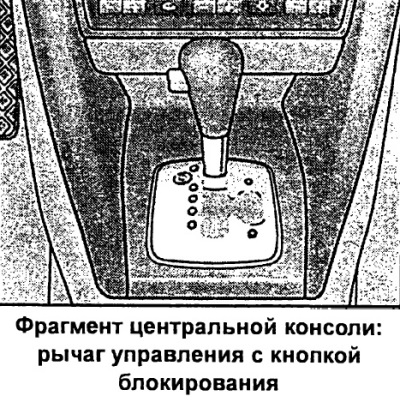
Shifting to higher and lower forward gears is carried out automatically.
Moving off
- Press and hold the brake pedal.
- While holding down the lock button (on the control lever), set the control lever to the desired position, for example, position D, and release the lock button.
- Wait until the automatic system switches on, creating a power connection between the gearbox and the drive wheels (at the moment of switching on, a slight jolt is felt).
- Release the brake pedal and press the accelerator pedal.
Short stops
- Hold the car with the brake pedal, for example, at traffic lights.
- Do not press the accelerator pedal.
Parking
- Press and hold the brake pedal.
- Apply the handbrake fully.
- While holding down the lock button, set the control lever to the "P" position and release the lock button.
The engine can only be started when the control lever is in position "P" or "N".
When parking on a level surface, it is sufficient to set the control lever to the "P" position. If the road is sloping, first tighten the parking brake all the way and only then move the control lever to the "P" position. This reduces the load on the locking mechanism and makes it easier to move the control lever from the "P" position.
Attention.
- When shifting gears before starting off, do not press the accelerator pedal - risk of accident!
- While driving, never set the control lever to the "R" or "P" position - risk of accident!
Control lever positions
This section provides a description of all control lever positions.
The actual position of the control lever is indicated on the instrument cluster displays.
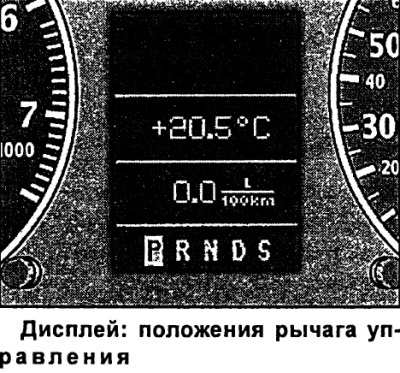
P - Parking lock
In this position, the drive wheels are locked mechanically. The parking lock may only be engaged when the vehicle is stationary.
To set the control lever to the "P" position and to move it from this position, press the locking button (on the control lever) and the brake pedal at the same time.
R — reverse gear
When the control lever is set to this position, reverse gear is engaged.
Reverse gear may only be engaged when the vehicle is stationary and the engine is idling.
To set the control lever to the "R" position, press the lock button and the brake pedal at the same time. When the ignition is on and the control lever is in the "R" position, the reversing lights are on.
N — neutral position (idle position)
This position is the idle position.
D - the basic position when moving forward
In this position, upshifting and downshifting are automatic, depending on engine load, speed and the Dynamic Shift Program (DSP). To move the control lever from position "N" to position "D" at a speed of less than 5 km/h or when the vehicle is stationary, the brake pedal must be pressed.
To enable manual adjustment of the gear ratio to driving conditions, under certain circumstances, (for example, when driving in the mountains or with a trailer) it may be preferable to temporarily switch to a manual shift program.
S - sport position
Set the control lever to the "S" position when driving in sport mode. Later upshifts allow the engine's power reserves to be fully utilized.
To move the control lever from the "N" position to the "S" position at a speed of less than 5 km/h or when the vehicle is stationary, press the brake pedal.
Attention
- While driving, never set the control lever to the "R" or "P" position - risk of accident!
- Regardless of the selected driving mode (except "P" and "N"), with the engine running, hold the car with the foot brake, since even in idle mode the kinematic connection of the engine with the wheels does not completely disappear - the car "crawls" When the car is stationary with the driving mode on, do not add gas inadvertently under any circumstances (for example, with your hand in the engine compartment). Otherwise, the car will immediately start moving, possibly even with the parking brake fully applied - risk of accident!
- Before opening the hood and starting work with the engine running, move the control lever to the "P" position and fully tighten the parking brake.
Note
- If the control lever is accidentally moved to the "N" position while driving, release the gas and wait for the revs to drop to idle speed before returning to the "D" or "S" mode.
- For reasons of fuel consumption and environmental protection, on some modifications the transmission is designed so that the maximum speed of the car is achieved only in the "S" position.
Control lever lock
The control lever lock prevents the inadvertent engagement of the driving range and thus the spontaneous movement of the vehicle from a standstill.
The blocking can be removed as follows:
- Turn on the ignition.
- Press the brake pedal and simultaneously hold down the lock button.
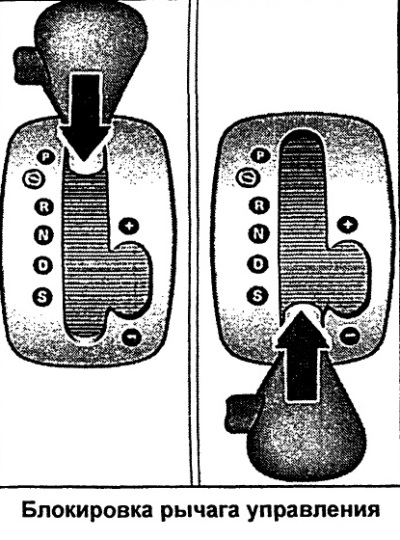
Automatic control lever lock
When the ignition is on, the control lever is locked in the "P" and "N" positions. To move it from these positions, press the brake pedal. As a reminder to the driver, when the control lever is in the "P" and "N" positions, the following indication appears on the display:
"BIEM EINLEGEN EINER FAHRSTUFE IM STAND FUSSBREMSE BETATIGEN" (when selecting the stationary vehicle driving mode, press the brake pedal).
In addition, the gj symbol for automatic control lever lock lights up on the control lever linkage.
At speeds of approximately 5 km/h and above, the control lever lock in the "N" position is automatically released.
When the control lever is quickly moved through the "N" position (for example, from the "R" position to the "D" position), the control lever is not locked. This will allow, for example, the "rocking" movement of a stuck car. If the control lever is in the "N" position for more than 1 second with the brake pedal released, it is locked.
Lock button
The control lever lock button prevents the control lever from being moved to certain positions unintentionally. When this button is pressed, the control lever is unlocked. The positions in which the lock button must be pressed are highlighted in the figure.
Locking the key in the ignition switch
After turning off the ignition, the key can be removed from the lock only when the control lever is in the "P" position (parking lock). After removing the key from the lock, the lever is locked in the "P" position.
Kick-down device
The Kick-down device allows for maximum acceleration.
When the accelerator pedal is pressed sharply and the resistance point is crossed, the automatic system switches to a lower stage depending on the speed and revolutions. Switching to the next higher stage occurs immediately after reaching the maximum engine shaft speed corresponding to the given stage.
Attention. Remember that on a slippery road the drive wheels may slip when the Kick-down device is activated - there is a risk of skidding!
Dynamic Switching Program (DSP)
The automatic transmission is controlled electronically.
The automatic transmission is controlled electronically. Shifting to higher and lower gears is carried out according to the driving programs stored in the memory.
With a restrained driving style, the automatic system selects an economical shift program.
With a spirited driving style with sharp accelerations and frequent speed changes, using maximum speed or after sharply pressing the accelerator pedal (Kick-down), the automatic system operates in the range of sports programs. Late transition to higher gears allows the engine power reserve to be fully realized. Switching to lower gears is carried out at higher engine speeds.
Selecting the optimal driving program for specific conditions is a continuous process. However, regardless of this, you can switch to a more sporty program by pressing the accelerator pedal sharply. In this case, the gearbox switches to a lower level corresponding to the actual speed of movement, providing the possibility of dynamic acceleration (for example, when overtaking) without the need to press the accelerator pedal sharply to the stop. After switching back to a higher stage and with the appropriate driving mode, operation is restored according to the original program.
The mountain program controls the gear selection on uphill and downhill gradients. This eliminates the need to shift gears when driving uphill. Pressing the brake pedal when driving downhill shifts down to a lower gear. This allows engine braking without having to shift manually.
"Tiptronic" mode
The tiptronic system also gives the driver the option of manual gear shifting.
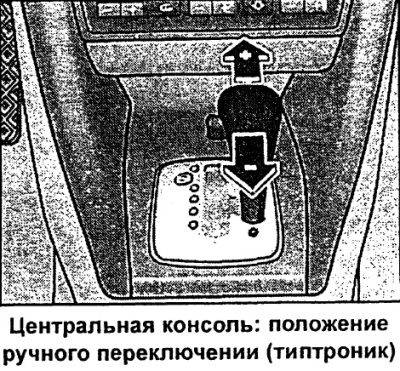
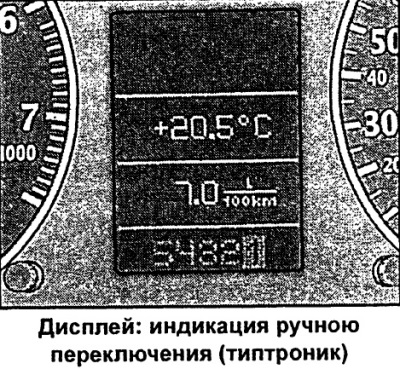
Switching to manual mode
- Press the control lever from position "D" to the right. When manual mode is engaged, the display shows "5 4 3 21" with the currently engaged gear highlighted.
Shifting into higher gears
- When moving the control lever forward (in tiptronic position) shifting to higher gears (+) occurs.
Downshifting
- When moving the control lever back (in tiptronic position) downshifting occurs (-).
You can switch to manual mode both while driving and while parked.
When accelerating in 1, 2, 3 and 4 gears, the gearbox will automatically switch to the next higher gear shortly before reaching maximum engine speed.
When switching from a higher gear to a lower one, the automatic transmission will switch only after it becomes impossible to increase the engine speed in a variable manner.
When the Kick-down device is operating, the transmission switches to the next lower gear depending on the speed and engine shaft rotation frequency.
Emergency program
In case of a system failure, the automation switches to the emergency program.
If the system malfunctions, the automatic system switches to the emergency program. This is indicated by all segments on the indicator panel lighting up or going out at once.
The control lever can be moved to all positions. However, in the "D" and "S" positions, the 4th stage will be engaged.
It is also possible to engage reverse gear "R". However, the electronic reverse gear lock is disabled when operating in emergency mode.
In emergency mode, the manual switching program (tiptronic) is disabled.
If the transmission switches to emergency mode, contact an Audi dealer as soon as possible and have the fault rectified.
"Tiptronic" steering wheel
The buttons located on the steering wheel also give the driver the option of manual gear shifting.
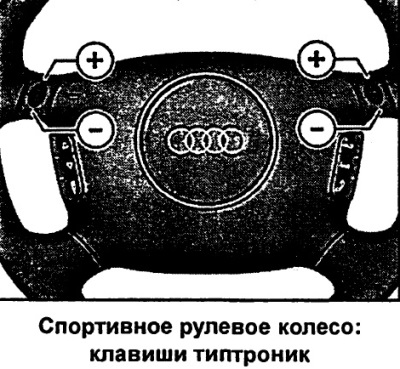
Shifting into higher gears
- Press the top side of one of the keys (+).
Downshifting
- Press the bottom side of one of the keys (-).
The gearshift buttons on the steering wheel are in working mode when the control lever is in position "D", "S" or manual shift program (tiptronic).
Of course, manual gear shifting is also possible using the control lever on the centre console.