



Table of contents: Ignition switch of a car with a… ↓ Ignition switch of a car with a… ↓ Locking the key in the ignition… ↓ Starting the engine ↓ Engine shutdown ↓
Ignition switch of a car with a gasoline engine
The ignition key can be used to start and stop the engine.
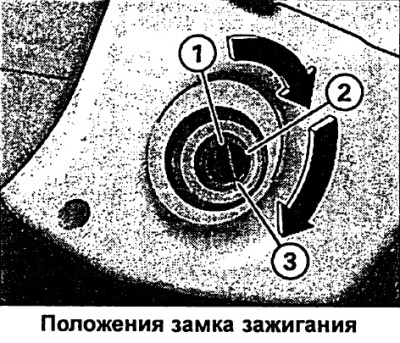
Ignition off 1
In position 1 the ignition is off, the engine is not running and the steering wheel can be locked.
To lock the steering wheel, remove the key from the lock and turn the steering wheel until it is heard to lock. Always lock the steering wheel when leaving the car. This makes it more difficult for potential car theft.
Ignition on (position "on for driving") 2
If the key turns with difficulty or does not turn at all in this position, then it is necessary to turn the steering wheel slightly to relieve the anti-theft device.
Engine start 3
In this position, the engine starts. At the same time, the headlights switch to parking lights, and powerful consumers of electricity are switched off. After starting the engine, the ignition key returns to position 2.
Before each subsequent engine start, return the ignition key to position 1. The restart lock in the ignition switch prevents damage to the starter by preventing its pinion from engaging with the flywheel ring gear when the engine is already running.
Attention
- Remove the key from the lock only after a complete stop! Otherwise, the steering wheel may accidentally snap into the lock - risk of accident!
- Always remove the ignition key from the vehicle whenever you leave it, even for a short time, especially when leaving children in the vehicle.
Note: When disconnecting and then reconnecting the battery, wait with the ignition key in position 2 for about 5 seconds and only then start the engine.
Ignition switch of a car with a diesel engine
The ignition key can be used to start and stop the engine.
Fuel supply stopped 1
In position 1, the fuel supply is cut off, the engine is not running and the steering wheel may be locked.
To lock the steering wheel, remove the key from the lock and turn the steering wheel until it is audibly locked. Always lock the steering wheel when leaving the car. This makes it more difficult for potential car theft.
Preheating position and "on for driving" position 2
Pre-start heating is possible in this position. During pre-start heating of the engine, do not turn on powerful current consumers, so as not to uselessly overload the battery.
If the key turns with difficulty or does not turn at all in this position, then it is necessary to turn the steering wheel slightly to relieve the anti-theft device.
Engine start 3
In this position, the engine starts. At the same time, the headlights switch to parking lights, and powerful power consumers are switched off. After starting the engine, the ignition key returns to position 2.
Before each subsequent engine start, return the ignition key to position 1. The restart lock in the ignition switch prevents damage to the starter by preventing its pinion from engaging with the flywheel ring gear when the engine is already running.
Locking the key in the ignition switch
Car with automatic transmission
The key can only be removed from the ignition switch when the control lever is in position "P".
After the ignition is switched off, the key can only be removed from the ignition switch when the control lever is in the "parking lock" position. After this, the control lever is locked.
Starting the engine
The engine can only be started with an original Audi key.
- Apply the parking brake fully.
- Set the gear shift lever to neutral (automatic transmission control lever to position "P" or "N").
At low outside temperatures, when starting the engine, fully depress the clutch pedal so that the starter turns only the engine.
After a cold start, the engine may run with increased noise for a short time until the required oil pressure in the hydraulic valve clearance compensation system is established. This is a normal phenomenon that should not cause alarm.
If the engine does not start...
You can use another car's battery to help start the engine.
Towing a car is only possible with a manual transmission. The maximum towing distance is 50 meters.
Warning: Do not operate the engine in closed spaces - risk of poisoning!
Caution: Avoid high revs, driving with the accelerator pedal fully depressed and significant engine loads before reaching operating temperature - risk of engine damage!
Note: To avoid unnecessary emission of harmful substances into the atmosphere, do not warm up the engine at idle speed. Start driving immediately.
Gasoline engine
- Turn the ignition key to position 3. Do not press the accelerator pedal!
- As soon as the engine starts, release the key - the starter should not rotate together with the crankshaft.
When starting a cold engine or one warmed up to operating temperature, do not press the accelerator pedal either before engaging the starter or while it is running.
If the engine does not start immediately, then after about 10 seconds stop trying to start and try again after about half a minute.
After starting a very hot engine, it may be necessary to press the accelerator pedal slightly.
Diesel engine
- Turn the ignition key to position 2 - the preheating system indicator lamp lights up, indicating preheating.
- To start the engine, turn the ignition key to position 3 when the indicator lamp goes out. Do not press the accelerator pedal.
- As soon as the engine starts, release the key - the starter should not rotate together with the crankshaft.
Pre-heating system
Diesel engines are equipped with a pre-heating system. The required warm-up time is determined by the coolant temperature and the outside temperature.
During the pre-start warm-up period, do not turn on powerful current consumers, so as not to unnecessarily overload the battery.
Start the engine immediately as soon as the pre-heating indicator lamp goes out.
When starting an engine warmed up to operating temperature, as well as at an ambient temperature above +8°C, the pre-heating system control lamp lights up for about one second. This means that the engine can be started immediately.
If the engine does not start immediately, then after about 10 seconds stop trying to start and try again after about half a minute.
Starting the engine after the fuel supply has been completely used up
If the diesel fuel in the tank has been completely used up, then after refueling the engine start process may take longer than usual - up to one minute. This is due to the need to remove air from the fuel system during engine start.
Engine shutdown
- Turn the ignition key to position 1.
Caution. When turning off the engine after a long period of heavy load, heat may accumulate in the engine compartment - risk of engine damage! Therefore, let the engine idle for about 2 minutes and only then turn it off.
Note: After the engine has stopped, the cooling system fan may continue to run for up to 10 minutes - even if the ignition is switched off. The fan may also switch on again after a while if the coolant temperature increases due to heat accumulation or if the engine compartment is additionally heated by strong sunlight when the engine is warm.