



Table of contents: Ignition switch ↓ Diesel engines ↓ Recommendations for all vehicles: ↓ Starting the engine ↓ Petrol engines ↓ Diesel engines ↓
Ignition switch
Petrol engines
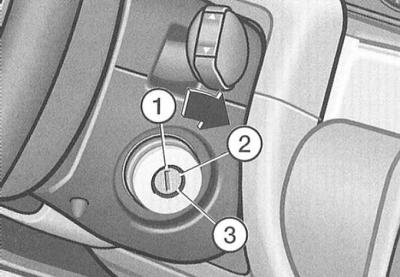
1 – ignition off / engine not running, steering wheel may be locked
2 – ignition on*
3 – engine start
* When disconnecting and then reconnecting the battery, wait about 5 seconds and only then start the engine.
Diesel engines
1. fuel supply is cut off / engine does not work, steering wheel may be locked
2. position of preheating and subsequent movement
During preheating, do not turn on powerful current consumers so as not to overload the battery.
3. starting the engine.
Recommendations for all vehicles:
Position 1:
To lock the steering wheel, remove the key from the lock and turn the steering wheel until you hear it lock.
On vehicles with automatic transmission, the key can only be turned to position 1 and removed when the selector lever is in position "P".
Warning: On vehicles with manual transmission, remove the key from the lock only after the vehicle has come to a complete stop! Otherwise, the steering wheel may accidentally snap into the lock.
Position 2:
If the key turns with difficulty or does not turn at all in this position, you may need to turn the steering wheel slightly to release the steering wheel lock.
Position 3:
Before each subsequent engine start, return the ignition key to position 1. The restart interlock in the ignition switch prevents damage to the starter by preventing its pinion from engaging with the flywheel ring gear while the engine is already running.
Starting the engine
General Provisions
Warning: There is a risk of poisoning when the engine is running in closed areas!
Before starting the engine, set the gearshift lever to neutral (automatic transmission selector lever to position "P" or "N") and apply the handbrake.
In a car with a manual transmission, press the clutch pedal when starting the engine so that the starter turns only the engine.
Once the engine starts, release the key – the starter should not rotate together with the crankshaft.
After a cold start, the engine will run noisily for a while until the required oil pressure is established in the hydraulic valve clearance compensation system. This is normal and should not cause alarm.
Do not warm up the engine at idle speed! Start moving immediately!
Avoid high revs and driving with the accelerator pedal fully depressed until the engine reaches operating temperature.
A vehicle with a catalytic converter must not be towed for more than 50 m*. Unburned fuel may enter the converter and cause damage.
*This does not apply to vehicles with diesel engines.
Petrol engines
When starting a cold engine or one that has warmed up to operating temperature, do not press the accelerator pedal either before engaging the starter or while it is running.
If the engine does not start immediately, then after about 10 seconds stop trying to start it and try again after about half a minute.
After starting a very hot engine, it may be necessary to press the accelerator pedal lightly.
Diesel engines
Preheat
The engine is equipped with a preheating system. The required preheating time is determined by the lighting of the preheating control lamp connected to the coolant temperature sensor - refer to subsection Control and measuring devices. Warning and diagnostic systems.
Turn the ignition key to position 2. When the engine is cold, the preheating system indicator lamp lights up, indicating that the engine preheating is on. It goes out when the ignition temperature is reached.
During the pre-heating period, do not turn on powerful current consumers, so as not to unnecessarily overload the battery.
When starting an engine warmed up to operating temperature, as well as at an ambient temperature above +8°C, the pre-heating system control lamp lights up for approximately one second – the engine can be started immediately.
Start the engine as soon as the indicator light goes out.
Do not press the accelerator pedal when starting.
If individual flashes occur, continue to hold the starter on for a few more seconds (maximum half a minute), until the engine starts working on its own.
If the engine does not start, wait about half a minute, preheat again and try starting again as described above.
(The original material is located on the website: AUDIMANUAL.ru)