



Instructions: Secure the towing rope or towing bar to the eyes.
Front towing eye
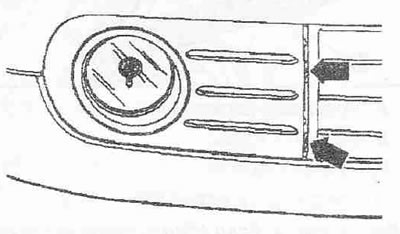
Remove the towing eyes and screwdriver from the on-board tool kit. Use the screwdriver to unlock the "arrow" trim and remove it. Screw in the towing eye as far as it will go and tighten it tightly with the wheel wrench. After use, unscrew the towing eye and put it away in the on-board tool kit. The towing eye must be in the vehicle at all times.
Rear towing eye
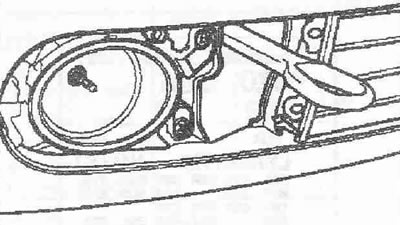
Take the towing eyes and screwdriver from the on-board tool. Use the screwdriver to unlock the trim and remove it.
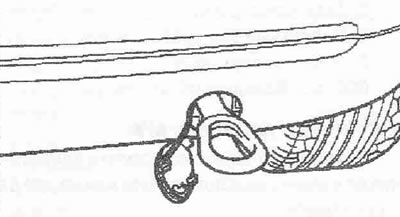
Screw the towing eye in until it stops and tighten it firmly with a wheel wrench.
Instructions. The towing rope must be elastic so as not to create excessive load on both vehicles. In this regard, use ropes made of artificial fibers or similar elastic materials. However, it is considered more reliable to use a towing rod! Always ensure that excessive traction force and jerky load are not created. Maneuvering during towing is associated with the risk of overloading the fastening elements and damaging them. Before starting the engine by towing, if possible, try to start it using the battery of another vehicle.
When towing or attempting to start the engine by towing, observe the following rules. Both drivers must be familiar with the specifics of towing. Drivers without towing experience must not be behind the wheel of the towed/towing vehicle. When using a towing rope, the driver of the towing vehicle must operate the clutch especially smoothly when starting off and when changing gears. The driver of the towed vehicle must ensure that the rope is kept taut at all times. The hazard warning lights must be on on both vehicles; if necessary, observe rules that prescribe otherwise. The ignition must be on to avoid locking the steering wheel and to enable the driver to turn on the direction indicators, horn, windshield wipers and washers. Since the brake booster only functions when the engine is running, significantly more force must be applied when the brake pedal is not running. If there is no oil in the manual or automatic transmission, tow the vehicle only with the drive wheels raised.
When starting the engine of a vehicle with a manual transmission by towing, observe the following rules: before starting towing, engage 2nd or 3rd gear, then press and hold the clutch pedal. Turn on the ignition. When starting the vehicle, release the clutch pedal. To avoid hitting the towing vehicle, press the clutch pedal on the towed vehicle and disengage the gear immediately after starting the engine.
Instructions. For cars with a catalytic converter (only for petrol), starting the engine by towing is only possible when the catalytic converter is warmed up to operating temperature, and the towing distance should not exceed 50 m. Otherwise, unburned fuel may get into the catalytic converter and cause it to fail.