



Notes: Always replace gaskets and self-locking nuts.
After servicing and repairing the exhaust system, check that the system is installed freely, without tension, with sufficient clearance relative to the body elements.
To make it easier to subsequently unscrew the nuts and bolts that secure the system, lubricate them with Liqui Moly LM–508–ASC high-temperature paste.
Before re-installing the exhaust system components, clean the joints with sandpaper to remove any remaining sealant or rust.
The connecting element in the front exhaust pipe must not be bent more than 10°, otherwise it will be damaged.
The rear and central mufflers are made as a single unit, but each of them can be replaced separately.
Tighten the clamp mounting nuts evenly to a torque of 40 Nm.
Note: Please use a new gasket when installing.
The rear and central mufflers are made as a single unit, but each of them can be replaced separately.
Tighten the clamp fastening nuts evenly to a torque of 40 Nm.
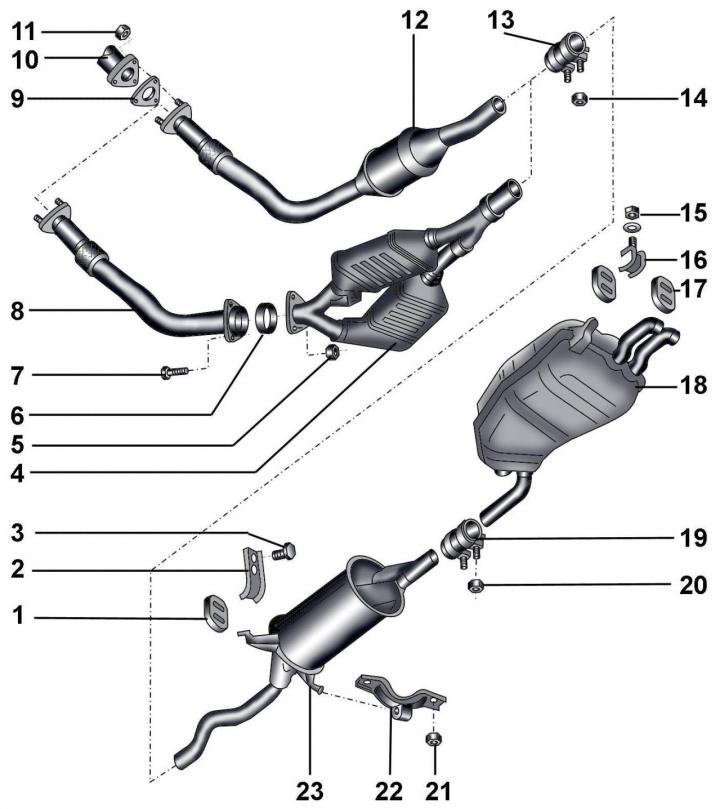
Fig. 5.3–13. Exhaust system of vehicles with diesel engines: 1 – suspension; 2 – bracket; 3 – bolt, 25 Nm; 4 – catalytic converter; 5 – nut, 25 Nm; 6 – gasket; 7 – bolt, 25 Nm; 8 – exhaust inlet pipe; 9 – gasket; 10 – exhaust manifold elbow; 11 – nut, 25 Nm; 12 – exhaust pipe with catalytic converter; 13 – front clamp; 14 – nut, 40 Nm; 15 – nut, 25 Nm; 16 – bracket; 17 – suspension; 18 – rear muffler; 19 – rear clamp; 20 – nut, 40 Nm; 21 – nut, 25 Nm; 22 – suspension; 23 – central muffler
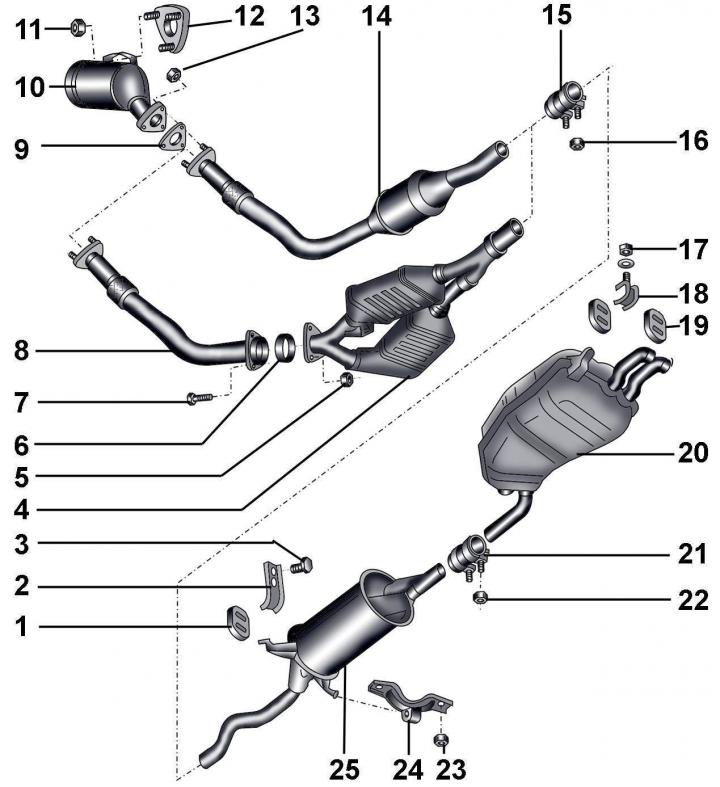
Fig. 5.3–14. Exhaust system of vehicles with diesel engines, two catalytic converters and a turbocharger: 1 – suspension; 2 – bracket; 3 – bolt, 25 Nm; 4 – catalytic converter; 5 – nut, 25 Nm; 6 – gasket; 7 – bolt, 25 Nm; 8 – exhaust inlet pipe; 9 – gasket; 10 – primary neutralizer; 11 – nut, 25 Nm; 12 – turbocharger flange; 13 – nut, 25 Nm; 14 – exhaust pipe with catalytic converter; 15 – front clamp; 16 – nut, 40 Nm; 17 – nut, 40 Nm; 18 – bracket; 19 – suspension; 20 – rear muffler; 21 – rear clamp; 22 – nut, 40 Nm; 23 – nut, 25 Nm; 24 – installation (suspension); 25 – central muffler
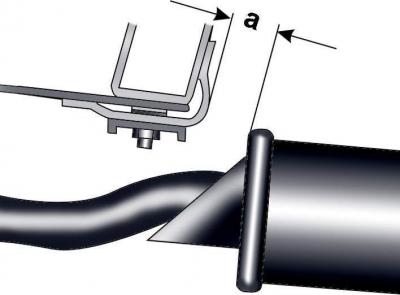
Fig. 5.3–15. Measuring the distance between the central muffler and the cross beam: a = (19±3) mm
When installing the exhaust system, the distance between the central muffler and the cross beam in a free state should be (19±3) mm (Fig. 5.3–15).
The distance between the front pipes of the central muffler and the cross beam in a free state should be 31.5 mm on front-wheel drive vehicles and 29.5 mm on all-wheel drive vehicles.
Connect the new muffler section to the old one and connect them with a clamp, positioning it so that the lower edge of its mounting bolt is located at the level of the muffler pipe.
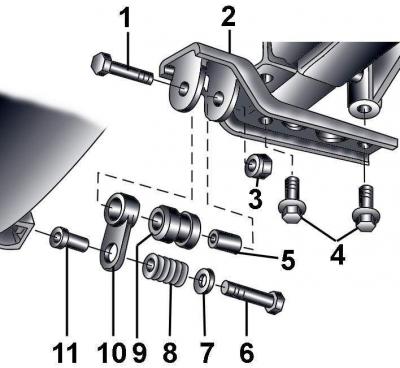
Fig. 5.3–16. Exhaust pipe suspension elements to body elements on front-wheel drive vehicles with a manual transmission: 1 – bolt, 25 Nm; 2 – bracket; 3 – self-locking nut, 25 Nm; 4 – bolts, 25 Nm; 5 – bushing; 6 – bolt, 25 Nm; 7 – plate; 8 – spring; 9 – buffer; 10 – earring; 11 – bushing
Front-wheel drive and all-wheel drive vehicles use different designs of exhaust pipe suspensions to body elements (Fig. 5.3–16, 5.3–17, 5.3–18).
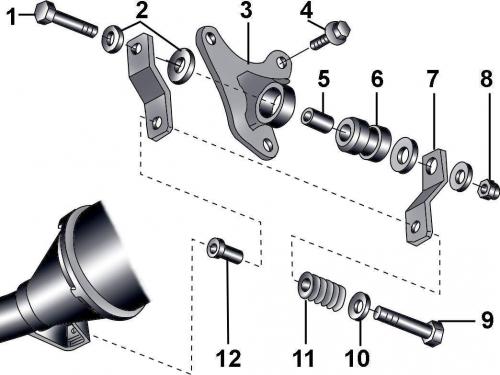
Fig. 5.3–17. Exhaust pipe suspension elements to body elements on front-wheel drive vehicles with automatic transmission: 1 – bolt, 25 Nm; 2 – washers; 3 – bracket; 4 – bolt, 25 Nm; 5 – bushing; 6 – buffer; 7 – earring, 8 – self-locking nut, 25 Nm; 9 – bolt, 25 Nm; 10 – plate; 11 – spring; 12 – bushing
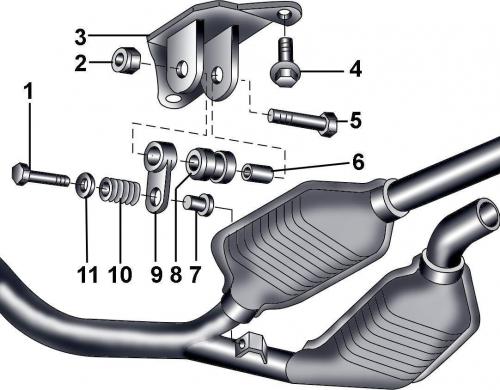
Fig. 5.3–18. Exhaust pipe suspension elements to body elements on all-wheel drive vehicles with automatic transmission: 1 – bolt, 25 Nm; 2 – self-locking nut, 25 Nm; 3 – bracket; 4 – bolt, 25 Nm; 5 – bolt, 25 Nm; 6 – bushing; 7 – bushing; 8 – buffer; 9 – earring; 10 – spring; 11 – washer
The original article is posted on the resource: Audimanual.ru