



Table of contents: Recommendations ↓ Removal the brake line ↓
Recommendations
Brake fluid is poisonous. Therefore, it should not be put into the mouth.
Brake fluid is aggressive towards the bodywork. Do not place rags soaked in brake fluid or tools stained with brake fluid on body parts.
When removing the brake hose or brake pipe, brake fluid gradually flows out of the receiver. You can prevent this as follows: before removing the bolted connections, loosen the bleed valve in the corresponding circuit. Put a hose on it and direct it into some container. Now fully depress the brake pedal and fix it in this position with a suitable board. This will close the drain holes in the main brake cylinder - brake fluid will no longer flow out.
To remove and install the brake line, you will need to get the brake line wrench shown in the illustration below. You will also need an open-end wrench to hold the brake hoses.
After repairing the brake hydraulic system, it must be bled. Often it is enough to bleed only the brake circuit in which the work was carried out.
Removal the brake line
Unscrew the brake pipe union. To do this, hold the opposite connection nut - for example, on the brake hose.
If the nut is rusted to the tube, causing it to rotate with the nut, the tube should be replaced. Thin-walled tubes break quickly.
If the relevant piece of pipe has to be replaced, the following technique can be used to loosen the pipe connection:
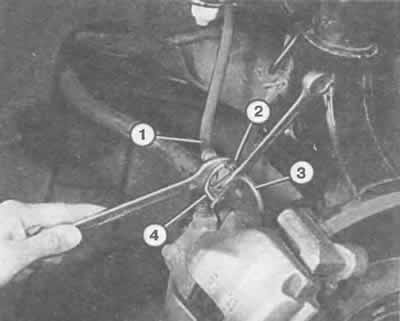
If the brake drive pipeline (3) and brake hoses (1) with stamped fasteners (4) are connected to the chassis elements or the body, then the spring hose holder (2) must not be missing.
In the illustration, the connection is loosened with an open-end wrench and a brake pipe wrench (right).
Removing brake hoses
Cut off the brake pipe near the bolted connection, unscrew the union nut with a hex head.
Insert the brake line into the holders.
Bleed the brake system.
First, unscrew the fitting of the corresponding brake pipe. While doing this, make sure that the pipe does not twist.
If the brake hose is secured to the body using a stamped holder, it is protected from slipping by a sheet bracket. When assembling, it is imperative to install this so-called hose holder.
When installing the hose, it should be tightened first at the end that has an external thread.
Then tighten the other thread.
The brake hose must not be twisted. A colored strip or rubber rim serves as a check.
Bleed the brake system.
Immediately after repair, check whether the hose rubs anywhere during springy movements.
This check should be repeated after a relatively long trip.