
Repair Chevrolet Repair Toyota Repair Honda Repair AvtoVAZ Repair Mercedes-Benz Repair BMW Repair Opel
Home  |  Contacts  |  Sitemap  |    
English Русский
Български
Беларускі
Український
Српски
Hrvatski
Română
Polski
Slovenský
Magyar
AudiManual.ru


  • AUDI 80
  • AUDI 100
  • AUDI A3
  • AUDI A4
  • AUDI A6
  • AUDI A8
  • AUDI Q
  • OTHER
  • ARTICLES
C4 (1990-1994) C4 (1990-1994, petrol) C3 (1982-1990) C3 (1982-1990, petrol) C3 (1982-1990, diesel)

Checking the brake pedal travel (Audi 100 C4)

  • Home
  • Audi 100
  • C4 (1990-1994, petrol)
  • Chassis
  • Brake system
  • Checking the brake pedal travel
            0
Table of contents: TO No.29 ↓ Removal the brake drum ↓ Checking the condition of the brake… ↓ Removal brake pads ↓ Removal the drum brake cylinder ↓

TO No.29


Press the brake pedal with your hand.

Free travel should be a maximum of ⅓ of the total pedal travel.

A longer pedal free play indicates that the brake pads have worn down to their minimum thickness and need to be replaced.

Or the parking brake is not adjusted correctly.

Excessively long pedal travel can also be caused by jammed brake pads or a rusted brake caliper.

There may be air in the brake system.

Removal the brake drum


Remove one wheel bolt.

The brake drum can be removed without removing the wheel. In this case:

Raise the car from behind.

Turn the wheel disc or brake drum so that the hole for the bolt is at the front and top in the direction of the vehicle.

Using a screwdriver, press the adjusting wedge upwards through the bolt hole - this will press the brake pads.

Remove the crown cap of the wheel (see fig. in chapter "Wheels and tires").

Bend and remove the safety pin in the wheel hub bearing.

Remove the crown retainer, unscrew the hex nut, remove the thrust washer and the outer wheel bearing.

Remove the brake drum.

When installing, be sure to adjust the wheel hub bearing play (see chapter "Wheel suspension and steering").

Bring the shoes to the brake drum by pressing the brake pedal hard once.

Tip: If you have an older car and the rusted adjusting wedge cannot be pushed up, have an assistant press the brake pedal while you push the wedge up. Then release the brake pedal and only then remove the screwdriver from the hole, otherwise the wedge will go down again. Make sure that you only press the pedal when both brake drums are installed.


Checking the condition of the brake drums


The friction surface in the drum should be as smooth as possible.

If deep grooves or scratches are visible (due to brake pads worn down to the rivets), the drum can be bored.

The inner diameter of the new brake drums is 230 mm.

After boring, the internal diameter should not be more than 231 mm, otherwise both brake drums must be replaced.

Removal brake pads


Remove the brake drum.

Press the spring plate of the brake shoe holder with pliers, turn it 90° (holding the mounting pin at the back of the shield,

so that it does not rotate together with the shield) and remove them, then remove the springs.

Detach the return spring of the adjusting wedge.
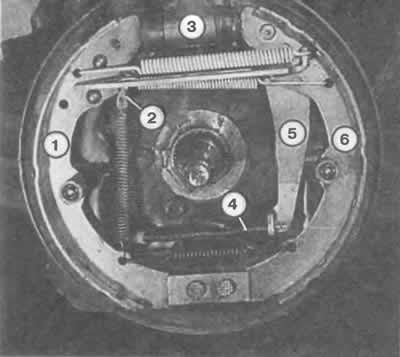
With the brake drum removed, we see the following elements in the rear wheel brake mechanism:

With the brake drum removed, we see the following elements in the rear wheel brake mechanism:
1 - front brake shoe;
2 - adjusting wedge;
3 - wheel brake cylinder;
4 — parking brake cable drive;
5 — parking brake lever;
6 - rear brake shoe.


Separate the brake shoe from the lower support and the brake cylinder piston.

Disconnect the parking brake cable from the removed brake shoes.

Remove the return springs at the top and bottom.


Pull the adjusting wedge out of the push rod.

Unhook the main spring from the top of the pressure rod. If necessary, secure the pressure rod in a vice.

When assembling, secure the pressure bar in a vice.

Attach the main spring to the pressure rod and brake shoe. How to install the spring is shown in the picture above on this and the next page.

Install the brake shoe on the pressure rod, insert the adjusting wedge from above. Its projection is directed towards the brake shoe.

Install the brake lever of the passive shoe into the protrusion of the pressure rod, attach the upper return spring.

With the brake shoes still loose, attach the parking brake cable to the parking brake lever.

Removal the drum brake cylinder


Remove the brake drum.

Remove the brake pads.

Unscrew the bleed valve.

Disconnect the brake hose. If you are not going to install a new brake cylinder right away, you should depress the brake pedal and leave it in this position to prevent unnecessary loss of brake fluid.

Remove the two mounting bolts from the rear of the drum brake shield and remove the brake cylinder.

(Read the original source on the website: AUDImanual)
The article was checked by auto expert Nikita Rudakov
This article is available at russian, bulgarian, belarusian, ukrainian, serbian, croatian, romanian, polish, slovak, hungarian

Share information:
Previous articles
Audi 100 C4: Brake system
Next articles

Measuring drum brake shoes
Drum brake mechanism
Replacing disc brake pads
Checking the condition of brake discs
Rear disc brake mechanism
Measuring the thickness of rear disc brake pads
Parking brake system
Checking the free travel of the parking brake lever


Similar articles on other Audi car models:
Rear Brake Shoes — Checking and Replacing Audi 80 B3 (1986-1991, petrol)
Checking the brake system Audi A3 Type 8L (1996-2003)
Checking the brake system. Adjusting the parking brake Audi A4 B6 (2000-2006)
Checking the front brake linings Audi A6 C4 (1994-1997)
Checking brake hoses Audi A8 D2 (1994-2002)
Checking for leaks by pressing the brake pedal Audi Q5 Type 8R (2008-2017)
Engine — Checking Oil Level Audi A2 (1999-2005)
Link to this page in different formats


Visitor comments

No comments yet


How much will 36 + 27 =


100(C4, 1990-1994) 
  • General information
  • User manual
  • Power unit
  • Engine repair
  • Ignition system
  • Fuel system (gasoline)
  • Fuel system (diesel)
  • Lubrication system
  • Cooling system
  • Exhaust system
  • Transmission
  • Clutch
  • Car gearbox
  • Drive shafts
  • Chassis
  • Car suspension
  • Steering
  • Wheels and tires
  • Brake system
  • Body
  • Ventilation and heating
  • Body repair
  • Electrical equipment
  • Power devices
  • Lighting and appliances
  • Electrical circuits
 
100(C4, 1990-1994, petrol) 
  • General information
  • Operation and maintenance
  • Power unit
  • Engine repair
  • Exhaust system
  • Cooling system
  • Supply system
  • Air filter
  • Mono-Motronic injection system
  • Digifant injection system
  • KE-III-Jetronic and KE-Motronic
  • MPI and MPFI injection system
  • Transmission
  • Clutch
  • Car gearbox
  • Chassis
  • Suspension and steering
  • Brake system
  • Wheels and tires
  • Body
  • Exterior
  • Interior
  • Electrical equipment
  • Fuses and relays
  • Power devices
  • Ignition system
  • Lighting and signaling
  • Equipment and devices
  • Electrical circuits
 
100(C3, 1982-1990) 
  • General information
  • User manual
  • Maintenance
  • Specifications
  • Power unit
  • Engines 4-cylinder
  • Engines 5-cylinder
  • Diesel engine
  • Cooling system
  • Power system (carburetor)
  • Power system (injector)
  • Fuel system (diesel)
  • Transistor ignition system
  • Electronic ignition system
  • Transmission
  • Clutch
  • 4 speed gearbox 014
  • 5 speed gearbox 013 and 093
  • 5 speed gearbox 016 and 012
  • Shift mechanism KP 016
  • Automatic transmission
  • Front wheel drive
  • Chassis
  • Front suspension
  • Rear suspension
  • Steering
  • Brake system
  • Body
  • Body elements
  • Electrical equipment
  • Lighting and appliances
  • Power devices
  • Electrical circuits
 
100(C3, 1982-1990, petrol) 
  • General information
  • Maintenance and operation
  • 4 cylinder engine
  • Engine repair
  • Cooling and lubrication system
  • Supply system
  • Ignition system
  • 5 cylinder engine
  • Engine repair
  • Cooling and lubrication system
  • Supply system
  • Ignition system
  • Transmission
  • Clutch and drive shafts
  • 4 speed gearbox 014
  • 5 speed gearbox 013 and 093
  • 5 speed gearbox 016 and 012
  • Automatic gearbox
  • Chassis
  • Steering
  • Front suspension
  • Rear suspension
  • Brake system
  • Body
  • Body elements
  • Doors, locks and windows
  • Body repair
  • Electrical equipment
  • Equipment and devices
  • Power devices
  • Electrical circuits
 
100(C3, 1982-1990, diesel) 
  • General information
  • User manual
  • Maintenance
  • Troubleshooting
  • Power unit
  • Engine in a car
  • Engine removed
  • Cooling system
  • Fuel system
  • Exhaust system
  • Starting and charging
  • Preheating
  • Transmission
  • Clutch
  • Mechanical gearbox
  • Automatic gearbox
  • Drive shafts
  • Chassis
  • Brake system
  • Suspension
  • Steering
  • Body
  • Exterior
  • Interior
  • Electrical equipment
  • Equipment and devices
  • Electrical circuits
 
AudiManual.ru © 2017-2026 · Mobile version · Feedback · Sitemap: EN BG BY UA RS HR RO PL SK HU · Site search · News and articles
80 B2 · 80 B3 petrol · 80 B3 · 80 B4 · 100 C3 diesel · 100 C3 petrol · 100 C3 · 100 C4 petrol · 100 C4 · A3 Type 8L · A4 B5 petrol · A4 B5 · A4 B6 petrol · A4 B6 · A4 B7 · A4 B8 · A6 C4 · A6 C5 · A6 C5 Allroad · A8 D2 · Q5 Type 8R · Q7 Typ 4L · Audi A2 ·
This site uses cookies 🍪. Click the button to accept this fact.