



TO No.37
The front wheels move on double-row ball bearings. At the rear, front-wheel drive models have radial-thrust tapered roller bearings. All-wheel drive vehicles have the same ball bearings at the rear as at the front. They are installed on consistent grease and usually last much longer than 100,000 km. Defective bearings attract attention by noise when driving. While driving, it is difficult to determine which bearing is faulty. You can find a faulty bearing with the car raised and the wheels rotated manually. A wheel with damaged bearings rotates with a crunching sound and unevenly.
Dust covers are checked in the same way as the tie rod joints.
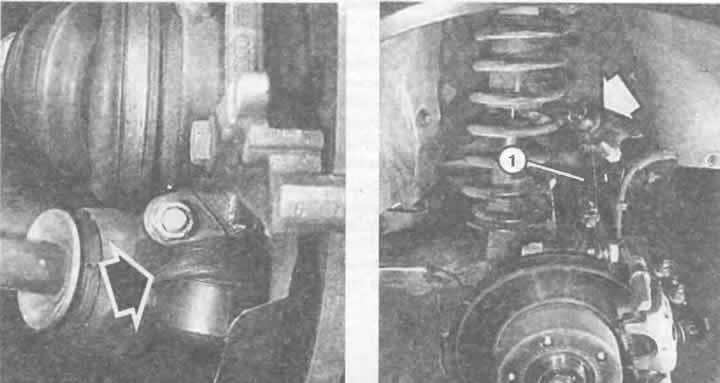
Left: Shown here is the front axle joint at the bottom of the wheel bearing housing.
Right: The illustration shows the rear axle in all-wheel drive vehicles. Here the joint (arrow) is located on the inside of the upper wishbone (1).
Try to swing one after another the wheels firmly on the ground relative to their vertical axis.
If the bearings are in good condition, there should be virtually no play.
If the play is noticeable, press the brake pedal and rock the wheel again: if there is no more play, then the reason is in the bearing.
If there is still play, the wheel suspension needs to be checked.
Now you need to lift the car and turn the wheel: if it moves with difficulty or jerks, then the bearing is installed too tightly. If you clearly hear a grinding sound, you need to replace the bearing.
Hint: The rear wheel bearings on front-wheel drive models are adjustable. The rear bearings on all-wheel drive models, as well as the bearings on all front wheels, are not adjustable.
[This publication is borrowed from the resource: AudiManual.ru]