



Table of contents: Signs of a problem with the brake… ↓ Brake lines and hoses ↓ Checking the thickness of brake pads ↓ Checking and running in the parking… ↓ Break-in of the brake ↓
Warning: Dust from lining wear that collects on brake components may contain asbestos, which is hazardous to health. Do not blow out this dust with compressed air or inhale it! Do not use gasoline-based solvents to remove dust. Dust should be washed off with a special brake system cleaner or methylated spirits into a drain container. After wiping the brake components with a damp cloth, keep the cloth and the contents of the drain container in a closed and labeled container. In the future, try to use asbestos-free components whenever possible.
Warning: In addition to checking at specified intervals, the brake system condition should be checked whenever the wheels are removed or when the system shows signs of malfunction. The following brake system checks are the most important of all the vehicle maintenance procedures you will perform to ensure safe driving.
Signs of a problem with the brake system
Disc brakes may have built-in friction lining wear indicators that signal that the lining wear has reached a critical level. In this case, the linings should be replaced immediately, otherwise the brake discs will be damaged and will require expensive repairs.
Any of the following symptoms may indicate a potential brake system defect:
1. When you press the brake pedal, the car "pulls" to one side.
2. The brake mechanisms make scraping or squealing sounds when braking.
3. The brake pedal has excessive travel.
4. The brake pedal pulsates (this is normal only when the ABS system is working).
5. Brake fluid leaks are observed (usually on the inside of a tire or wheel).
If you notice any of these signs, inspect the brake system components immediately.
Brake lines and hoses
Warning: The brake system uses mostly steel brake lines, with the exception of flexible reinforced hoses at the front wheels and as connections at the rear axle. Regular inspection of all these lines is very important.
1. Jack up the car and securely place it on supports.
2. Remove the wheels (refer to Section Checking the condition of tires and pressure in them. Designation of tires and wheel disks. Rotation and replacement of wheels and the materials of the chapter Controls and safe operation techniques).
3. Check all brake lines and hoses for cracks, chafing in their outer coating, leaks, bulges, and deformations. Check the brake hoses at the front and rear of the vehicle for signs of softening, cracks, deformation, or wear due to friction with other components. Check all fittings for signs of leaks and make sure that all bolts and clamps on the brake hoses are securely fastened.
4. Bend the brake hose in both directions with your hands to identify damage. Do not twist the hoses. Follow the direction of the color line on the hose!
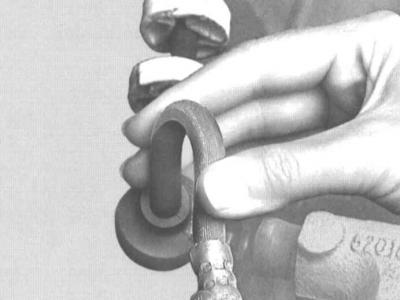
5. Turn the steering wheel to the right and left until it stops. The hoses should not touch the vehicle's structural elements. If any fluid leaks or damage are detected, they should be repaired immediately. For a more detailed description of the brake system repair procedure, refer to Chapter Brake system.
Checking the thickness of brake pads
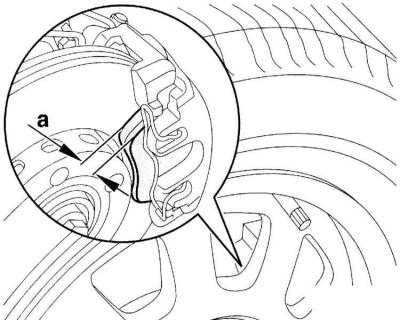
Checking the thickness of the front brake pads
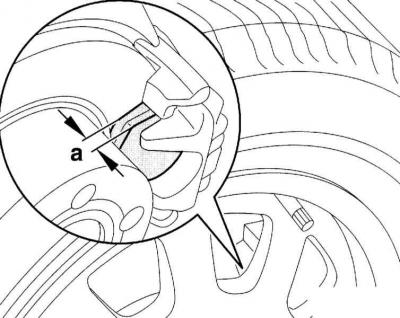
Checking the thickness of the rear brake pads
The thickness of the outer brake pads can be checked through the opening in the wheel rim using a flashlight. The inner pad can be checked using a flashlight and a mirror. If you need to estimate the pad thickness more accurately, remove the wheel and measure the pad with a caliper.
Warning: Experience shows that the brake pad wear on the front passenger side wheel is greater than that on the driver side. Therefore, it is recommended to remove the front passenger side wheel to check the brake pad thickness.
1. Mark the position of the front wheel in relation to the hub with paint. This will allow the balanced wheel to be installed in its working position. Loosen the wheel mounting bolts. The car must be on the ground.
2. Raise the front of the car and place it on stands. Remove the front wheel.
3. Thickness (arrows in the illustration) check the inner and outer pads through the opening in the caliper.
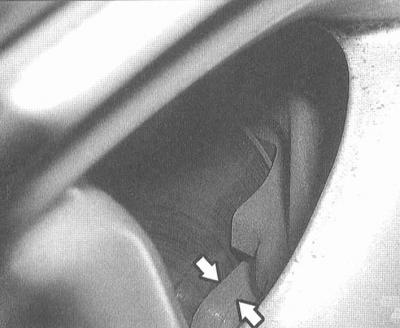
4. The wear limit of the brake pad thickness is reached if the pad lining has a thickness of 2.0 mm (7mm with base plate). In this case the brake pad needs to be replaced, refer to Sections Removal and installation front brake pads and Removal and installation rear wheel brake pads.
Warning: In practice, 1 mm of brake pad wear corresponds to at least 1000 km of vehicle mileage. This rule corresponds to unfavorable vehicle operating conditions. Under normal conditions, pad wear is significantly less. With a pad thickness of 10.0 mm (with base plate) the pad can still be used for at least 3000 km.
5. Check for possible brake fluid leakage in the calipers. If there is a leak, repair the caliper immediately (work of the service station).
6. Visually inspect the brake discs for grooves, traces of corrosion and cracks. Ventilated discs with hairline cracks up to 25 mm long, which may be caused by increased load, do not need to be replaced. If cracks and grooves are deeper than 0.5 mm, the brake discs must be replaced.
7. Check the thickness of the brake discs, refer to Section Chapter Brake system.
8. Install the front wheels so that the marks made during removal match. Pre-lubricate the centering belt of the wheel disk on the hub with a thin layer of bearing grease. Do not lubricate the wheel mounting bolts. Replace rusty bolts. Tighten the bolts. Lower the car onto the wheels and tighten the bolts crosswise.
Checking and running in the parking brake
1. Drive your car and stop it on a road with light traffic.
2. Pull the parking brake lever 3 notches and release the foot brake.
3. The parking brake is effective enough if the vehicle is held securely.
Caution: If the parking brake is pressed further than 5 teeth, the brake needs to be adjusted.
Break-in of the brake
The parking brake is provided by 2 drum brakes located in the rear disc brakes. This ensures that the parking brake wears only slightly. The braking torque may decrease due to corrosion of the brake drum or contamination of the brake shoes. To achieve optimum performance, the brake must be run in.
1. Drive on a dry, lightly trafficked road.
2. At a speed of about 50 km/h, set the gearbox to neutral. Pull the parking brake handle. This will stop the car. When braking with the parking brake, the brake light does not come on. For this reason, be especially careful of the traffic behind you.
3. Continue driving the vehicle at a constant speed of approximately 50 km/h.
4. Pull the parking brake handle for about 10 seconds and release.
Warning: If the parking brake does not engage properly, repeat the braking process after it has cooled.
5. If the parking brake releases poorly after checking or tightens on one side after running-in and adjustment, check the brake pads and cables and replace if necessary.