
Repair Chevrolet Repair Toyota Repair Honda Repair AvtoVAZ Repair Mercedes-Benz Repair BMW Repair Opel
Home  |  Contacts  |  Sitemap  |    
English Русский
Български
Беларускі
Український
Српски
Hrvatski
Română
Polski
Slovenský
Magyar
AudiManual.ru


  • AUDI 80
  • AUDI 100
  • AUDI A3
  • AUDI A4
  • AUDI A6
  • AUDI A8
  • AUDI Q
  • OTHER
  • ARTICLES
B8 (2007-2015) B7 (2004-2008) B6 (2000-2006) B6 (2000-2006, petrol) B5 (1994-2001) B5 (1994-2001, petrol)

Changing engine oil and oil filter (Audi A4 B6)

  • Home
  • Audi A4
  • B6 (2000-2006)
  • General information
  • Maintenance
  • Changing engine oil and oil filter
            0
Table of contents: Necessary tool ↓ Necessary spare parts and consumables ↓ Oil filter ↓ Removal engine oil ↓ Replacing the oil filter ↓ Gasoline engine ↓ Diesel engine 1.9 l ↓ Diesel engine 2.5 l ↓ Filling the system with engine oil ↓
Warning: Prolonged skin contact with used engine oil is quite dangerous. Use barrier cream and wear gloves during this procedure. Change oil-soaked clothing immediately.


Warning: Frequent engine oil changes are the most important preventative maintenance procedure available to the amateur mechanic. Over time, oil is susceptible to dilution and contamination, leading to premature engine wear.


Engine oil can be pumped out using a special probe (available at gas stations) through the oil dipstick tube. After this, it is usually necessary to fill the system with oil.

Do not dispose of used oil with household waste or in any other way. This may cause environmental pollution.

When changing the oil, it is advisable to attach a tag to the engine with the oil brand and its viscosity.

The use of oils of different types has an adverse effect on engine operation. It is also not recommended to mix different brands of oils. Engine oils of the same type and brand, but of different viscosity, can be mixed if necessary, particularly in the off-season.

Necessary tool


  • Inspection pit or hydraulic lift with supports (if the oil is not sucked out).
  • Head for unscrewing the drain plug.
  • Special tool for unscrewing the filter (filter wrench, strap wrench or tool HAZET 2171-1).
  • oil collection container (if the oil is not sucked out) capacity of at least 6 liters.


Necessary spare parts and consumables


  • Only if oil is not sucked out: aluminum or copper sealing ring for drain plug (sometimes supplied with an oil filter).
  • Oil filter.
  • For the required amount of engine oil approved by the manufacturer, please refer to Specifications.

Oil filter


There are filters with replaceable paper elements on sale. Their advantage is that only the filter element is subject to replacement.
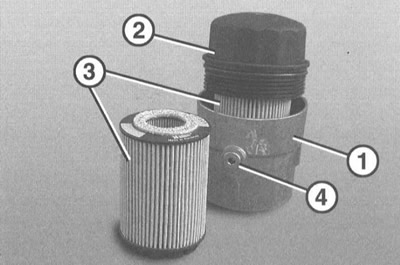
There are filters with replaceable paper elements on sale. Their advantage is that only the filter…


The oil filter consists of a housing (1), a cover (2) and a filter element (3). The oil filter housing is bolted to the cylinder block instead of the previous oil cartridge. Depending on the manufacturer, there may be a drain plug (4) on the filter housing. Filter elements from different manufacturers are interchangeable regardless of the cartridge used.

Removal engine oil


Engine oil can be removed by suction, through the dipstick hole, or drained from the oil pan.

A suitable pump is required for suction, and care must be taken to ensure that the hose fits the opening and is long enough.

1. Diesel engine: Unscrew the cap on the filter housing so that the oil can drain from the filter housing into the pan.


2. Suck out or drain the oil. To do this, lift and place the car horizontally on stands or place the car over an inspection pit.

3. Remove the lower engine compartment cover, refer to Section Removal and installation the upper engine cover/lower engine compartment protection/subframe.

4. Place a container for used oil under the drain plug. Make sure that hot oil does not get on your hands when unscrewing the drain plug. Therefore, keep your hand horizontal when unscrewing the plug.

5. – Remove the drain plug (1) from the oil pan (2) and completely drain the used oil.
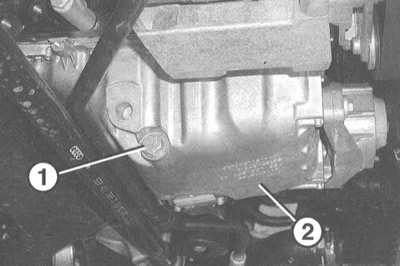
– Remove the drain plug (1) from the oil pan (2) and completely drain the used oil.


Caution: If the used oil contains large amounts of metal shavings and wear products, this indicates the presence of scoring, for example, in the crankshaft bearings and connecting rod bearings. To avoid unwanted consequences of repair, it is necessary to thoroughly clean the oil passages and hoses. In addition, it is necessary to clean the oil cooler, if there is one.


6. Finally, tighten the drain plug with a new sealing ring. Do not exceed the specified tightening torque, otherwise it may cause leakage and damage.

7. Lower the car onto its wheels.


Replacing the oil filter


Warning: Used filters or filter elements are special materials and must be disposed of in a special manner.


Gasoline engine


1. Disconnect the oil filter. Special tools are available for this, such as a strap wrench or the HAZET 2171-1 tool. Wipe off any leaked oil with a rag. The accompanying illustration shows the oil filter of a 4-cylinder engine.
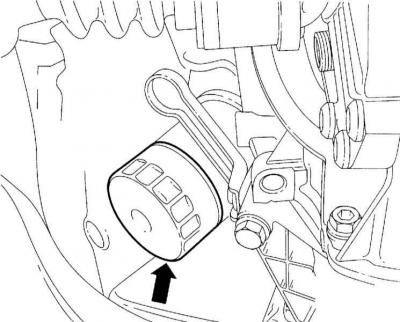
1. Disconnect the oil filter. Special tools are available for this, such as a strap wrench or the…


2. Clean the oil filter flange on the cylinder block with fuel. Remove any remaining sealing gasket.

3. Lubricate the rubber sealing ring on the new filter with a thin layer of clean engine oil.

4. Tighten the new oil filter by hand. When the seal is seated against the cylinder block, turn the filter an additional 1/2 turn. If there are instructions on the filter housing, follow them.

2.4, 3.0 L engines: After replacing the oil filter cartridge, check that the hoses from the oil cooler to adjacent parts pass freely and, if necessary, adjust the position of the oil cooler.

Diesel engine 1.9 l


1. Unscrew the cover using a filter wrench, for example HAZET 2169 or VW/AUDI-3417.
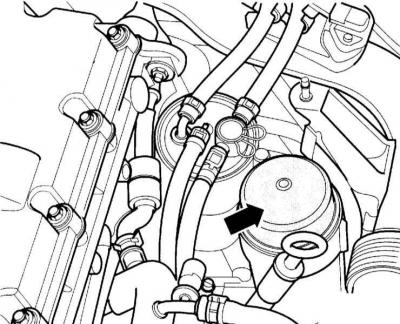
1. Unscrew the cover using a filter wrench, for example HAZET 2169 or VW/AUDI-3417.


2. Replace the sealing rings and filter element.


3. Tighten the cap with a filter wrench to the torque 25Nm.

Diesel engine 2.5 l


1. Unscrew the filter cover (1) using a 32 mm filter wrench, e.g. HAZET 2169-2. Replace the filter element (3) and the sealing ring (2) on the filter cover.
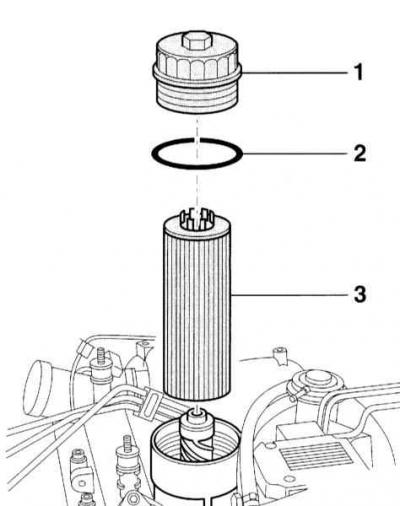
1. Unscrew the filter cover (1) using a 32 mm filter wrench, e.g. HAZET 2169-2. Replace the filter…


2. Screw the filter cover onto the housing and tighten it with torque 25Nm.

3. Reinstall the engine top cover, refer to Section Removal and installation the upper engine cover/lower engine compartment protection/subframe.

Filling the system with engine oil


Warning: When starting a diesel engine for the first time after changing the oil, make sure that the engine initially only runs at idle speed until the oil pressure control lamp goes out. Only then will the oil pressure reach its full value and you can give the engine gas. If you give gas when the pressure control lamp is on, the turbocharger may be damaged due to insufficient lubrication.


1. Open the cover (1) and fill in new oil through the filler nipple of the cylinder head cover.
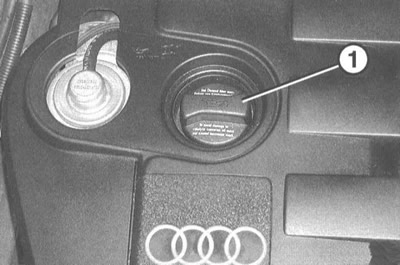
1. Open the cover (1) and fill in new oil through the filler nipple of the cylinder head cover.


Warning: It is recommended to first pour in 0.5 l less oil than the required volume, start the engine, warm it up and after a few minutes check the oil level with the indicator. If necessary, add oil. Excess oil should be sucked out, otherwise the engine seals and catalytic converter may be damaged.


2. The oil level is normal if it is in range (B). If the oil level is in range (C), oil must be added to the level of range (B). The accompanying illustration shows various versions of level indicators used in AUDI A4 engines. If the oil is in range (A), it should not be added.
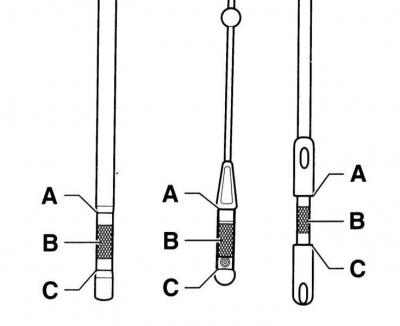
2. The oil level is normal if it is in range (B). If the oil level is in range (C), oil must be…


3. Drive the car and check the tightness of the drain plug and oil filter, if necessary, carefully tighten the plug.

4. After 3 minutes from stopping the engine, check the oil level again and adjust if necessary.

5. Install the lower engine compartment cover, refer to Section Removal and installation the upper engine cover/lower engine compartment protection/subframe.
The article was checked by auto expert Elisey Ermolaev
This article is available at russian, bulgarian, belarusian, ukrainian, serbian, croatian, romanian, polish, slovak, hungarian

Share information:
Previous articles
Audi A4 B6: Maintenance
Next articles

Checking the condition of tires and pressure in them.…
Checking fluid levels, leak control
General information about the setup
Schedule of current maintenance
Checking the brake system. Adjusting the parking brake
Checking the fuel system
Checking the condition and replacing engine compartment hoses,…
Checking the condition of the ribbed belts of the serpentine…


Similar articles on other Audi car models:
Changing engine oil and oil filter Audi 80 B3 (1986-1991)
Changing engine oil and oil filter Audi 100 C4 (1990-1994, petrol)
Changing engine oil and oil filter Audi A3 Type 8L (1996-2003)
Changing engine oil and filter Audi A6 C4 (1994-1997)
Draining water from the fuel filter of a V6 TDI diesel engine Audi A8 D2 (1994-2002)
Changing engine oil and oil filter Audi Q7 Typ 4L (2005-2015, diesel)
Engine oil — draining or pumping out, replacing the oil filter Audi A2 (1999-2005)
Link to this page in different formats


Visitor comments

No comments yet


How much will 11 + 24 =


A4(B8, 2007-2015) 
  • General information
  • Operating instructions
  • Power unit
  • Petrol engines 1.8 l
  • Petrol engines 1.8/2.0 l
  • Petrol engines 3.0 l
  • Petrol engines 3.2 l
  • Fuel system (petrol)
  • Diesel engines 2.0 l (CA*)
  • Diesel engines 2.0 l (CJCB)
  • Diesel engines 2.7/3.0 l
  • Diesel engines 3.0 l
  • Fuel system (diesel)
  • Transmission
  • Manual gearbox 0B1
  • Manual gearbox 0B2
  • Manual gearbox 0B3
  • Manual gearbox 0B4
  • Automatic transmission 0B5
  • Automatic transmission 0B6
  • Automatic transmission 0AW
  • All-wheel drive system
  • Chassis
  • Front suspension
  • Rear suspension
  • Brake system
  • Steering system
  • Body
  • Exterior
  • Interior
  • Seats
  • Doors, locks and windows
  • Security system
  • Heating and air conditioning
  • Electrical equipment
  • Audio system
  • Power devices
  • Equipment and devices
  • Lighting and lamps
  • Electrical circuits
 
A4(B7, 2004-2008) 
  • General information
  • Introduction to manual
  • Troubleshooting
  • Operating instructions
  • Maintenance
  • Power unit
  • Petrol engines 2.0 (ALT)
  • Petrol engines 2.0 (TFSI)
  • Petrol engines 1.8 (MPI)
  • Diesel engines
  • Cooling system
  • Air conditioner
  • Fuel and exhaust system
  • Ignition system
  • Starting and charging
  • Transmission
  • Clutch
  • Manual gearbox
  • Automatic gearbox
  • Drive shafts
  • Chassis
  • Brake system
  • Front suspension
  • Rear suspension
  • Steering
  • Body
  • Exterior
  • Interior
  • Electrical equipment
  • Equipment and devices
  • Lighting and signaling
  • Windscreen wipers and washers
  • Electrical diagrams
  • Electrical diagrams (since 2007)
 
A4(B6, 2000-2006) 
  • General information
  • Vehicle Description
  • User manual
  • Maintenance
  • Power unit
  • Gasoline engine
  • Diesel engine
  • Lubrication system
  • Cooling system
  • Supply system
  • Injection system
  • Exhaust system
  • Ignition and control
  • Transmission
  • Gear box
  • Clutch and drive shafts
  • Chassis
  • Brake system
  • Car suspension
  • Steering
  • Body
  • Heating and ventilation
  • Exterior (external elements)
  • Interior (internal elements)
  • Electrical equipment
  • Power devices
  • Lighting and appliances
  • Electrical circuits
 
A4(B6, 2000-2006, petrol) 
  • General information
  • Introduction to the guide
  • Car care
  • Power unit
  • Engine repair
  • Lubrication system
  • Cooling system
  • Injection and control system
  • Ignition system
  • Power and exhaust system
  • Transmission
  • Clutch and drive shafts
  • Car gearbox
  • Chassis
  • Suspension and wheels
  • Steering
  • Brake system
  • Body
  • Interior
  • Exterior
  • Electrical equipment
  • Equipment and devices
  • Lighting and signaling
  • Power devices
  • Electrical circuits
 
A4(B5, 1994-2001) 
  • General information
  • Introduction to the guide
  • Car care
  • Maintenance (gasoline)
  • Maintenance (diesel)
  • Power unit
  • Gasoline engines
  • Diesel engines
  • Engine overhaul
  • Cooling system
  • Fuel injection (gasoline)
  • Fuel system (diesel)
  • Exhaust system
  • Ignition system
  • Transmission
  • Clutch
  • Mechanical gearbox
  • Automatic gearbox
  • Drive shafts
  • Chassis
  • Brake system
  • Car suspension
  • Steering
  • Body
  • Exterior
  • Interior
  • Doors, locks and windows
  • Heating and ventilation
  • Electrical equipment
  • Power devices
  • Equipment and devices
  • Electrical circuits
 
A4(B5, 1994-2001, petrol) 
  • General information
  • Vehicle description
  • Maintenance
  • Power unit
  • Engine repair
  • Turbocharging
  • Exhaust system
  • Cooling system
  • Ignition system
  • Fuel system
  • Motronic injection system
  • MPI and MPFI injection system
  • Transmission
  • Clutch
  • Gearbox and shafts
  • Chassis
  • Steering
  • Car suspension
  • Brake system
  • Wheels and tires
  • Body
  • Heating and ventilation
  • Body parts
  • Electrical equipment
  • Fuses and relays
  • Power devices
  • Lighting and lamps
  • Tools and devices
  • Electrical circuits
 
AudiManual.ru © 2017-2026 · Mobile version · Feedback · Sitemap: EN BG BY UA RS HR RO PL SK HU · Site search · News and articles
80 B2 · 80 B3 petrol · 80 B3 · 80 B4 · 100 C3 diesel · 100 C3 petrol · 100 C3 · 100 C4 petrol · 100 C4 · A3 Type 8L · A4 B5 petrol · A4 B5 · A4 B6 petrol · A4 B6 · A4 B7 · A4 B8 · A6 C4 · A6 C5 · A6 C5 Allroad · A8 D2 · Q5 Type 8R · Q7 Typ 4L · Audi A2 ·
This site uses cookies 🍪. Click the button to accept this fact.