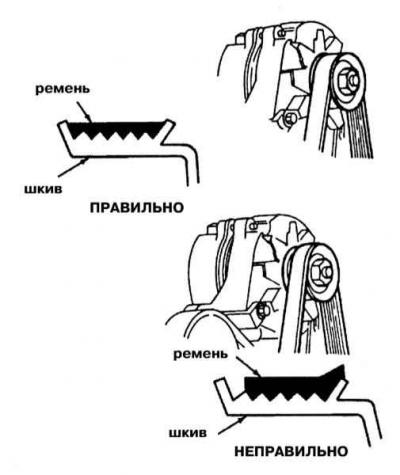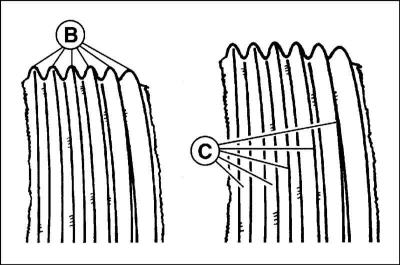
Wear of the edges of the ribbed belt
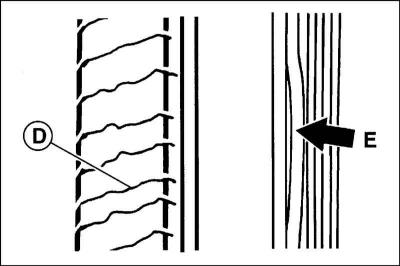
Transverse cracks D on the back side of the belt and delamination of the ribs E of the ribbed belt
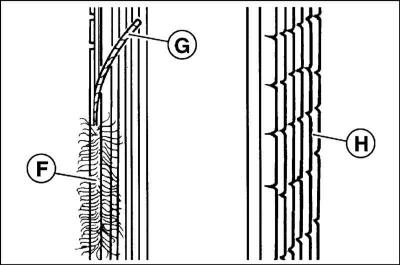
Fraying of the side ribs F, cracks H and delamination of the side ribs G
1. It is necessary to periodically check the condition of the belt, and if defects are found, replace the belt.
2. The belt tension is carried out by an automatic tensioner and does not require checking.
3. Turn off the engine, set the transmission to neutral. Raise and place the car on stands.
4. Mark the belt with chalk in a clearly visible place.
5. Turn the engine by the crankshaft pulley in the direction of rotation until the chalk mark is visible. Inspect the belt section by section.
6. With fingers (and using a flashlight if necessary) walk the entire length of the belt, feeling for cracks and delamination. Also check for abrasions and polished areas. The belt should be inspected from both sides, which means twisting it to check the condition of the reverse side. At the same time, check for rust, cracks and burrs on the pulleys. Shallow perpendicular cracks are allowed on the working surface of the belt. If these cracks do not extend beyond the boundaries of one rib and are not very deep, there is no need to replace the belt.
7. The belt tension is checked by pressing firmly on it with your thumb and determining the degree of its deflection. Measure the amount of deflection with a ruler. If the distance between the pulley centers is from 180 to 280 mm, then the deflection value should be equal to 6 mm. If the distance between the pulley centers is within the range between 300 and 400 mm, the deflection should be 13 mm.
8. If one or more of the above damages are present, the V-belt must be replaced with a new one.
9. Place the belt on the pulleys correctly - it should be exactly in the center of the pulley. Even a short-term operation of an incorrectly installed belt can lead to its damage.