Repair Chevrolet Repair Toyota Repair Honda Repair AvtoVAZ Repair Mercedes-Benz Repair BMW Repair Opel
Home  |  Contacts  |  Sitemap  |    
English Русский
Български
Беларускі
Український
Српски
Hrvatski
Română
Polski
Slovenský
Magyar
AudiManual.ru


  • AUDI 80
  • AUDI 100
  • AUDI A3
  • AUDI A4
  • AUDI A6
  • AUDI A8
  • AUDI Q
  • OTHER
  • ARTICLES
Type 8L (1996-2003)

Checking the condition of ribbed drive belts (Audi A3 8L)

  • Home
  • Audi A3
  • Type 8L (1996-2003)
  • General information
  • Maintenance
  • Checking the condition of ribbed drive belts
            0
1. The ribbed belt tension is automatic. It is necessary to periodically check the condition of the belt, and if defects are found, replace the belt.

2. Drive belts, sometimes called V-belts or simply fan belts, are located at the front of the engine and play a vital role in the operation of the vehicle and its individual components. Due to the nature of the material and operating conditions, drive belts wear out over time and should therefore be checked periodically and the tension adjusted to avoid serious engine damage.

3. Drive belts are used to drive the alternator, steering pump, water pump, and air conditioning compressor. Depending on the arrangement of the pulleys, a single belt can drive several components at once.

4. Turn off the engine, set the manual transmission to neutral. Raise and place the car on stands.
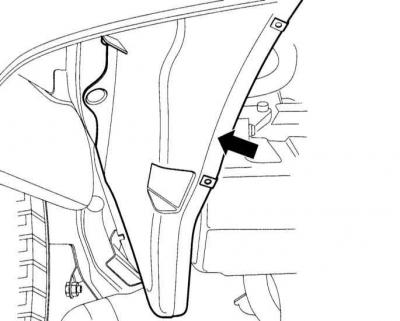
4. Turn off the engine, set the manual transmission to neutral. Raise and place the car on stands.


5. Remove the lower engine compartment cover, refer to subsection Removal and installation the lower engine compartment cover.
5. Remove the lower engine compartment cover, refer to subsection Removal and installation the…


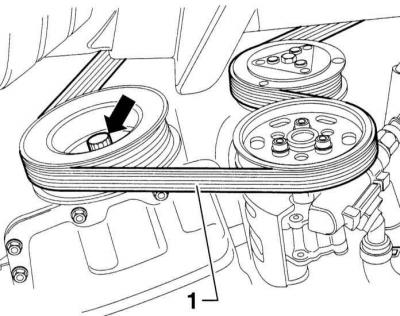
6. Mark the belt –1– with chalk in a clearly visible place.


7. From the bottom of the engine, use the head to turn the engine by the crankshaft pulley in the direction of rotation, i.e. to the right, so that the chalk marking is visible. In this case, inspect the belt section by section.
7. From the bottom of the engine, use the head to turn the engine by the crankshaft pulley in the…


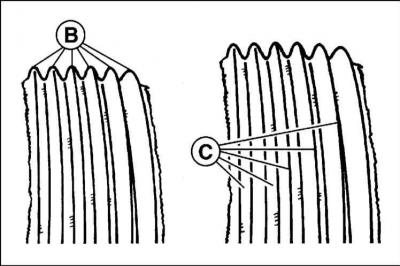
Wear of the edges of the ribbed belt

Wear of the edges of the ribbed belt


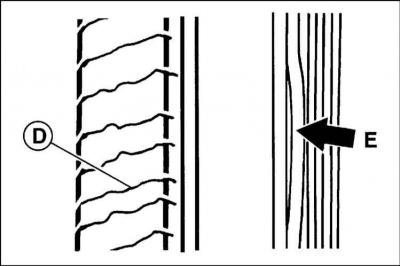
Transverse cracks D on the back side of the belt and delamination of the ribs E of the ribbed belt
Transverse cracks D on the back side of the belt and delamination of the ribs E of the ribbed belt


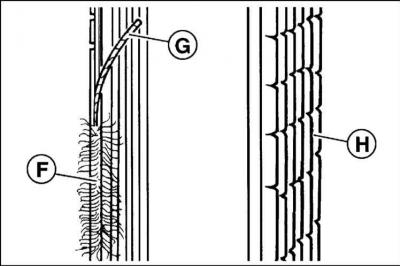
Fraying of the side ribs F, cracks H and delamination of the side ribs G


Fraying of the side ribs F, cracks H and delamination of the side ribs G


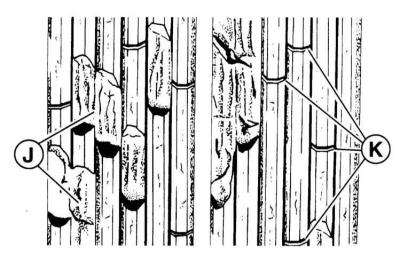
J rib detachment, K cracks

8. With fingers (and using a flashlight if necessary) walk the entire length of the belt, feeling for cracks and delamination. Also check for any abrasions or polished areas. The belt should be inspected from both sides, which means twisting it to check the condition of the reverse side.

9. Belt tension is checked by pressing firmly with your thumb and determining the degree of deflection. Measure the deflection with a ruler. If the distance between the pulley centers is between 180 and 280 mm, the deflection should be 6 mm. If the distance between the pulley centers is between 300 and 400 mm, the deflection should be 13 mm.

10. If one or more of the above damages are present, the V-belt must be replaced with a new one, and refer to the subsections Removal and installation a ribbed V-belt and Removal and installation the V-belt.

11. Replace the engine compartment side cover.

The original version of the article is posted on the website AUDIMANUAL
The article was checked by auto expert Nikita Rudakov
This article is available at russian, bulgarian, belarusian, ukrainian, serbian, croatian, romanian, polish, slovak, hungarian

Share information:
Previous articles
Audi A3 Type 8L: Maintenance
Next articles

Changing the oil in the Haldex clutch of all-wheel drive models
Checking the automatic transmission final drive fluid level
Checking the power steering fluid level
Replacing the fuel filter of a diesel engine
Checking the AT transmission fluid level


Similar articles on other Audi car models:
V-belt/ribbed belt — checking condition and tension Audi 80 B4 (1991-1996)
Checking the oil level in the rear axle drive Audi 100 C4 (1990-1994, petrol)
Checking the condition of the ribbed belts of the serpentine… Audi A4 B6 (2000-2006)
Checking the condition of seat belts Audi A6 C5 (1997-2004)
Checking the condition of the poly V-belt Audi A8 D2 (1994-2002)
Checking the condition of drive belts Audi Q7 Typ 4L (2005-2015, diesel)
Poly V-belt — checking condition (petrol engines) Audi A2 (1999-2005)
Link to this page in different formats


Visitor comments

No comments yet


How much will 30 + 17 =


A3(8L, 1996-2003) 
  • General information
  • User manual
  • Maintenance
  • Power unit
  • Engine repair
  • Lubrication system
  • Cooling system
  • Supply system
  • Fuel injection system
  • Exhaust system
  • Ignition system
  • Transmission
  • Manual transmission
  • Automatic transmission
  • Clutch and drive shafts
  • Chassis
  • Brake system
  • Front suspension
  • Rear suspension
  • Steering
  • Body
  • Ventilation and heating
  • Exterior (external elements)
  • Interior (internal elements)
  • Doors, covers and windows
  • Electrical equipment
  • Power devices
  • Lighting and appliances
  • Electrical circuits
 
AudiManual.ru © 2017-2026 · Mobile version · Feedback · Sitemap: EN BG BY UA RS HR RO PL SK HU · Site search · News and articles
80 B2 · 80 B3 petrol · 80 B3 · 80 B4 · 100 C3 diesel · 100 C3 petrol · 100 C3 · 100 C4 petrol · 100 C4 · A3 Type 8L · A4 B5 petrol · A4 B5 · A4 B6 petrol · A4 B6 · A4 B7 · A4 B8 · A6 C4 · A6 C5 · A6 C5 Allroad · A8 D2 · Q5 Type 8R · Q7 Typ 4L · Audi A2 ·
This site uses cookies 🍪. Click the button to accept this fact.