
Repair Chevrolet Repair Toyota Repair Honda Repair AvtoVAZ Repair Mercedes-Benz Repair BMW Repair Opel
Home  |  Contacts  |  Sitemap  |    
English Русский
Български
Беларускі
Український
Српски
Hrvatski
Română
Polski
Slovenský
Magyar
AudiManual.ru


  • AUDI 80
  • AUDI 100
  • AUDI A3
  • AUDI A4
  • AUDI A6
  • AUDI A8
  • AUDI Q
  • OTHER
  • ARTICLES
Q7 Typ 4L (2005-2015, diesel) Q5 Type 8R (2008-2017)

Checking the condition of drive belts (Audi Q7-4L-D)

  • Home
  • Audi Q
  • Q7 Typ 4L (2005-2015, diesel)
  • General information
  • Maintenance
  • Checking the condition of drive belts
            0
Note: Replacement of the multi-ribbed accessory drive belt is described in Chapter 2. The toothed belt is used only to drive the fuel injection pump (see Chapter 4).


1. Belt tension is adjusted by automatic tensioners. However, the tension should be checked periodically along with the condition of the belt. To gain access to the belt, raise the vehicle and remove the right underbody protection cover. If necessary, turn the crankshaft using its pulley bolt.

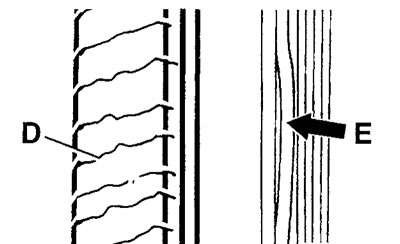
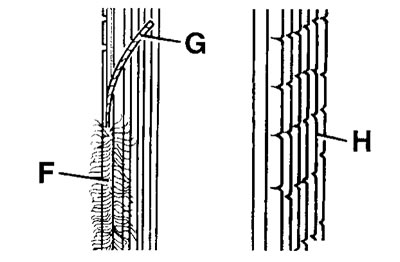
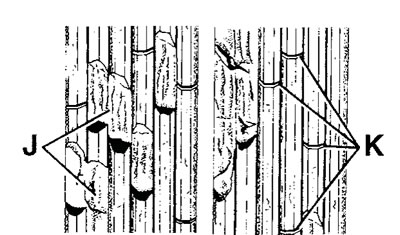
2. Feel the belt with your fingers along its entire length, checking for cracks and delamination (see illustrations).
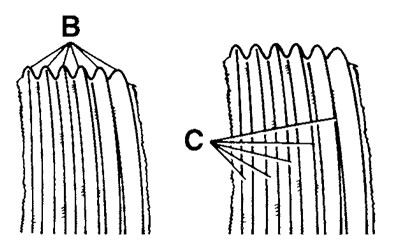
18.2a. Wear of the edges of the drive belt ribs.
18.2a. Wear of the edges of the drive belt ribs.


18.2b. Transverse cracks (D) on the back side of the belt and rib separation (E).
18.2b. Transverse cracks (D) on the back side of the belt and rib separation (E).


18.2c. Fraying of side ribs (F), cracks (H) and delamination of side ribs (G).
18.2c. Fraying of side ribs (F), cracks (H) and delamination of side ribs (G).


18.2d. Rib separation (J), cracks (K).
18.2d. Rib separation (J), cracks (K).


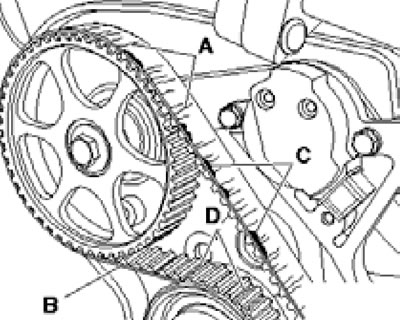
18.2e. Timing belt damage:

18.2e. Timing belt damage:
A - Cracks in the coating, transverse fractures;
B - Lateral wear;
C - Cord wear;
D - Cracks on the teeth.


Also check that the belt is free of scuffs and polished areas. The belt should be inspected from both sides, which means it needs to be twisted. At the same time, make sure that there is no rust, cracks or burrs on the pulleys. The presence of shallow perpendicular cracks on the working surface of the belt is allowed. If these cracks do not extend beyond the boundaries of one rib, are not very deep and their number does not exceed 15 per 10 cm of belt length, there is no need to replace the belt.


3. Make sure the belt is correctly positioned on the pulleys and rollers.

4. If necessary, replace the drive belt (see Chapter 2).

[The original material is located on the website «AudiManual»]
The article was checked by auto expert Daniil Ushakov
This article is available at russian, bulgarian, belarusian, ukrainian, serbian, croatian, romanian, polish, slovak, hungarian

Share information:
Previous articles
Audi Q Q7 Typ 4L: Maintenance
Next articles

Checking and caring for your battery
Replacing the air cleaner filter element
Replacing the air conditioning system cabin filter
Filling with AdBlue fluid (models with SCR system)
Maintenance of body parts, removal/installation of some covers…
Conducting a roadside inspection
Resetting the maintenance indicator and checking the volume of…


Similar articles on other Audi car models:
Checking the technical condition of the oil pump Audi 80 B2 (1979-1986)
Checking the oil level in the rear axle drive Audi 100 C4 (1990-1994, petrol)
Checking the condition of ribbed drive belts Audi A3 Type 8L (1996-2003)
Checking the condition of the ribbed belts of the serpentine… Audi A4 B6 (2000-2006)
Checking the condition of seat belts Audi A6 C5 (1997-2004)
Checking the condition of the poly V-belt Audi A8 D2 (1994-2002)
Poly V-belt — checking condition (petrol engines) Audi A2 (1999-2005)
Link to this page in different formats


Visitor comments

No comments yet


How much will 32 + 21 =


Q7 4L(2005-2015, diesel) 
  • General information
  • Operating instructions
  • Maintenance
  • Power unit
  • Diesels 3.0 l (BUG, BUN, CAS)
  • Diesels 3.0 l (CATA, CCMA)
  • Diesels 3.0 l (CJGA/CJGC)
  • Diesels 4.2 l (BTR, CCFA/CCFC)
  • Cooling system
  • Fuel and exhaust system
  • Engine management system
  • Starting and charging
  • Transmission
  • Automatic gearbox
  • Drive shafts
  • Chassis
  • Brake system
  • Front suspension
  • Rear suspension
  • Steering system
  • Body
  • Air conditioner
  • Exterior
  • Interior
  • Electrical equipment
  • Equipment and devices
  • Electrical circuits
 
Q5 8R(2008-2017) 
  • General information
  • User manual
  • Power unit
  • Petrol engine 2.0 l
  • Petrol engine 3.2 l
  • Fuel system (petrol)
  • Diesel 2.0 liter (CA)
  • Diesel 2.0 liter (CG/CJ/CM)
  • Diesel engine 3.0 l
  • Fuel system (diesel)
  • Transmission
  • Manual gearbox 0B1
  • Manual gearbox 0B2
  • Automatic gearbox 0B5
  • Automatic gearbox 0B6
  • Chassis
  • Front suspension
  • Rear suspension
  • Brake system
  • Steering
  • Body
  • Exterior
  • Interior
  • Doors, locks and windows
  • Safety system
  • Ventilation and heating
  • Electrical equipment
  • Power devices
  • Equipment and devices
  • Lighting and alarm
  • Audio system
  • Electrical circuits
 
AudiManual.ru © 2017-2026 · Mobile version · Feedback · Sitemap: EN BG BY UA RS HR RO PL SK HU · Site search · News and articles
80 B2 · 80 B3 petrol · 80 B3 · 80 B4 · 100 C3 diesel · 100 C3 petrol · 100 C3 · 100 C4 petrol · 100 C4 · A3 Type 8L · A4 B5 petrol · A4 B5 · A4 B6 petrol · A4 B6 · A4 B7 · A4 B8 · A6 C4 · A6 C5 · A6 C5 Allroad · A8 D2 · Q5 Type 8R · Q7 Typ 4L · Audi A2 ·
This site uses cookies 🍪. Click the button to accept this fact.