



Front brakes FN3
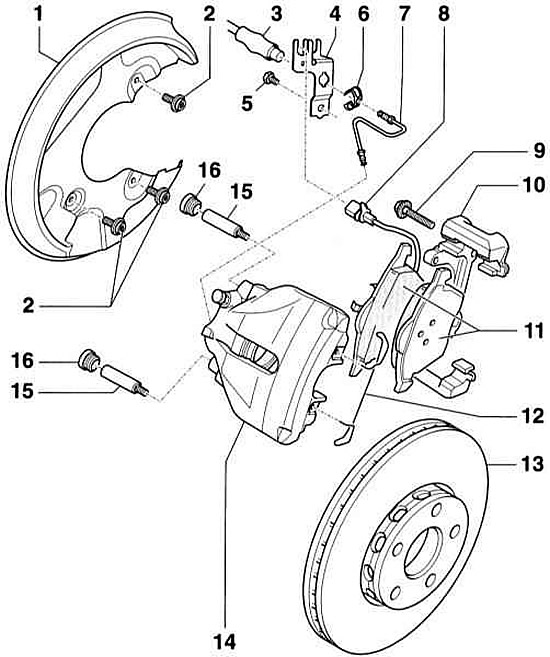
- 1 - Brake disc cover
- 2 - Screw, 10Nm
- 3 — Brake hose. Do not unscrew when replacing brake pads.
- 4 — Holder. Attaches to the caliper body
- 5 - Bolt, 10Nm
- 6 - Spring clamp
- 7 — Brake pipe, 15Nm. Screwed into the caliper body and connected to the brake hose. In this case, it is necessary to hold the brake hose by the hexagon. Make sure that the locking tabs are securely positioned in the holder grooves
- 8 — Wear sensor connector. When replacing the brake pad, remove it from the holder (4)
- 9 - Bolt with serrated flange, 190Nm. When reusing, clean the teeth.
- 10 — Guide. Attaches to the wheel bearing housing
- 11 — Brake pads. All four pads on one axle must be replaced.
Note: The inner shoe has an arrow. The arrow should point in the direction of rotation of the brake disc when the car is moving forward. If installed incorrectly, it can cause noise.
The outer brake pads have an adhesive film on the backing plates. The protective film must be removed before installing the pads.
When the appropriate wear is reached (2 – 3 mm), a control lamp lights up on the instrument panel. Please note the different designs of brake pads (spare parts catalog). Before installing new pads, the caliper must be thoroughly cleaned. A thin layer of lithium grease G 052 142 A2 from AUDI must be applied to the guide surfaces of the pads.
- 12 — Retaining spring. Inserted into the holes in the caliper body. Note: After installation in the holes, the locking spring must be pressed under the guide. If installed incorrectly, the wear of the outer shoe may not be compensated, which will lead to an increase in the brake pedal travel
- 13 — Brake disc. Both brake discs on the same axle must be replaced. Only the caliper must be disconnected for removal
- 14 — Caliper housing. To replace the brake pads, disconnect from the guide
- 15 - Guide pin, 25Nm
- 16 — Lid
Note: All external bolts and screws have a protective coating.
Removal
1. Mark the direction of rotation on the tire. Loosen the wheel mounting bolts. Raise and place the front of the car on stands and remove the wheel.
Warning: Be sure to follow the instructions in Section In emergency cases.
Warning: If the brake pads are to be reinstalled, they must be marked when removed. Do not interchange the outer and inner brake pads, or move them from the right to the left wheel. All front wheel brake pads must be replaced at the same time, even if the brake pad on one side has reached the wear limit.
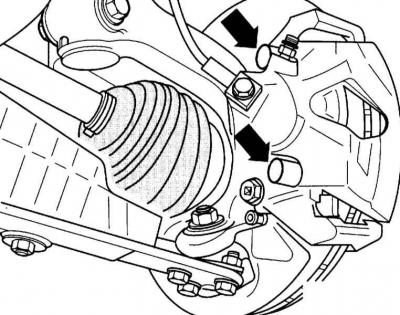
2. Remove the lids (arrows in the accompanying illustration) from both guide pins.
3. Disconnect the connector (1) of the brake pad wear indicator, if present. Turn the locking plate of the lower part of the plug by 90°.
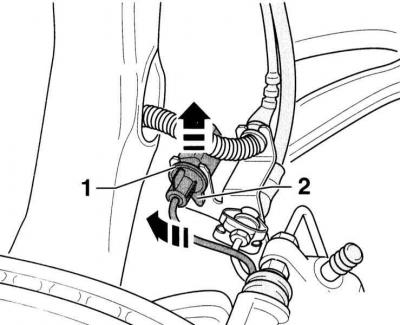
4. Remove the lower part of the plug from the holder.
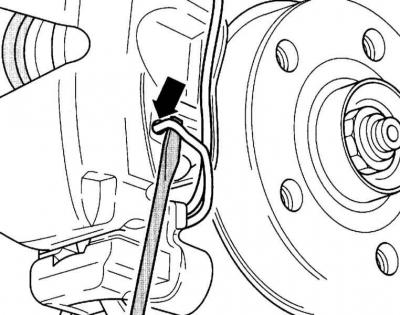
5. Use a screwdriver to pry it out of the hole (arrow on the accompanying illustration) brake shoe retaining spring.
6. Remove both guide pins from the caliper.
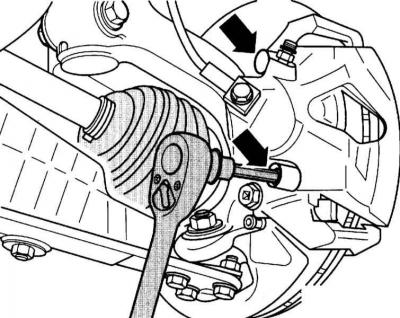
7. Remove the caliper housing and secure it to the suspension with wire.
Caution: Do not allow the brake hose to become strained.
8. Remove the outer brake shoe from the guide.
9. Remove the inner brake shoe with the spring from the brake piston.
Installation
Warning: When the brake pads are removed, do not press the brake pedal, otherwise the piston may be pressed out of the housing. In this case, remove the caliper as a set and ask the service station to put it back in place.
1. Before installing the pads in place, check the brake disc by feeling it with your fingers. If there are grooves, the disc can be turned down (work of the service station), if the thickness still allows it.
2. Measure the thickness of the brake disc, refer to the relevant Section.
Warning: Use only alcohol to clean the disc. Clean the guide surface and the pad seating areas in the housing well with a rag. Do not use a tool with sharp edges for this. Pay special attention to removing any adhesive film residue on the adjacent surfaces of the outer brake pads.
3. Check the piston dust boot for cracks. Replace a damaged dust boot immediately, as dirt that has penetrated quickly leads to loss of sealing of the caliper. In this case, you will have to disassemble the caliper (work of the service station).
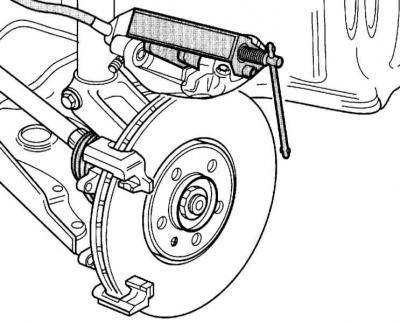
Warning: If the brake pad is heavily worn, check the ease of piston movement. To do this, insert a wooden block into the caliper and ask an assistant to slowly press the brake pedal. The piston should move in and out easily. Another caliper must be installed for checking. Make sure that the piston is not completely pressed out. If the piston moves hard, take the caliper to a service station for repair. Press the piston in with the tool shown in the accompanying illustration.
Warning: This can also be done with a wooden block (hammer handle). In doing so, make sure that the piston does not warp or damage the piston surface or the dust boot.
Caution: When the piston is pressed, brake fluid is forced out of the brake cylinder into the reservoir. Monitor the fluid in the reservoir and, if necessary, suck out the fluid using a siphon.
4. To suck out the brake fluid, use a plastic bottle that is intended only for this purpose. Do not use a drinking bottle for this! Brake fluid is poisonous and should never be sucked out by mouth through a hose. Use a siphon for this. When replacing brake pads, the brake fluid level in the reservoir should not exceed the MAX mark, since the fluid expands when heated. Leaking fluid gets on the master brake cylinder, destroys its coating and causes corrosion.
5. Before installing new brake pads, clean them thoroughly and lubricate them with a thin layer of lithium grease G 052 142 A2.
6. Insert the inner brake shoe with the retaining spring into the brake piston.
- 1 - Inner brake shoe of the right wheel
- 2 — Inner brake shoe of the left wheel
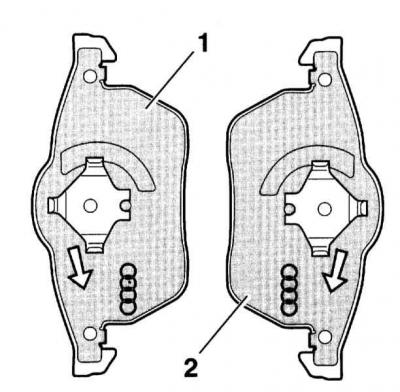
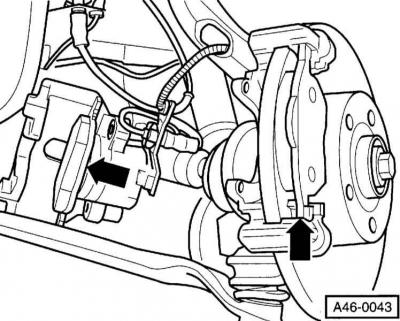
Caution: Inner brake shoe (has a spring) equipped with an arrow. The arrow must point in the direction of rotation of the brake disc when the vehicle is moving forward. Incorrect installation (to the other side of the car) may cause noise.
7. Remove the protective film from the back plate of the outer brake shoe.
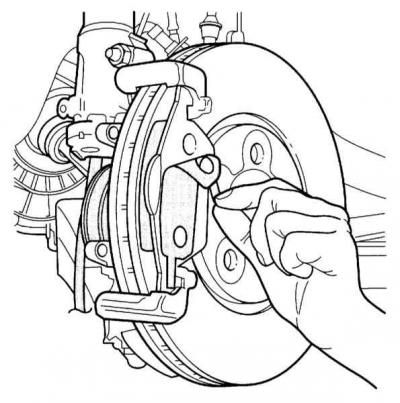
8. Install the outer shoe onto the guide.
9. Install the caliper body in place and secure it to the guide with two guide pins using torque 25Nm.
10. Replace both finger covers.
11. Insert the spring into the caliper body.
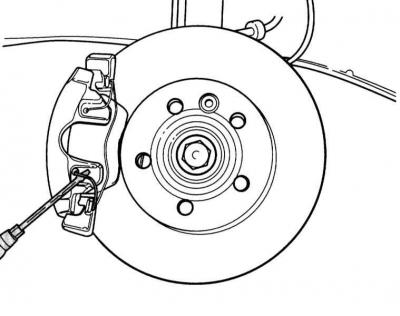
Caution: After installation in the holes, the locking spring must be pressed under the guide. If installed incorrectly, the wear of the outer shoe may not be compensated, which will lead to an increase in the brake pedal stroke.
12. Secure the wheels, observing the direction of rotation of the wheels. Lower the car onto the wheels and only then tighten the mounting bolts crosswise with a torque of 120Nm.
Caution: While standing, press the brake pedal hard several times until you feel resistance. This will cause the brake pads to adhere to the disc and take their working position.
13. Check the brake fluid in the reservoir, if necessary, add fluid to the MAX mark.
14. Carefully allow the new brake pads to break in. To do this, brake the car several times from 80 to 40 km/h, without pressing hard on the brake pedal. Allow the brake to cool between braking.
Warning: After installing a new brake pad, it must be run in. To do this, do not brake abruptly for the first 200 km.
Warning: In some areas, brake pads must be disposed of as special material. The necessary information on possible disposal points should be provided by local authorities.
Attention, please perform a reliability check:
- Are the brake hoses secured?
- Is the brake hose secured in the holder?
- Are the air bleed nipples tightened?
- Is there enough brake fluid?
- With the engine running, check for leaks. To do this, press the brake pedal with a force of 200–300 N (20–30 kg) for 10 s. The pedal should not weaken. Check all connections for leaks.
FNR-G60 Support
Use the illustration to determine the design of the caliper installed on your vehicle. This subsection only covers differences from the FN-3 caliper.
Front brakes FNR-G60
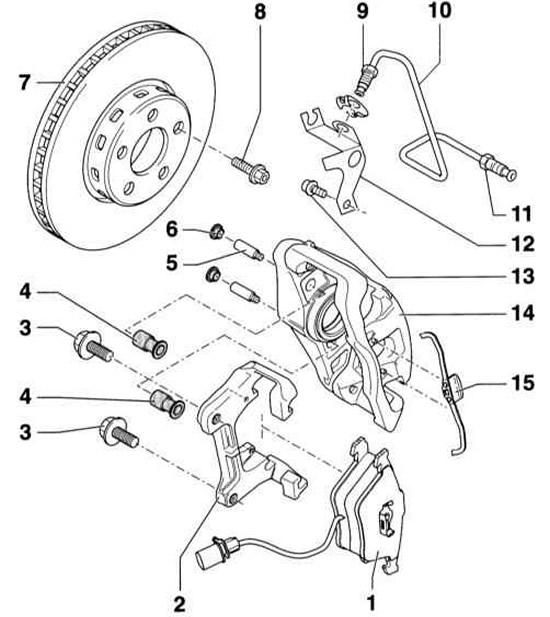
- 1 — Brake pad. All 4 pads on one axle must be replaced. Check the ease of movement of the caliper by moving it laterally. The inner pad with spring has a cable for the wear sensor. When the appropriate wear is reached (2 - 3 mm), a control lamp lights up on the instrument panel. Before installing new brake pads, thoroughly clean the caliper. Apply a thin layer of lithium grease G 052 142 A2 to the guide surfaces of the pads. When installing, connect the wear sensor cable
- 2 - Guide
- 3 - Toothed flange bolt, 1 90Nmwhen reusing, clean the teeth
- 4 — Bushing. Inserted into the caliper body
- 5 - Guide pin, 30Nm
- 6 — Lid
- 7 — Brake disc. It is essential to replace both discs on one axle. To remove, first disconnect the caliper. Lubricate the mating surfaces between the brake disc and the wheel hub with grease G 052 142 A2.
- 8 — Wheel mounting bolts, 120Nm
- 9 — Connecting the brake pipe, 12Nm
- 10 — Brake pipe. Screwed into the caliper body and connected to the brake hose. The hose must be held from turning by the hexagon. The hose should not twist as a result of installation. Make sure that the locking tabs are correctly positioned in the grooves on the holder
- 11 — Connecting the brake pipe to the caliper, 19Nm
- 12 — Holder. Fasten to the caliper body. Connect the brake pipe
- 13 - Bolt, 25Nm
- 14 — Caliper housing. To replace the brake pads, disconnect from the guide and secure with wire to the suspension
- 15 — Retaining spring. Inserted into the holes in the caliper body. Note: After installation in the holes, the locking spring must be pressed under the guide. If installed incorrectly, the wear of the outer shoe may not be compensated, which will lead to an increase in the brake pedal travel
Removal
1. Secure the brake disc with one wheel mounting bolt (arrow on the accompanying illustration).
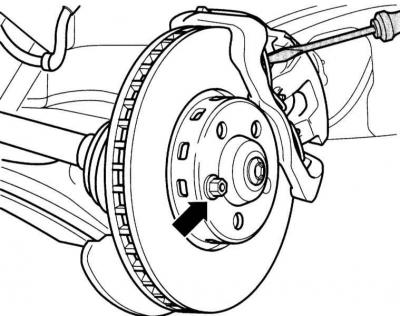
2. Use a screwdriver to pry up and remove the brake pad retaining spring from the caliper housing.
3. Disconnect the brake pad wear indicator connector by turning it, pull it up and disconnect the electrical wire.
4. Disconnect the brake hose from the holder.
5. Remove the covers and unscrew both guide pins.
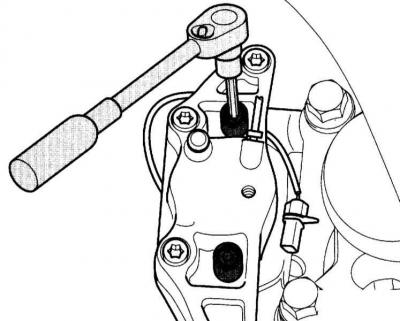
6. Remove the caliper housing and secure it to the suspension with wire.
7. Remove the pad from the caliper body or remove it from the guide.
Installation
1. Insert the brake pad with retaining spring and wear indicator into the caliper body.
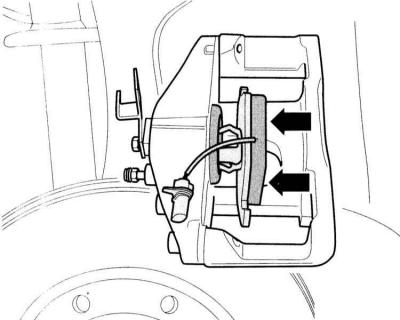
2. Insert the inner (1) and outer (2) brake pads into the caliper and install them together on the guide and brake disc.
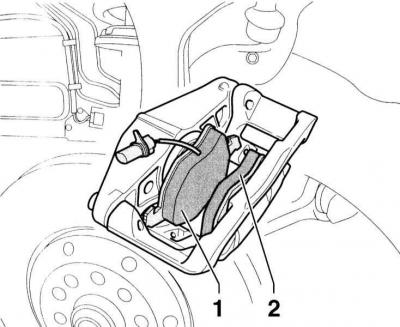
3. Fasten the caliper body with pins to the guide with torque 30Nm. Make sure that the brake hose does not twist. Install the finger caps.
4. Secure the wear indicator plug and fasten the wire into the holder.
Support C54
Use the illustration to determine the design of the caliper installed on your vehicle. This subsection only covers differences from the FN-3 caliper.
Front brakes C54
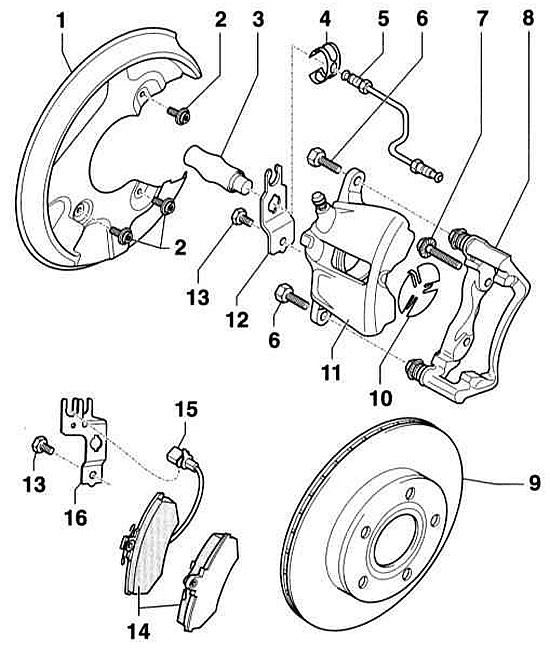
- 1 - Brake disc cover
- 2 - Screw, 10Nm
- 3 — Brake hose. When replacing brake pads, it is not disconnected
- 4 - Spring clamp
- 5 — Brake pipe, 15Nm. Screw into the caliper body and connect to the brake hose. At the same time, hold the hose by the hexagon to prevent it from turning. Make sure that the locking strips are correctly positioned in the grooves on the holder
- 6 - Self-locking bolt, 30Nm. The bolt must be replaced. When loosening and tightening, hold the guide pin
- 7 - Bolt with serrated flange, 190Nm. When reusing, clean the teeth
- 8 — Guide with guide pins and protective cap. Spare part, supplied with grease on the guide pin
- 9 — Brake disc. Both discs of one axle must be replaced. To remove, first disconnect the caliper
- 10 — Heat shield. Inserted into the piston
- 11 — Caliper housing. To replace the brake pads, it is disconnected from the guide. The brake hose is not disconnected
- 12 — Holder. Fastened to the caliper body
- 13 - Bolt, 10Nm
- 14 — Brake pads. All 4 pads on one axle must be replaced. When the appropriate wear is reached (2-3 mm), a control lamp lights up on the instrument panel. Before installing new pads, be sure to thoroughly clean the caliper. Apply a thin layer of grease G 000 650 to the guide surfaces of the pads
- 15 — Brake pad wear indicator connector. When replacing pads, remove from holder (16)
- 16 — Holder
Removal
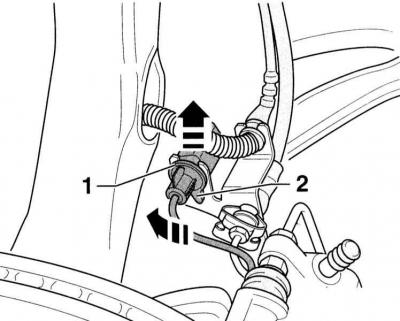
1. Turn the brake pad wear indicator connector apart, pull it up and disconnect the electrical wire.
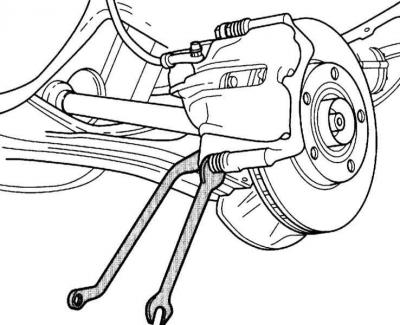
2. Unscrew the bolts from the caliper body, while holding the guide pins from turning.
3. Fold the caliper housing upward and remove the brake pads.
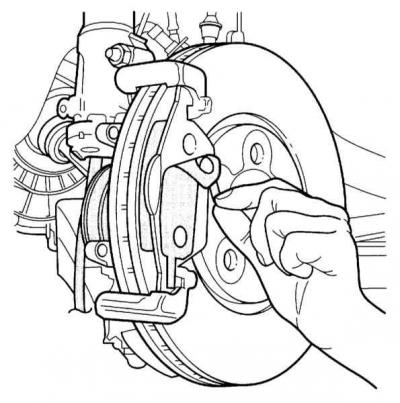
Installation
1. Install the brake pads.
2. Lower the caliper body and tighten the new mounting bolts to torque 30Nm.
Caution: The repair kit contains 4 self-locking bolts.