
Repair Chevrolet Repair Toyota Repair Honda Repair AvtoVAZ Repair Mercedes-Benz Repair BMW Repair Opel
Home  |  Contacts  |  Sitemap  |    
English Русский
Български
Беларускі
Український
Српски
Hrvatski
Română
Polski
Slovenský
Magyar
AudiManual.ru


  • AUDI 80
  • AUDI 100
  • AUDI A3
  • AUDI A4
  • AUDI A6
  • AUDI A8
  • AUDI Q
  • OTHER
  • ARTICLES
B8 (2007-2015) B7 (2004-2008) B6 (2000-2006) B6 (2000-2006, petrol) B5 (1994-2001) B5 (1994-2001, petrol)

Removal and installation rear wheel brake pads (Audi A4 B6)

  • Home
  • Audi A4
  • B6 (2000-2006)
  • Chassis
  • Brake system
  • Removal and installation rear wheel brake pads
            0
Table of contents: Support C38 ↓ C43 support with automatic… ↓
Use the illustration to determine the design of the caliper installed on your vehicle.

Rear wheel brakes C38
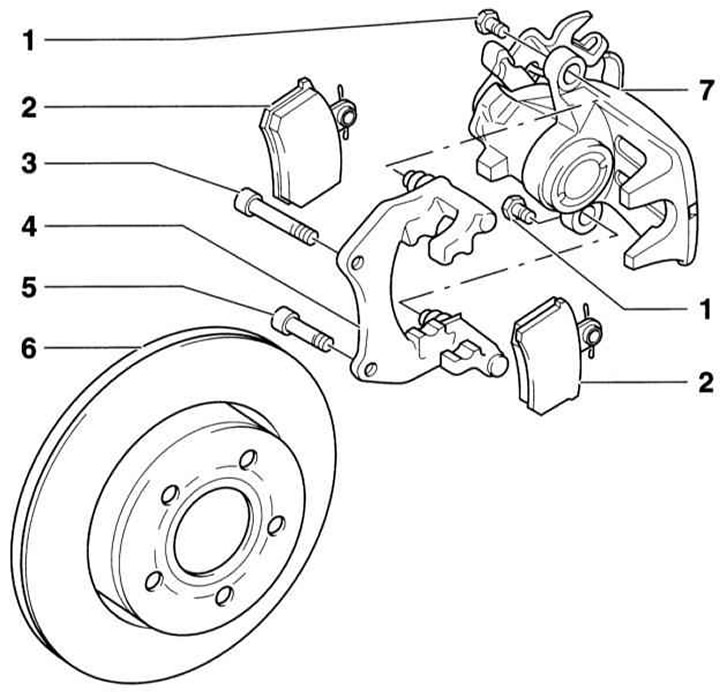


Rear wheel brakes C38

  • 1 - Bolt, 35Nm. Self-locking, be sure to replace. When loosening and tightening, it is necessary to hold the guide pins from turning.
  • 2 — Brake pads. All 4 pads on one axle must be replaced
  • 3 - Bolt with serrated flange, 75Nm. Be sure to replace
  • 4 — Guide complete with guide pins and protective cover. Supplied as a spare part with grease. If there is damage to the protective covers, install a repair kit. Use the supplied package of grease to lubricate the guide pins
  • 5 - Bolt with serrated flange, 75Nm. Be sure to replace
  • 6 — Brake disc. Both brake discs of one axle must be replaced. To remove, first remove the caliper
  • 7 — Caliper housing. The hose does not need to be disconnected to replace the brake pad


Support C38


Warning: There are different versions of rear brakes. Therefore, first, using the illustration, find out which version is used on your car.


Removal


Warning: The operation of lifting and installing the vehicle on stands is associated with danger! Therefore, before carrying out the operation, read Section Jacking and towing.


1. Raise and support the vehicle on stands.

2. Mark the direction of rotation on the tire. Loosen the wheel mounting bolts. Raise and place the front of the car on stands and remove the wheel.

Warning: Be sure to follow the instructions in Section In emergency cases.


Caution: If the brake pads are to be reinstalled, they must be marked when removed. Do not interchange the outer and inner brake pads, or switch them from the right to the left wheel. Replace all front brake pads, even if the brake pad on one side has reached the wear limit.


3. Remove the caliper housing mounting bolts. While doing this, hold the guide pins from turning.
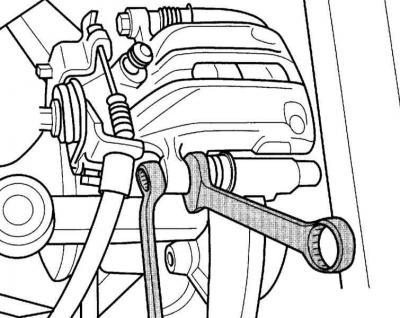
3. Remove the caliper housing mounting bolts. While doing this, hold the guide pins from turning.


4. Remove the caliper housing and take out the brake pads.

Installation


Warning: When the brake pads are removed, do not press the brake pedal, otherwise the piston may be pressed out of the housing. In this case, it is necessary to remove the caliper and piston as a set and hand them over to a service station for repair.


1. Press the piston into the housing.

Caution: Never use a conventional tool or hammer handle to push on the piston, as this may damage the parking brake adjustment mechanism.


2. To unscrew, install the special device AUDI-3272 so that its flange is adjacent to the caliper. Turn the handle to the left until it stops. Turn the spindle to the right and unscrew the piston.
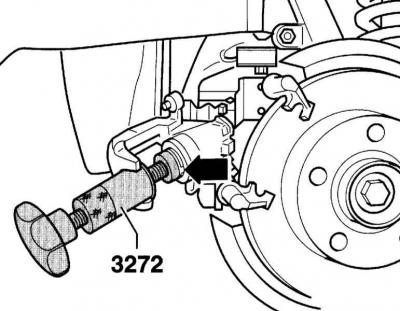
2. To unscrew, install the special device AUDI-3272 so that its flange is adjacent to the caliper.…


3. If there is no special device available, then cut a metal strip accordingly and insert it into both grooves of the piston. Turn the piston with force in the opposite direction.

Caution: When the piston turns, brake fluid is squeezed out of the brake cylinder into the reservoir. Monitor the fluid level in the reservoir and suck it out if necessary.


Warning: Use a plastic bottle intended for this purpose only to suck out brake fluid. Do not use a drinking bottle! Brake fluid is poisonous and should never be sucked out by mouth through a hose. Use a siphon for this. When replacing brake pads, the brake fluid level in the reservoir should not exceed the MAX mark, as the fluid expands when heated. Leaking fluid gets on the master cylinder, destroys its coating and causes corrosion.


Warning: Use only alcohol to clean the brakes. Clean the guide surface and the seat of the pads in the housing shaft with a rag. Never use a tool with sharp edges for this.


4. Install the brake pads back into place.
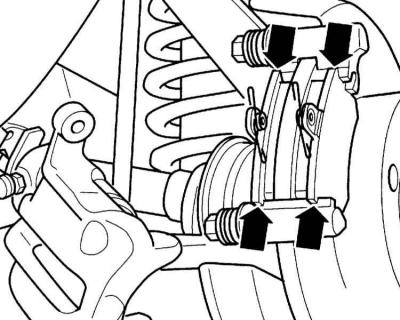
4. Install the brake pads back into place.


5. Install the caliper body and secure it with new self-locking bolts to torque 35Nm.

Caution: The repair kit contains self-locking bolts that must be installed.


6. Observing the direction of rotation, secure the wheels. Lower the car onto the wheels and only then tighten the mounting bolts crosswise with a torque of 120Nm.

Warning: While standing, press the brake pedal hard several times until you feel resistance. This will cause the brake pads to adhere to the disc and take their working position.


7. Check the brake fluid in the reservoir, if necessary, add fluid to the MAX mark.

8. Carefully allow the new brake pads to break in. To do this, brake the car several times from 80 to 40 km/h, pressing the brake pedal lightly. Allow the brakes to cool between braking.

Warning: After installing a new brake pad, it must be run in. To do this, do not brake abruptly for the first 200 km.


C43 support with automatic installation


Warning: There are different versions of rear brakes. Therefore, first determine with the help of the illustration which version your car has.


Warning: This section only covers differences relative to the C38 rear brake. All safety precautions apply.


Removal


1. Secure the brake disc with one wheel mounting bolt.

2. Remove the bolts from the caliper body using a wrench to hold them in place.
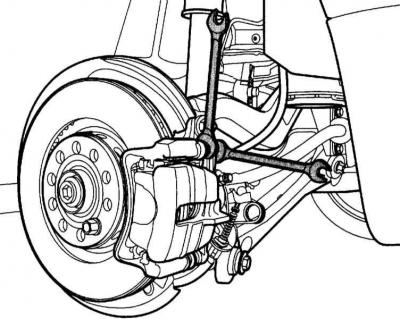
2. Remove the bolts from the caliper body using a wrench to hold them in place.


3. Release the parking brake lever. Remove the lock washer (1) of the brake cable from the holder and disconnect the cable at the caliper.
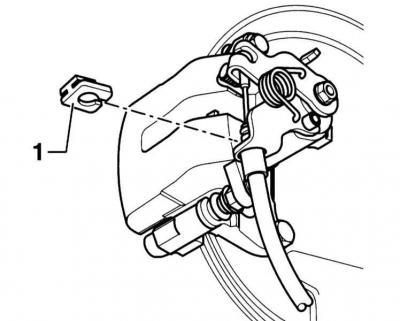
3. Release the parking brake lever. Remove the lock washer (1) of the brake cable from the holder…


4. Remove the caliper body and tie it with wire to the suspension so that the brake hose is not stretched or damaged.

5. Remove the brake pads.

6. Remove the guide brackets.

Installation


1. Screw in the piston by turning it clockwise using special tool 3272. The operation requires force.
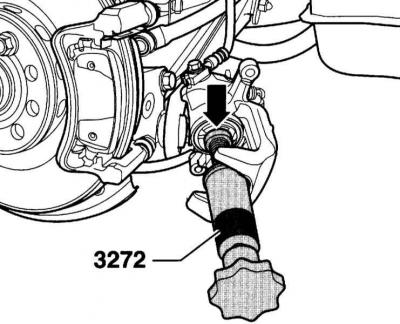
1. Screw in the piston by turning it clockwise using special tool 3272. The operation requires…


2. Install the brake shoe retaining springs in place.
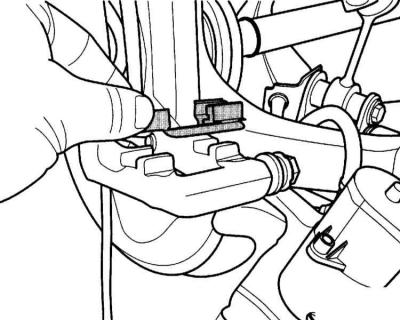


2. Install the brake shoe retaining springs in place.


3. Install the brake pads. Make sure that the brake pads are seated on their bearing surfaces.
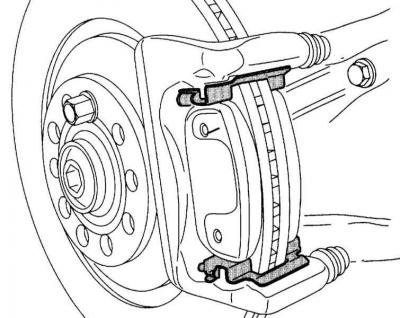
3. Install the brake pads. Make sure that the brake pads are seated on their bearing surfaces.


4. Install the caliper body in place and tighten the new mounting bolts to torque 35Nm.

Caution: Install the 4 self-locking bolts provided in the repair kit. Be careful not to twist the brake hose.


5. Connect the parking brake cable to the caliper and secure with a lock washer.
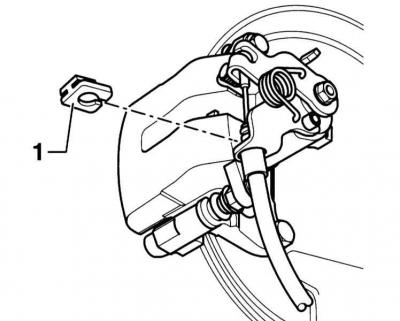
5. Connect the parking brake cable to the caliper and secure with a lock washer.


6. Adjust the parking brake, refer to Section Adjusting the parking brake.
The article was checked by auto expert Elisey Ermolaev
This article is available at russian, bulgarian, belarusian, ukrainian, serbian, croatian, romanian, polish, slovak, hungarian

Share information:
Previous articles
Audi A4 B6: Brake system
Next articles

Removal and installation front brake pads
Bleeding the brake system
Brake system specifications
Brake system — general information
Checking the thickness of the brake disc
Removal and installation the brake disc / caliper
Adjusting the parking brake
Removal and installation the brake light switch


Similar articles on other Audi car models:
Rear brake pads — checking, removal and installation Audi 80 B3 (1986-1991, petrol)
Rear wheel cylinder — removal, overhaul and installation Audi 100 C3 (1982-1990, diesel)
Removal and installation front and rear wheel arch liners Audi A3 Type 8L (1996-2003)
Rear brake pads with caliper C43 — removal and installation Audi A6 C5 Allroad (1999-2005)
Replacing rear brake pads Audi A8 D2 (1994-2002)
Removal the rear brake pads Audi Q5 Type 8R (2008-2017)
Removal and installation the thermostat housing and coolant pipe… Audi A2 (1999-2005)
Link to this page in different formats


Visitor comments

No comments yet


How much will 43 + 48 =


A4(B8, 2007-2015) 
  • General information
  • Operating instructions
  • Power unit
  • Petrol engines 1.8 l
  • Petrol engines 1.8/2.0 l
  • Petrol engines 3.0 l
  • Petrol engines 3.2 l
  • Fuel system (petrol)
  • Diesel engines 2.0 l (CA*)
  • Diesel engines 2.0 l (CJCB)
  • Diesel engines 2.7/3.0 l
  • Diesel engines 3.0 l
  • Fuel system (diesel)
  • Transmission
  • Manual gearbox 0B1
  • Manual gearbox 0B2
  • Manual gearbox 0B3
  • Manual gearbox 0B4
  • Automatic transmission 0B5
  • Automatic transmission 0B6
  • Automatic transmission 0AW
  • All-wheel drive system
  • Chassis
  • Front suspension
  • Rear suspension
  • Brake system
  • Steering system
  • Body
  • Exterior
  • Interior
  • Seats
  • Doors, locks and windows
  • Security system
  • Heating and air conditioning
  • Electrical equipment
  • Audio system
  • Power devices
  • Equipment and devices
  • Lighting and lamps
  • Electrical circuits
 
A4(B7, 2004-2008) 
  • General information
  • Introduction to manual
  • Troubleshooting
  • Operating instructions
  • Maintenance
  • Power unit
  • Petrol engines 2.0 (ALT)
  • Petrol engines 2.0 (TFSI)
  • Petrol engines 1.8 (MPI)
  • Diesel engines
  • Cooling system
  • Air conditioner
  • Fuel and exhaust system
  • Ignition system
  • Starting and charging
  • Transmission
  • Clutch
  • Manual gearbox
  • Automatic gearbox
  • Drive shafts
  • Chassis
  • Brake system
  • Front suspension
  • Rear suspension
  • Steering
  • Body
  • Exterior
  • Interior
  • Electrical equipment
  • Equipment and devices
  • Lighting and signaling
  • Windscreen wipers and washers
  • Electrical diagrams
  • Electrical diagrams (since 2007)
 
A4(B6, 2000-2006) 
  • General information
  • Vehicle Description
  • User manual
  • Maintenance
  • Power unit
  • Gasoline engine
  • Diesel engine
  • Lubrication system
  • Cooling system
  • Supply system
  • Injection system
  • Exhaust system
  • Ignition and control
  • Transmission
  • Gear box
  • Clutch and drive shafts
  • Chassis
  • Brake system
  • Car suspension
  • Steering
  • Body
  • Heating and ventilation
  • Exterior (external elements)
  • Interior (internal elements)
  • Electrical equipment
  • Power devices
  • Lighting and appliances
  • Electrical circuits
 
A4(B6, 2000-2006, petrol) 
  • General information
  • Introduction to the guide
  • Car care
  • Power unit
  • Engine repair
  • Lubrication system
  • Cooling system
  • Injection and control system
  • Ignition system
  • Power and exhaust system
  • Transmission
  • Clutch and drive shafts
  • Car gearbox
  • Chassis
  • Suspension and wheels
  • Steering
  • Brake system
  • Body
  • Interior
  • Exterior
  • Electrical equipment
  • Equipment and devices
  • Lighting and signaling
  • Power devices
  • Electrical circuits
 
A4(B5, 1994-2001) 
  • General information
  • Introduction to the guide
  • Car care
  • Maintenance (gasoline)
  • Maintenance (diesel)
  • Power unit
  • Gasoline engines
  • Diesel engines
  • Engine overhaul
  • Cooling system
  • Fuel injection (gasoline)
  • Fuel system (diesel)
  • Exhaust system
  • Ignition system
  • Transmission
  • Clutch
  • Mechanical gearbox
  • Automatic gearbox
  • Drive shafts
  • Chassis
  • Brake system
  • Car suspension
  • Steering
  • Body
  • Exterior
  • Interior
  • Doors, locks and windows
  • Heating and ventilation
  • Electrical equipment
  • Power devices
  • Equipment and devices
  • Electrical circuits
 
A4(B5, 1994-2001, petrol) 
  • General information
  • Vehicle description
  • Maintenance
  • Power unit
  • Engine repair
  • Turbocharging
  • Exhaust system
  • Cooling system
  • Ignition system
  • Fuel system
  • Motronic injection system
  • MPI and MPFI injection system
  • Transmission
  • Clutch
  • Gearbox and shafts
  • Chassis
  • Steering
  • Car suspension
  • Brake system
  • Wheels and tires
  • Body
  • Heating and ventilation
  • Body parts
  • Electrical equipment
  • Fuses and relays
  • Power devices
  • Lighting and lamps
  • Tools and devices
  • Electrical circuits
 
AudiManual.ru © 2017-2026 · Mobile version · Feedback · Sitemap: EN BG BY UA RS HR RO PL SK HU · Site search · News and articles
80 B2 · 80 B3 petrol · 80 B3 · 80 B4 · 100 C3 diesel · 100 C3 petrol · 100 C3 · 100 C4 petrol · 100 C4 · A3 Type 8L · A4 B5 petrol · A4 B5 · A4 B6 petrol · A4 B6 · A4 B7 · A4 B8 · A6 C4 · A6 C5 · A6 C5 Allroad · A8 D2 · Q5 Type 8R · Q7 Typ 4L · Audi A2 ·
This site uses cookies 🍪. Click the button to accept this fact.