
Repair Chevrolet Repair Toyota Repair Honda Repair AvtoVAZ Repair Mercedes-Benz Repair BMW Repair Opel
Home  |  Contacts  |  Sitemap  |    
English Русский
Български
Беларускі
Український
Српски
Hrvatski
Română
Polski
Slovenský
Magyar
AudiManual.ru


  • AUDI 80
  • AUDI 100
  • AUDI A3
  • AUDI A4
  • AUDI A6
  • AUDI A8
  • AUDI Q
  • OTHER
  • ARTICLES
C4 (1990-1994) C4 (1990-1994, petrol) C3 (1982-1990) C3 (1982-1990, petrol) C3 (1982-1990, diesel)

Steering gear work (Audi 100 C4)

  • Home
  • Audi 100
  • C4 (1990-1994, petrol)
  • Chassis
  • Suspension and steering
  • Steering gear work
            0
Table of contents: Replacing the tie rod end ↓ Complete replacement of the steering… ↓

Replacing the tie rod end


A tie rod puller is required here. The tie rod end cannot be simply pulled out of the control arm after the bolt has been loosened; it is inserted with the so-called responsibility cone. The conical formations in the tie rod end and the control arm fit tightly into each other and can then no longer be separated without an auxiliary means.

You are already familiar with the puller from the first time you removed the shock absorber:

Remove the wheel.

Unscrew the self-locking nut in the tie rod end.

Use a puller to pull the tie rod end upwards from the control arm.

Loosen the lock nut on the steering linkage rod, while supporting the hex bolt.

Mark the position of the screw-in depth of the tie rod end so that during assembly it is clear how much the new end needs to be screwed in.

Unscrew the tie rod end and screw in a new one up to the mark.

Press the ball-head bolt of the tie rod end into the control arm, and tap it gently if necessary.

Tighten the new self-locking nut to 50 Nm.

Tighten the tie rod nuts to 50 Nm, making sure that the tie rod ends do not move forward or backward.

Check the alignment.
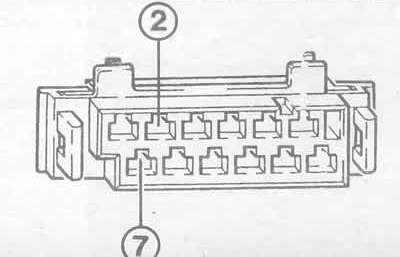
Checking the power supply of the power amplifier control unit. Voltage from the battery is supplied…

Checking the power supply of the power amplifier control unit. Voltage from the battery is supplied between the connection points 2 and 7 of the control unit indicated here when the ignition is on. If this does not happen, the fuse or wiring is faulty. Further testing should be carried out at a car repair shop.
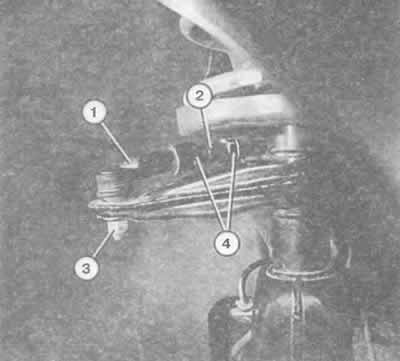

Shown here is the tie rod end (1) with the self-locking nut (3), the hexagonal threaded adjusting…

Shown here is the tie rod end (1) with the self-locking nut (3), the hexagonal threaded adjusting rod (2), and both lock nuts (4) used to secure the steering column (stalls) position of the transverse steering rod.


Complete replacement of the steering linkage


Buy new self-locking nuts.

Separate the tie rod end from the control arm as described in the previous section.

In the engine compartment, unscrew the steering linkage rod from the drive control mount.

Additionally: loosen the vertically stable panel fastening.

When screwing on new steering linkage rods, pay attention to their position.

In the middle (in drive control): the bend points in the direction of travel.

The central rod of the steering trapezoid should be bent downwards in the middle.

Tie rod end, outside: bend must be in direction of travel.

Tighten the steering linkage rod in the drive control mount with a force of 60 Nm.

Tighten the control panel rod mount to 40 Nm.

Pay attention to the fact that the tips of the transverse tie rod do not deviate either forward or backward. Otherwise, loosen the contour nuts in the cross tie rod tip and align the cross tie rod tip.

Tightening torque of lock nuts: 50 Nm. Tightening torque of the end of the transverse steering rod in the control arm: also 50 Nm.

Check the alignment.
The article was checked by auto expert Nikita Rudakov
This article is available at russian, bulgarian, belarusian, ukrainian, serbian, croatian, romanian, polish, slovak, hungarian

Share information:
Previous articles
Audi 100 C4: Suspension and steering
Next articles

Amplification system
Steering system
Adjusting the suspension level
Rear suspension repair
Steering repair
V-belts and poly-V-belts
List of faults. Power steering
Steering adjustment


Similar articles on other Audi car models:
Steering gear — removal and installation Audi 80 B3 (1986-1991, petrol)
Adjustable steering column Audi A3 Type 8L (1996-2003)
Checking the steering gear cuffs Audi A4 B5 (1994-2001, petrol)
Steering gear dust boots Audi A6 C4 (1994-1997)
Steering gear Audi A8 D2 (1994-2002)
Hydraulic steering gear Audi Q5 Type 8R (2008-2017)
Intake camshaft gear with variable valve timing Audi A2 (1999-2005)
Link to this page in different formats


Visitor comments

No comments yet


How much will 47 + 36 =


100(C4, 1990-1994) 
  • General information
  • User manual
  • Power unit
  • Engine repair
  • Ignition system
  • Fuel system (gasoline)
  • Fuel system (diesel)
  • Lubrication system
  • Cooling system
  • Exhaust system
  • Transmission
  • Clutch
  • Car gearbox
  • Drive shafts
  • Chassis
  • Car suspension
  • Steering
  • Wheels and tires
  • Brake system
  • Body
  • Ventilation and heating
  • Body repair
  • Electrical equipment
  • Power devices
  • Lighting and appliances
  • Electrical circuits
 
100(C4, 1990-1994, petrol) 
  • General information
  • Operation and maintenance
  • Power unit
  • Engine repair
  • Exhaust system
  • Cooling system
  • Supply system
  • Air filter
  • Mono-Motronic injection system
  • Digifant injection system
  • KE-III-Jetronic and KE-Motronic
  • MPI and MPFI injection system
  • Transmission
  • Clutch
  • Car gearbox
  • Chassis
  • Suspension and steering
  • Brake system
  • Wheels and tires
  • Body
  • Exterior
  • Interior
  • Electrical equipment
  • Fuses and relays
  • Power devices
  • Ignition system
  • Lighting and signaling
  • Equipment and devices
  • Electrical circuits
 
100(C3, 1982-1990) 
  • General information
  • User manual
  • Maintenance
  • Specifications
  • Power unit
  • Engines 4-cylinder
  • Engines 5-cylinder
  • Diesel engine
  • Cooling system
  • Power system (carburetor)
  • Power system (injector)
  • Fuel system (diesel)
  • Transistor ignition system
  • Electronic ignition system
  • Transmission
  • Clutch
  • 4 speed gearbox 014
  • 5 speed gearbox 013 and 093
  • 5 speed gearbox 016 and 012
  • Shift mechanism KP 016
  • Automatic transmission
  • Front wheel drive
  • Chassis
  • Front suspension
  • Rear suspension
  • Steering
  • Brake system
  • Body
  • Body elements
  • Electrical equipment
  • Lighting and appliances
  • Power devices
  • Electrical circuits
 
100(C3, 1982-1990, petrol) 
  • General information
  • Maintenance and operation
  • 4 cylinder engine
  • Engine repair
  • Cooling and lubrication system
  • Supply system
  • Ignition system
  • 5 cylinder engine
  • Engine repair
  • Cooling and lubrication system
  • Supply system
  • Ignition system
  • Transmission
  • Clutch and drive shafts
  • 4 speed gearbox 014
  • 5 speed gearbox 013 and 093
  • 5 speed gearbox 016 and 012
  • Automatic gearbox
  • Chassis
  • Steering
  • Front suspension
  • Rear suspension
  • Brake system
  • Body
  • Body elements
  • Doors, locks and windows
  • Body repair
  • Electrical equipment
  • Equipment and devices
  • Power devices
  • Electrical circuits
 
100(C3, 1982-1990, diesel) 
  • General information
  • User manual
  • Maintenance
  • Troubleshooting
  • Power unit
  • Engine in a car
  • Engine removed
  • Cooling system
  • Fuel system
  • Exhaust system
  • Starting and charging
  • Preheating
  • Transmission
  • Clutch
  • Mechanical gearbox
  • Automatic gearbox
  • Drive shafts
  • Chassis
  • Brake system
  • Suspension
  • Steering
  • Body
  • Exterior
  • Interior
  • Electrical equipment
  • Equipment and devices
  • Electrical circuits
 
AudiManual.ru © 2017-2026 · Mobile version · Feedback · Sitemap: EN BG BY UA RS HR RO PL SK HU · Site search · News and articles
80 B2 · 80 B3 petrol · 80 B3 · 80 B4 · 100 C3 diesel · 100 C3 petrol · 100 C3 · 100 C4 petrol · 100 C4 · A3 Type 8L · A4 B5 petrol · A4 B5 · A4 B6 petrol · A4 B6 · A4 B7 · A4 B8 · A6 C4 · A6 C5 · A6 C5 Allroad · A8 D2 · Q5 Type 8R · Q7 Typ 4L · Audi A2 ·
This site uses cookies 🍪. Click the button to accept this fact.