



Table of contents: Replacement ↓ Disassembly, defect detection of… ↓
Wheel brake cylinder
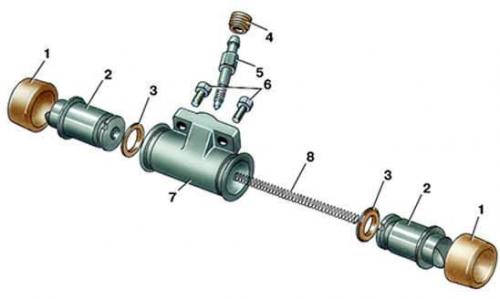
- 1 - protective cap;
- 2 - piston;
- 3 - cuff;
- 4 - protective cap;
- 5 - air release valve;
- 6 - bolt;
- 7 - body;
- 8 - spring
Replacement
1. Remove the brake drum (see subsection 8.2.3).
2. Unscrew from the back side of the brake shield (see Fig. Rear wheel drum brake mechanism) the tube fastening nut and disconnect the tube from the wheel brake cylinder nipple. Plug the tube opening.
3. Loosen the two wheel cylinder mounting bolts.
4. Slightly spread the upper ends of the brake shoes using two screwdrivers and remove the wheel brake cylinder.
5. Install the brake wheel cylinder on the brake shield, slightly spreading the upper ends of the brake shoes with two screwdrivers. At the same time, make sure that the protrusions on the ends of the pistons are oriented outward and the flat surface is adjacent to the toes of the brake shoes.
6. Connect the brake pipe, having previously lubricated its end with brake fluid, and tighten the fastening nut to a torque of 15–20 N·m (1.5–2.0 kgf·m).
7. Install the brake drum and wheel.
8. After installation, it is necessary to bleed the brake mechanism being repaired (see subsection 10.15).
9. Press the brake pedal all the way down to adjust the brake mechanism automatically.
Disassembly, defect detection of parts and assembly
You can replace defective wheel cylinder parts without removing it from the vehicle.
1. Remove the brake pads (see subsection 10.8), if the cylinder is not removed from the vehicle.
2. Carefully pry up with a screwdriver and remove the protective caps (see Fig. Wheel brake cylinder) on both sides of the cylinder.
3. Remove the pistons with seals and spring from the cylinder body.
4. Wash the wheel brake cylinder parts with clean brake fluid and dry.
5. The cylinder mirror must not have any scratches, cavities or corrosion spots. If these defects are present, the cylinder must be replaced. There must be no mechanical damage on the threaded parts of the cylinder.
6. The wheel cylinder seals must be elastic and flexible. Torn, swollen and hardened seals, as well as those with scratches on the working surfaces, must be replaced. The protective caps must also be elastic and flexible. Torn, swollen and hardened caps must be replaced to prevent dirt and water from getting into the wheel cylinder.
7. The piston surfaces that contact the cylinder mirror must not show signs of one-sided wear. Otherwise, it is recommended to replace the wheel cylinder assembly.
8. The thread of the brake pipe tip must not have any mechanical damage. There must be no cracks or visible signs of deformation on the tip nipple.
9. Loosen the air release valve.
10. Install the cuffs on the piston. The working edges of the cuffs should be directed inside the cylinder. Lubricate the pistons with cuffs with brake fluid and the inner surface of the cylinder with fresh brake fluid.
11. Insert the piston into the cylinder from the left side.
12. Install the protective cap. It should fit tightly onto the piston head and the seat on the body.
13. Insert the spring into the cylinder from the right side and unscrew the air release valve. Then insert the second piston and install the protective cap.
14. Close the air release valve.
15. Install the brake shoes, brake drum and wheel.
16. After installation, it is necessary to bleed the brake mechanism being repaired (see subsection 10.15).
17. Press the brake pedal all the way down to adjust the brake mechanism automatically.
[Read the original source on the website: AUDImanual]