



Rear wheel drum brake mechanism
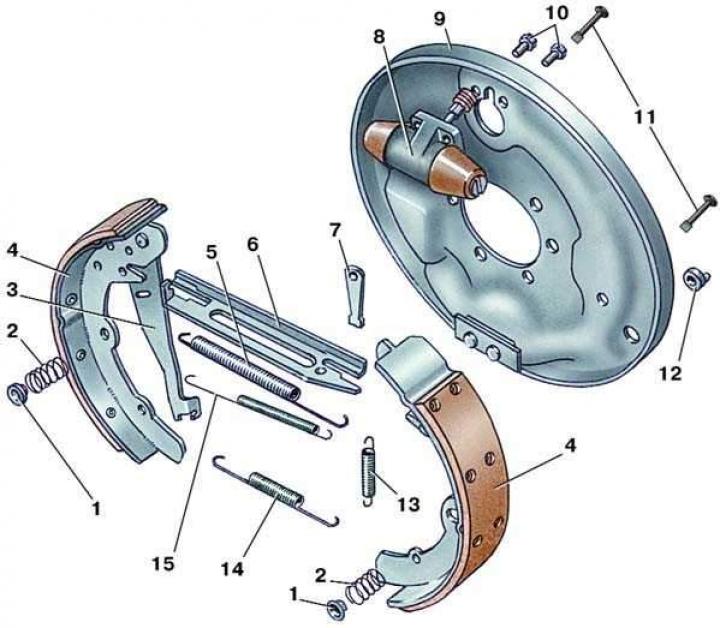
- 1 - cup;
- 2 - pressure spring;
- 3 - drive lever;
- 4 - brake shoe;
- 5 - upper tension spring;
- 6 - spacer bar;
- 7 - adjusting wedge;
- 8 - wheel brake cylinder;
- 9 - brake shield;
- 10 - bolt;
- 11 - rod;
- 12 - eccentric;
- 13 - pressure spring;
- 14 - lower tension spring;
- 15 - spacer bar pressure spring
Replacing brake pads
The thickness of the friction linings of the brake shoes must be at least 2 mm. The brake shoes must be replaced as a set on both rear brake mechanisms.
1. Install support blocks under the front wheels.
2. Loosen the rear wheel mounting bolts.
3. Raise and support the rear of the vehicle.
4. Remove the wheel.
5. Check the position of the parking brake lever, which should be in the extreme lower position.
6. Remove the brake drum (see subsection 8.2.3).
7. Press on the cup (see fig. Rear wheel drum brake mechanism) of the pressure spring and, turning it 90°, remove it together with the pressure spring, holding the cup rod from the back of the brake shield. Remove the spring and cups from the other shoe in the same way.
8. Disconnect the lower tension spring from the pads.
9. Remove the lower toes of the pads from the lower stop and remove the brake pads, removing their upper toes from the grooves of the wheel cylinder pistons.
10. Disconnect the parking brake cable end from the drive lever.
11. Clamp the lower ends of the pads in a vice.
12. Disconnect the adjusting wedge pressure spring.
13. Disconnect the upper tension spring.
14. Disconnect the spacer bar pressure spring and remove the spacer bar.
15. Clean all brake components.
16. Attach the pressure spring to the new front shoe and the spacer bar. Then, overcoming the force of the spring, insert the end of the spacer bar into the groove of the rear shoe and install the adjusting wedge, orienting it with the protrusion towards the brake shield.
17. Insert the other end of the spacer bar into the groove of the front shoe and install the upper tension spring.
18. Connect the parking brake cable end to the drive lever.
19. Insert the upper toes of the pads into the grooves of the wheel cylinder pistons.
20. Install the lower tension spring and insert the lower pads into the lower support.
21. Install the adjusting wedge pressure spring.
22. Install the cups with the pressure springs on the rods and secure them by turning them 90° while holding the rods from the inside of the brake shield.
23. Install the brake drum.
24. Install the wheel.
25. After finishing work, press the brake pedal vigorously several times to set the required gaps between the pads and the working surface of the drums.
Warning: If grease is found on the brake components, the axle bearing seal must be replaced.