
Repair Chevrolet Repair Toyota Repair Honda Repair AvtoVAZ Repair Mercedes-Benz Repair BMW Repair Opel
Home  |  Contacts  |  Sitemap  |    
English Русский
Български
Беларускі
Український
Српски
Hrvatski
Română
Polski
Slovenský
Magyar
AudiManual.ru


  • AUDI 80
  • AUDI 100
  • AUDI A3
  • AUDI A4
  • AUDI A6
  • AUDI A8
  • AUDI Q
  • OTHER
  • ARTICLES
C4 (1990-1994) C4 (1990-1994, petrol) C3 (1982-1990) C3 (1982-1990, petrol) C3 (1982-1990, diesel)

Ignition transformer (Audi 100 C4)

  • Home
  • Audi 100
  • C4 (1990-1994)
  • Power unit
  • Ignition system
  • Ignition transformer
            0
Table of contents: Monotronic ↓ Checking the ignition transformer ↓

Monotronic


This part combines the switch and the powerful final stage of the transistor ignition with the ignition coil: the combination in one housing prevents voltage losses.

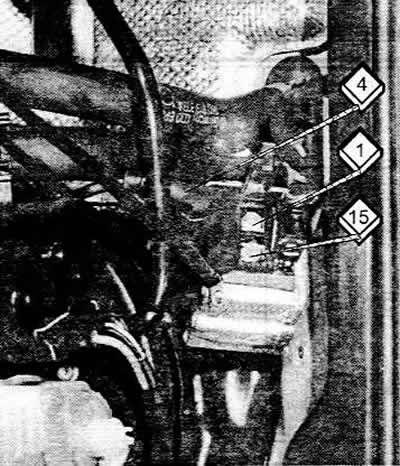
The black wire from the mounting block to the ignition transformer is used to supply voltage to the primary winding part of the ignition coil. The connection to the primary winding is made via the terminal contact (15) during the so-called closing time

In order for the necessary ignition energy to be available throughout the entire operating area, the time for supplying current to a part of the ignition coil is selected in accordance with the number of revolutions and the supply voltage. In addition, the switching (commuting) part can limit the primary winding current to the ignition coil part to the maximum value.

To protect part of the ignition coil, the ignition transformer has a safety shutdown system. Since the current circuit is always closed when the ignition is turned on, the coil windings can overheat when the ignition remains on for a long time. This is prevented by a safe shutdown: 12 V is applied to terminal (15), and on terminal (1), on the contrary, a maximum of 10 V (or less). Thus, the winding "consumes" at least 2 V, which can cause them to overheat. However, after 1-2 seconds, the ignition transformer also approaches terminal (1) 12 V. There will be no more voltage difference in the windings and the consumer switches off in a peculiar way.


The interrupt pulse is fed through the ignition/injection control unit via the green/black wire to the switching part with the final stage of the ignition transformer. There, the Hall sensor pulse is processed and amplified, which, as indicated above, controls the current through the primary winding via the contact of terminal 1.

High voltage, approximately 35,000 V, comes out of the thick terminal (4) of the transformer and passes through the high-voltage wire of the distributor cap.

The brown wire makes the connection to ground.

Checking the ignition transformer


The figures show how to connect the devices to test the ignition transformer.
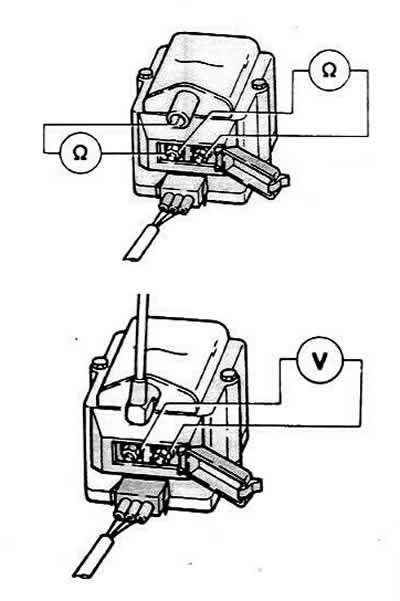
The figures show how to connect the devices to test the ignition transformer.


Visual inspection is described above.

To check the resistance, remove the three-pin plug and the high-voltage wire on the transformer with the ignition off. The primary and secondary windings of the ignition coil are measured.

Using an ohmmeter, measure the resistance between the transformer terminals 1/- and 15/+.

Nominal value: 0.5-0.7 Ohm.
Nominal value: 0.5-0.7 Ohm.


The next measurement is carried out between terminals (15) and (4).


Nominal value 3-4 kOhm.

If the measured values do not match the specified values, replace the transformer.

It is impossible to detect a short circuit between windings using these measurements. If the transformer is suspected despite satisfactory measurement results, the removed transformer should be checked in a workshop.

To check the voltage, you need a voltmeter with wires with sharp tips.

Connect the voltmeter to the external contacts of the three-pin plug of the ignition transformer.

Turn on the ignition: the voltmeter should show about 12 V. If there is no voltage, then you need to look for a break in the positive or "ground" wires.

Turn off the ignition.

Using auxiliary wires with sharp tips, connect the LED voltage tester to contacts (2) and (3) of the ignition transformer plug.

The assistant must turn on the starter.

The LED should blink. If it does not, then either the Hall sensor or the control unit is faulty.

Turn off the ignition.

Safe shutdown: Put the 3-pin plug back onto the transformer.

Connect the voltmeter to the contacts of terminals (1) and (15) of the transformer.

Turn on the ignition. The voltage should be at least 2 V (voltage difference between windings).

After 1-2 seconds the voltage drops to zero.

If this is not the case, then the transformer's safe shutdown is faulty and the system must be replaced.
The article was checked by auto expert Georgy Rodionov
This article is available at russian, bulgarian, belarusian, ukrainian, serbian, croatian, romanian, polish, slovak, hungarian

Share information:
Previous articles
Audi 100 C4: Ignition system
Next articles

Testing the KE-Motronic system's powerful output stage
Checking the switch
Ignition coil
Troubleshooting the ignition system
Ignition distributor
Troubleshooting Ignition Timing Systems
Adjusting ignition timing and knock sensor of the KE-Motronic…
Digital stabilization of idle speed of the KE-Motronic system


Similar articles on other Audi car models:
Ignition switch Audi 80 B3 (1986-1991, petrol)
Ignition switch and engine start Audi A3 Type 8L (1996-2003)
Multipoint injection control unit, ignition system, injection… Audi A4 B5 (1994-2001, petrol)
Ignition switch Audi A6 C5 (1997-2004)
Ignition switch Audi A8 D2 (1994-2002)
Ignition System — Control Data Audi Q5 Type 8R (2008-2017)
Removal and installation the ignition lock cylinder Audi A2 (1999-2005)
Link to this page in different formats


Visitor comments

No comments yet


How much will 48 + 35 =


100(C4, 1990-1994) 
  • General information
  • User manual
  • Power unit
  • Engine repair
  • Ignition system
  • Fuel system (gasoline)
  • Fuel system (diesel)
  • Lubrication system
  • Cooling system
  • Exhaust system
  • Transmission
  • Clutch
  • Car gearbox
  • Drive shafts
  • Chassis
  • Car suspension
  • Steering
  • Wheels and tires
  • Brake system
  • Body
  • Ventilation and heating
  • Body repair
  • Electrical equipment
  • Power devices
  • Lighting and appliances
  • Electrical circuits
 
100(C4, 1990-1994, petrol) 
  • General information
  • Operation and maintenance
  • Power unit
  • Engine repair
  • Exhaust system
  • Cooling system
  • Supply system
  • Air filter
  • Mono-Motronic injection system
  • Digifant injection system
  • KE-III-Jetronic and KE-Motronic
  • MPI and MPFI injection system
  • Transmission
  • Clutch
  • Car gearbox
  • Chassis
  • Suspension and steering
  • Brake system
  • Wheels and tires
  • Body
  • Exterior
  • Interior
  • Electrical equipment
  • Fuses and relays
  • Power devices
  • Ignition system
  • Lighting and signaling
  • Equipment and devices
  • Electrical circuits
 
100(C3, 1982-1990) 
  • General information
  • User manual
  • Maintenance
  • Specifications
  • Power unit
  • Engines 4-cylinder
  • Engines 5-cylinder
  • Diesel engine
  • Cooling system
  • Power system (carburetor)
  • Power system (injector)
  • Fuel system (diesel)
  • Transistor ignition system
  • Electronic ignition system
  • Transmission
  • Clutch
  • 4 speed gearbox 014
  • 5 speed gearbox 013 and 093
  • 5 speed gearbox 016 and 012
  • Shift mechanism KP 016
  • Automatic transmission
  • Front wheel drive
  • Chassis
  • Front suspension
  • Rear suspension
  • Steering
  • Brake system
  • Body
  • Body elements
  • Electrical equipment
  • Lighting and appliances
  • Power devices
  • Electrical circuits
 
100(C3, 1982-1990, petrol) 
  • General information
  • Maintenance and operation
  • 4 cylinder engine
  • Engine repair
  • Cooling and lubrication system
  • Supply system
  • Ignition system
  • 5 cylinder engine
  • Engine repair
  • Cooling and lubrication system
  • Supply system
  • Ignition system
  • Transmission
  • Clutch and drive shafts
  • 4 speed gearbox 014
  • 5 speed gearbox 013 and 093
  • 5 speed gearbox 016 and 012
  • Automatic gearbox
  • Chassis
  • Steering
  • Front suspension
  • Rear suspension
  • Brake system
  • Body
  • Body elements
  • Doors, locks and windows
  • Body repair
  • Electrical equipment
  • Equipment and devices
  • Power devices
  • Electrical circuits
 
100(C3, 1982-1990, diesel) 
  • General information
  • User manual
  • Maintenance
  • Troubleshooting
  • Power unit
  • Engine in a car
  • Engine removed
  • Cooling system
  • Fuel system
  • Exhaust system
  • Starting and charging
  • Preheating
  • Transmission
  • Clutch
  • Mechanical gearbox
  • Automatic gearbox
  • Drive shafts
  • Chassis
  • Brake system
  • Suspension
  • Steering
  • Body
  • Exterior
  • Interior
  • Electrical equipment
  • Equipment and devices
  • Electrical circuits
 
AudiManual.ru © 2017-2026 · Mobile version · Feedback · Sitemap: EN BG BY UA RS HR RO PL SK HU · Site search · News and articles
80 B2 · 80 B3 petrol · 80 B3 · 80 B4 · 100 C3 diesel · 100 C3 petrol · 100 C3 · 100 C4 petrol · 100 C4 · A3 Type 8L · A4 B5 petrol · A4 B5 · A4 B6 petrol · A4 B6 · A4 B7 · A4 B8 · A6 C4 · A6 C5 · A6 C5 Allroad · A8 D2 · Q5 Type 8R · Q7 Typ 4L · Audi A2 ·
This site uses cookies 🍪. Click the button to accept this fact.