



Table of contents: Checking the Hall sensor of the… ↓ Opening the distributor ↓ Checking the ignition distributor ↓ Removal the distributor ↓
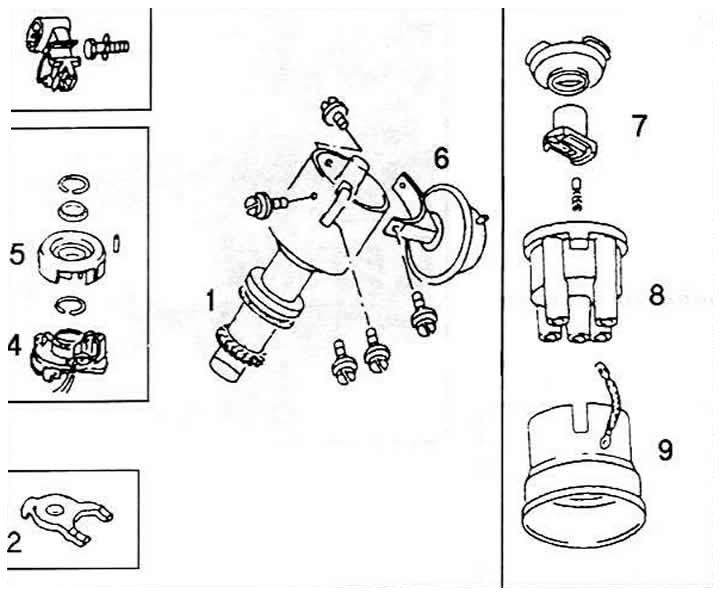
Distributor parts
1 Distributor housing
2 Fastening clamp
3 Plug connection
4 Hall's Knight
5 Rotor with hood
6 Vacuum chamber (only with mechanical installation of the ignition coil)
7 Distributor rotor
8 Distributor cap
9 Metal protective cover (screen) for suppressing interference to radio reception.
Power supply: Remove the 3-pin plug on the ignition distributor.
- Connect a voltmeter between the outer contacts of the plug with the red/black and brown/white wires.
- Turn on the ignition. The voltage should be at least 10 V.
- If there is no voltage, then there is a break in the wires or a defect in the switch or control unit.
Opening pulse: Remove the plug on the cold start valve and on the injection device or on the injector wire holder.
- Slide the protective sleeve back on the multi-pin plug of the Hall sensor on the distributor. The plug itself remains connected.
- Voltmeter or LED voltage tester (not an ordinary test lamp) connect between the middle contact and one of the outer contacts.
- The assistant must crank the engine with the starter.
- The LED should blink.
- If this is not the case, then the Hall sensor is faulty.
Checking the Hall sensor of the KE-Motronic system
Remove the plug by pressing on the brackets.
Connect a diode voltage tester with suitable tips between the green and brown wire contacts.
Turn on the ignition, turn the engine by hand or with the starter.
As the engine cranks, the LED should light up and go out alternately.
If this is not the case, turn off the ignition and check the voltage supply to the Hall sensor and the KE-Motronic control unit.
Remove the 3-pin plug on the ignition distributor.
Connect a voltmeter between the outer contacts of the plug with the red/black and brown/white wires.
Turn on the ignition. The voltage should be at least 9 V.
Move the rubber bushing back on the Hall sensor plug and put the plug back on.
Connect a diode voltage tester with suitable auxiliary leads between the middle contact on the Hall sensor plug and the plastic terminal of the battery.
Turn on the ignition, crank the engine by hand or with the starter.
If the diode now flashes and goes out alternately, then the Hall sensor is OK.
If it does not light up, the reason is in the Hall sensor and/or in the KE-Motronic control unit.
There are no testing methods in the usual sense of the word for the control unit.
Opening the distributor
Using a screwdriver, press both retaining clips (1) of the distributor cap. The bolt (2) of the distributor retaining clamp is visible below.
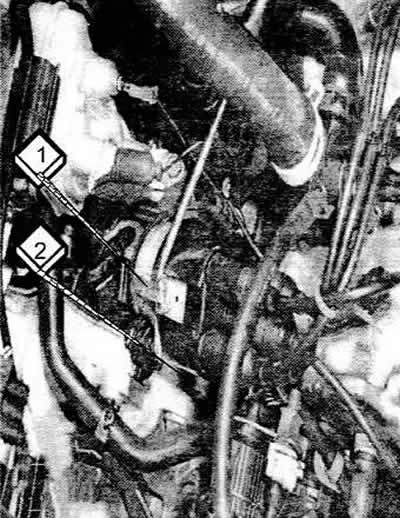
Remove the ground wire from the existing metal protective casing.
Remove the distributor cap, leaving the high tension wire connected.
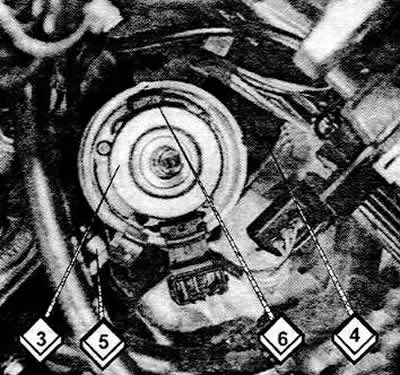
Distributor with cover removed
1 Rotor with hood
4 3-pin plug
5 Vacuum chamber for mechanical ignition timing adjustment
6 Hall sensor
Remove the distributor rotor and the dust cover underneath.
When installing the dust cover, position it so that the protrusion of its fastening fits into the recess on the edge of the distributor housing.
The distributor rotor has a protrusion that fits into a recess in the distributor shaft.
The distributor cap also has a cast "nose" to prevent it from turning, which fits into a recess in the distributor housing.
Engines with a power of over 100 kW: in models with a 20-valve engine, the distributor rotor cannot be removed - it is glued to the shaft.
If the distributor rotor needs to be replaced, it must be disassembled.
This is done by crushing with pliers. Do not break it under any circumstances, otherwise the distributor shaft or its bearings may be damaged (bearings).
Checking the ignition distributor
Remove the distributor cap. It must be clean inside and out to prevent dirt, moisture, etc. from creating current bridges.
The contact carbon in the middle should be smooth and shiny, slightly springy and move without sticking.
The distributor rotor must not be oiled on its contact surfaces, including the interference suppression resistor.
Distributor rotor resistance (designation R1) should be 0.6-1.4k Ohm.
The dark streaks on the distributor cap are burn marks from leakage currents that pass through dirt or damp areas.
In extreme cases, the spots can be scratched out with a screwdriver or knife, and then covered with glue, varnish, etc.
Caution: Due to high voltages, there may be interruptions between the high-voltage wires and the round metal cover. In this case, you can remove this protective cover completely.
Removal the distributor
Set the first cylinder to the point corresponding to the ignition timing.
Remove the distributor cap.
On some engines it is necessary to unscrew the bolt on the distributor mounting clamp and pull the distributor upward.
On others - unscrew the two mounting bolts on the distributor base, remove the distributor. To install the distributor, you need to put the engine in the following positions.
The "0" mark on the flywheel should be opposite the arrow in the inspection hole.
In addition, in the hole for the ignition distributor, the drive journal of the oil pump shaft must be parallel to the crankshaft.
The mark made with a center punch on the back side of the camshaft drive gear should be at the height of the cylinder head cover seal (gasket).
Turn the distributor shaft so that the distributor rotor points to the mark on the edge of the distributor housing. Insert the distributor.
Engine with a power of over 100 kW: the distributor drive coupling has an asymmetrical shape so that the distributor can only be inserted in one correct position.
Finally, adjust the ignition.