



Remove bearing caps #1 and #3 (the count is taken from the camshaft drive side), then, one by one, crosswise unscrew the nuts of the studs securing the bearing caps No.2 and 4.
Remove the camshaft from the cylinder head supports and remove the valve lifters.
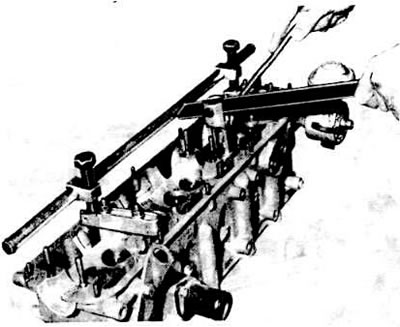
Disassembling valves using a valve spring compressor
Install a valve spring compressor on the cylinder head and use pliers with pointed ends to release the valves from the crackers.
Remove the springs with plates.
Remove the valve stem seals using an inertia puller.
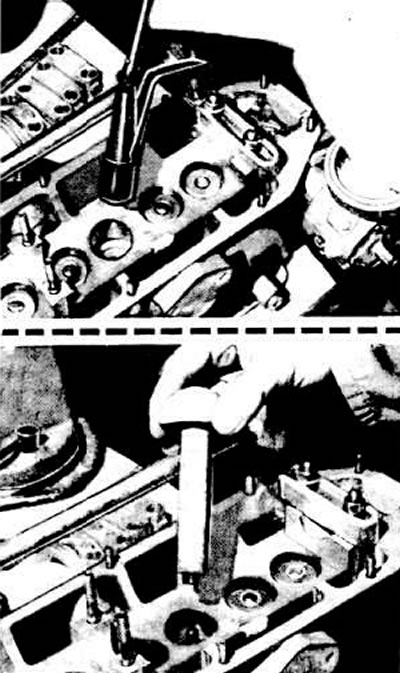
Removal and installation valve stem seals Top: removing the seal. Bottom: installing the seal
Remove the valves.
Remove the valve spring support washers.
Mark the position of the parts to be removed so that parts that cannot be replaced can be returned to their original position during assembly.
Clean the parts.
Check the degree of wear of the valve guide bushings and the clearance between the bushings and the valve stems.
Insert the new valve into the guide sleeve and measure the clearance between the end of the stem and the edge of the guide sleeve using the VW 387 tool with indicator.
Replace the guide bushings if the clearance exceeds 0.10 mm for intake valve bushings and 0.13 mm for exhaust valve bushings.
Check that the mating surface of the cylinder head is not flat using a metal ruler and a set of feeler gauges.
If necessary, grind the mating surface of the cylinder head within the permissible limits (see subsection "Detailed technical specifications").
Check the condition of the valves and valve springs.
Check the condition of the valve seats and, if necessary, grind them. Grinding is carried out using a special tool and observing the permissible limits (see "Detailed technical specifications").
On engines of the "KU" and "NF" models, in case of grinding of valve seats, in order to ensure normal operation of hydraulic valve tappets, it is necessary to maintain a minimum distance "a" (see the figure in the section "Four-cylinder engine") between the end of the valve stem and the upper plane of the cylinder head, which for intake valves should be equal to 33.80 mm, for exhaust valves - 34.10 mm.
The shrinkage of the working chamfer of the valve seat must not exceed a value equal to the difference between the value "a" before grinding the valve seat and the minimum value "a" after grinding.
If necessary, grind the working chamfers of the intake valves. The working chamfers of the exhaust valves are not subject to grinding; grinding of the exhaust valves is allowed, and in other cases they are subject to replacement.
Before assembly, thoroughly clean the cylinder head, as well as after grinding the valve seats and lapping the valves.
If necessary, grind the mating surface of the cylinder head within the permissible limits (see subsection "Detailed technical specifications").
Check the condition of the valves and valve springs.
Check the condition of the valve seats and, if necessary, grind them. Grinding is carried out using a special tool and observing the permissible limits (see "Detailed technical specifications").
On engines of the "KU" and "NF" models, in case of grinding of valve seats, in order to ensure normal operation of hydraulic valve tappets, it is necessary to maintain a minimum distance "a" (see the figure in the section "Four-cylinder engine") between the end of the valve stem and the upper plane of the cylinder head, which for intake valves should be equal to 33.80 mm, for exhaust valves - 34.10 mm.
The shrinkage of the working chamfer of the valve seat must not exceed a value equal to the difference between the value "a" before grinding the valve seat and the minimum value "a" after grinding.
If necessary, grind the working chamfers of the intake valves. The working chamfers of the exhaust valves are not subject to grinding; grinding of the exhaust valves is allowed, and in other cases they are subject to replacement.
Before assembly, thoroughly clean the cylinder head, as well as after grinding the valve seats and lapping the valves.
(The original publication in its entirety is posted on the website AUDImanual)