



Control unit
In most engines, the ignition system control is integrated with the injection system control. The only exceptions are models with a 5-cylinder engine: here, each system (ignition and injection) its own control unit. But there are no differences in the way they operate. Below is a short list of what the control unit does.
The ignition systems of Audi vehicles do not require an additional device to regulate the ignition timing. The control unit has all the data and engine indicators at its disposal. They are supplied by the Hall sensor or the engine speed and crankshaft position sensor, as well as the engine temperature sensor, throttle position sensor, etc. Based on all this data, the control unit calculates the correct ignition timing for the corresponding load condition.
If we depict the ignition timing angle (ignition timing) depending on the load and engine speed, we get the so-called ignition characteristic. The characteristic of new ignition systems is readily depicted because of its bizarre form - it can be used to draw a conclusion about the exact impact on operating modes.
The control unit has at its disposal correction programs, such as: for starting the engine, running an unheated engine, driving in forced idle mode, etc.
The control unit always allows the ignition coil exactly as much current as it needs at a given moment. In an extreme situation (ignition on but engine not running) these ignition systems cannot cause damage to the ignition coil even after a long time.
Knock control of the 85, 98 and 110 kW engines allows the engine to be operated with the most precise ignition advance, and therefore with the highest power. Therefore, an engine designed to run on AI-95 (super) gasoline can also run on AI-92 gasoline, since the control unit recognizes the lower octane number and switches to a later ignition mode.
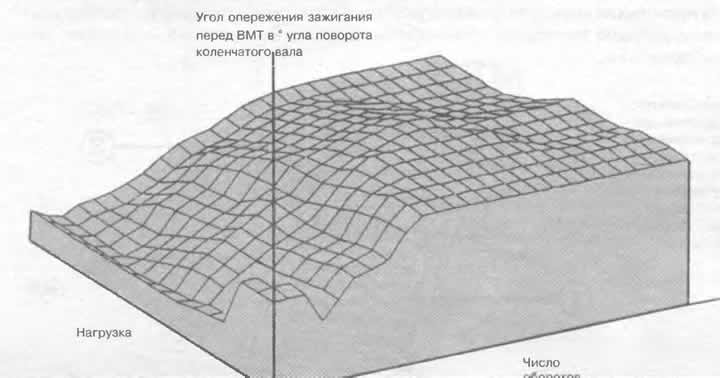
If you plot a diagram of the advance angle versus load and engine speed, you will get the so-called ignition characteristic. The stranger its shape looks, the more accurately the ignition is matched to the corresponding operating situation of the engine.
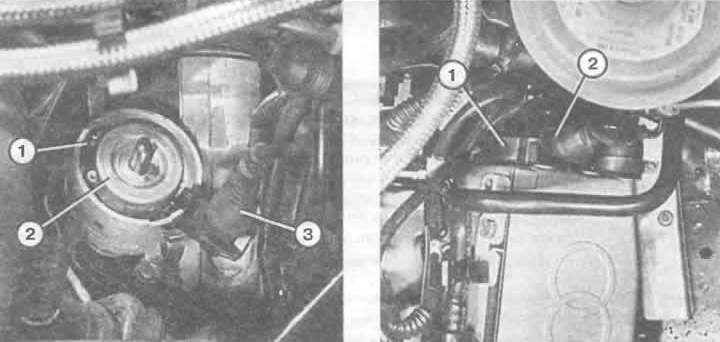
Left: Open ignition distributor (using a 4-cylinder engine as an example):
1 - Hall sensor;
2 — contactor;
3 — Hall sensor connecting plug.
Right: The Hall sensor is located on a 6-cylinder engine far back behind the left cylinder head.
The illustration shows:
1 - Hall sensor housing;
2 - connecting plug.
Knock control is also available in 6-cylinder engines with a capacity of 128 kW. However, AI-95 gasoline is used here, and AI-92 is not allowed for use in this engine. Those who wish can also use super plus gasoline without lead. The control unit reacts to it accordingly, which improves the dynamics of the car.
The 74 kW engine has no detonation control and runs on AI-92 gasoline.
Of course, there is an exchange of data with the injection system. This process is carried out even on models with a 5-cylinder engine, although here the ignition and injection systems are equipped with different control units (KE-III-Jetronic and VEZ).
And finally, a fault memory is installed, recording ignition system defects, the memory of which can be interrogated in the workshop with a special device (see also chapter "Regular maintenance").