



High voltage wires
The high-voltage part of the ignition system includes, in addition to the ignition coil and distributor - which have already been discussed - also high-voltage wires, wire tips with an interference-suppressing resistor and, of course, spark plugs.
Thick connecting wires running from the ignition coil to the distributor or from the distributor to the spark plugs (models with 6-cylinder engine without distributor), usually do not cause any trouble. They should be firmly inserted with their tips and noise suppression resistors (radio interference elimination) into the sockets of the ignition distributor cap. Their plug connections must not be oxidized and they must have good contact with the tips of the spark plugs.
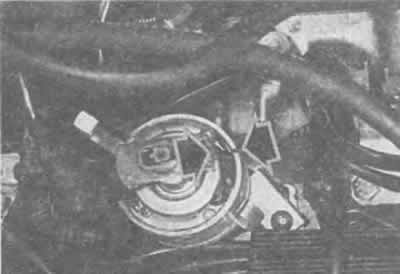
TDC — position of the ignition distributor: the contact plate of the distributor rotor should be opposite the mark on the edge of the housing (arrow). The mark is visible when the dust cover is removed.
If the high-voltage wires have become stiff and brittle, new ones should be installed. For a 6-cylinder engine, they can be purchased complete with both plugs.
For 4 and 5 cylinder engines, you will need to purchase the required length of high-tension wire and the associated brass terminals for the ends of the cable from a parts store. Press the brass terminals onto the ends of the cable, slide the spark plug caps and the terminals with interference suppression resistors on until they lock into place.
Hint: "leaky" spots in high-voltage wires can be easily spotted if you look into the engine compartment at night with the engine running. Then the ignition sparks jumping on the cable are clearly visible.
Spark plug tips, tips with interference suppression resistors
Only certain spark plug caps can be used in Audi. Suitable caps must have a self-resistance of 4-6 kOhm.
The same applies to the tips with interference suppression resistors installed on the distributor and ignition coil connections. Their own resistance should be 0.6-1.4 kOhm.
The distributor rotor must also have a specific 0.6-1.4 kOhm interference suppression resistor. It is marked "R1".
Hint: If the engine constantly or occasionally (in wet weather) does not work on all cylinders, this can often be due to faulty spark plug tips. There is a spark leak through the insulating material between the metal shell and the high-voltage electrode. To check, replace the spark plug tip with another one. Roadside assistance: remove the metal shield of the plug.
Firing order
For smooth engine operation, the cylinders, for example, of a 4-cylinder engine, are not fired in the order 1-2-3-4, but in a certain sense of the word randomly. According to the firing order, high-voltage wires are connected to the distributor cap. If the distributor rotor, with the distributor cap and dust cover removed, points to the mark on the edge of the distributor housing, then cylinder 1 (first in the direction of movement) is at the ignition moment. This is the starting point when putting on the wires.
Firing order (cylinder firing order) in our engines is as follows:
4-cylinder engine: 1-3-4-2, distributor rotor rotates to the right (clockwise).
5-cylinder engine: 1-2-4-5-3, distributor rotor rotates to the right (clockwise).
6-cylinder engine: 1-4-3-6-2-5. No distributor - the order of the high-tension wire connections to the ignition coil pack corresponds to the order of the cylinders. Example: the high-tension wire from the rear right connection leads to the rear right cylinder.