



All electrical cables and instrument connections must be touched, disconnected or connected only when the ignition is switched off.
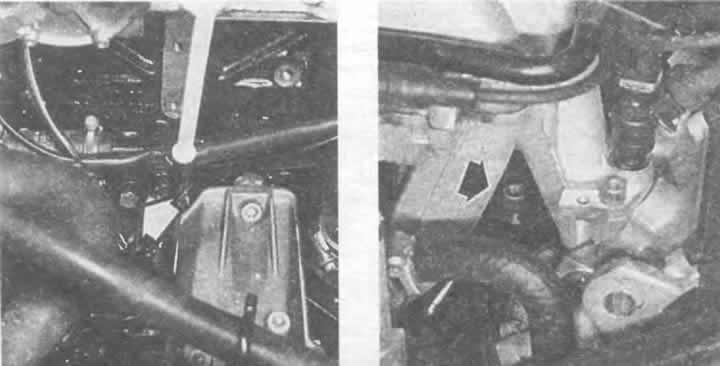
The knock sensor (arrow) on the 5-cylinder engine (left), like the 4-cylinder engine, is located on the left side of the engine. Models with a 6-cylinder engine (right) have two knock sensors: one on the right and one on the left at the top under the exhaust manifold. Important: The knock sensor mounting bolt must be tightened to exactly 20 Nm, otherwise the sensor will not work.
The battery should only be disconnected when the ignition is off.
If you just need to turn the engine over with the starter without starting it, then you should turn off the ignition system (see next section).
Before washing the engine, the ignition system should be turned off.
To start the engine with a discharged battery using a fast charger, it can be connected for no longer than one minute, and the voltage should not exceed 16.5 V.
If there is an obvious or suspected defect in the ignition system, it is necessary to turn off the ignition system when towing the vehicle (see next section).
A capacitor must not be connected to terminal 1/- of the ignition coil.
The distributor rotor cannot be replaced with the first one you come across, its resistance is 1 kOhm and the designation is "R1" (models with 4- and 5-cylinder engines).
Use only 1 kOhm resistance with thick high-voltage ignition system wires (models with 4- and 5-cylinder engines).
Use only spark plug contacts with a resistance of 5 kOhm.
When carrying out electric welding work in a vehicle, the battery cables must be disconnected.
[A link to the original source is available on the website: AUDIMANUAL.ru]