



A diesel engine does not have an ignition system, since when air is compressed in the engine cylinders, the air heats up so much that after fuel injection, it self-ignites.
The ignition system is an integral part of the engine management system. To determine the ignition timing, the control unit uses information stored in memory and information from sensors installed on the engine. The ignition system receives control signals from the Hall sensor or pulse sensor. Additionally, the ignition timing is also adjusted based on the signal from the knock sensor, which is sensitive to premature ignition and, accordingly, reduces the ignition advance angle.
The high voltage is distributed to the individual cylinder spark plugs by electronically controlled elements that replace the traditional mechanical distributor with distributor rotor. The ignition device has a separate ignition coil for each spark plug, which is mounted on the cylinder head.
The ignition system does not require maintenance during operation, except for replacing spark plugs as part of maintenance.
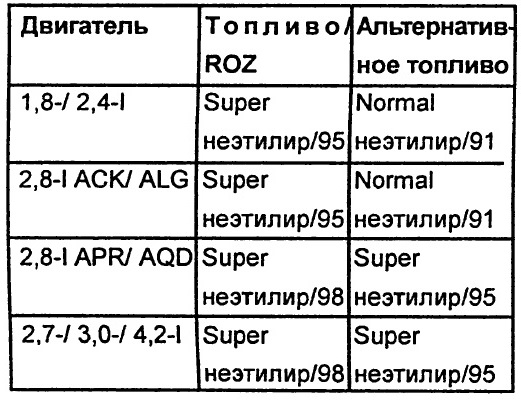
When refueling a car with alternative fuel, engine power decreases and fuel consumption increases.
The octane number (ROZ) of the fuel determines the antiknock properties of the fuel.
When working on the electronic ignition device, precautions must be taken to avoid personal injury or damage to the ignition device.
(This article was copied from an online resource «AUDIMANUAL.ru»)