Table of contents: Maintenance periods ↓ Self-service maintenance plan ↓ Who can perform the work? ↓ Diagnostics in the Audi workshop ↓ Diagnostics of the regulatory body ↓ Querying the fault memory ↓ Self-diagnosis ↓ Convenience in maintenance ↓ Vehicle Identification Number ↓
Reliability and safety are impossible without care and maintenance. Otherwise, you should not be surprised by problems with the car, where and when to "lay down straws", is written in the detailed maintenance instructions compiled by Audi.
Maintenance periods
The following maintenance regulations apply to our Audi 100:
Technical inspection with simultaneous exhaust gas toxicity test — once a year. Technical inspection with additional work every 30,000 and 60,000 km. Oil change if the car travels more than 15,000 km per year, thereby exceeding the annual inspection interval.
For those who drive high mileage per year (more than 15,000 km) and uses the services of auto repair shops for regular checks, unfavorable "intersections" may occur. At 20,000 km per year, the oil change should be carried out already before the annual check. For someone who drives 25,000 km per year, it is better to carry out the 30,000-kilometer check after the expiration of the annual interval. Well, and those who do everything themselves can decide as needed what and when they want to do. Every two years, Audi drivers need to change the brake fluid.
Self-service maintenance plan
The maintenance plan published in this book is also based on Audi's recommendations, and the sequence of individual points has been specially designed for those who like to do everything themselves. At the very beginning you will find "Regular checks" that cannot be contained in any kilometer interval.
To avoid you having to constantly flip back through the book while you work, we have included the maintenance plan at the end of the book on the inside cover. This way, you will always have it in front of you and can work through the work step by step.
Who can perform the work?
You can do almost all maintenance work on your Audi-100 yourself. Our tables will show you the right way:
○: For the car enthusiast, the road is clear. You can do this work yourself, armed with the knowledge from this book, and thus save money.
□: Although the work is not difficult, in most cases you may not have the necessary tools at hand.
△: Stop, it would be better to let a workshop work here. Special tools or devices are needed. The amount of time spent is not worth it because a workshop works much faster or special, deeper knowledge is needed to perform the work.
Cases of limited warranty service
If your Audi 100 is less than one year old or has had an engine replacement, the manufacturer requires that maintenance work be carried out on time at one of the Audi branded workshops. Otherwise, you may be denied support even in justified warranty cases. And anyone who wants to benefit from the "mobility guarantee" must visit a workshop at least once a year.
Diagnostics in the Audi workshop
Often, troubleshooting is the most expensive thing you have to pay for at the workshop, especially when it comes to phenomena that only occur from time to time. So what could be more reliable than checking the car's neural connections to immediately find out about the problem in all its depth?
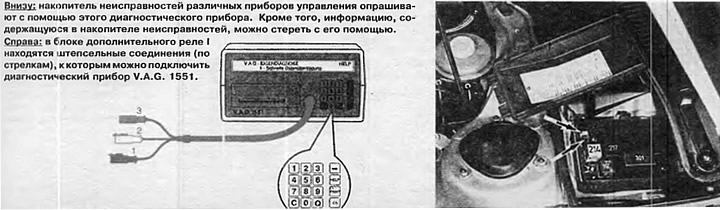
Numerous control units installed in the Audi-100 are capable of self-diagnosis. In this series, we can name the control units of the injection system, the ignition system (5-cylinder engine models), anti-lock braking system, EDS (electronic differential lock), airbag or air conditioning. Such a control unit is capable of diagnosing if it has a built-in fault memory that records all failures during vehicle operation. The control unit can be connected to the diagnostic unit in the workshop by connecting to the central plug for connecting the diagnostic center on the body of the central distribution device of the vehicle.
The correct use of the fault memory interrogation capabilities should be as follows: the driver arrives in his Audi to the workshop, and before any work begins, the car is connected to the diagnostic unit. A complete fault protocol is printed from it, which contains fault memory data for all control units capable of diagnostics. The testing is carried out by the auto mechanic according to the program, reading the instructions on the display. The end result is an accurate determination of the units and assemblies subject to repair.
Diagnostics of the regulatory body
A decisive factor for a quick and correct repair is also the function of the diagnostic system, which Audi calls control unit diagnosis. This means the following: Electrical functions such as the activation of the fuel pump relay, the solenoid valve for the activated charcoal canister or the idle speed stabilization valve can be connected to the diagnostic system. This makes it possible to determine with absolute certainty whether the cause is a faulty wiring or whether the unit itself is not functioning (its operation, not drowned out by the sound of the engine, is usually clearly audible). And this makes troubleshooting much easier.
Querying the fault memory
During maintenance, interrogation of the fault memory is included in the scope of work performed. In this way, the workshop can get an idea of possible faults in the operation of the vehicle's electronic units, without asking the customer in detail.
Someone who does maintenance themselves can waive this point when working, since they observe the car during everyday operation - that is, they should have noticed possible malfunctions.
Self-diagnosis
The times when car drivers, as was the case with the Volkswagen Beetle, could do all the work on the car themselves, are finally a thing of the past. But this does not mean that independent repair of your own car is completely impossible. Quite the contrary. You just need to slightly change the method of work and use modern technology. For example, the results of a survey of the fault memory, conducted by a workshop, can be used in work at home. The following example should make this idea clearer.
Example:
- The 85hp Digifant injection engine under full load feels underpowered. It's not underpowered all the time, just occasionally.
- As experienced amateur mechanics, we have already checked the car according to the points given in this book in the section "Help with faults of the Digifant injection system".
- Normally we would have probably found the fault by now, but the fact that it only appears from time to time makes it difficult to find.
- This example shows the clear advantage of the fault memory, because it stores faults that occur occasionally.
- Result of the fault memory query: throttle position sensor defective (loose contact).
Convenience in maintenance
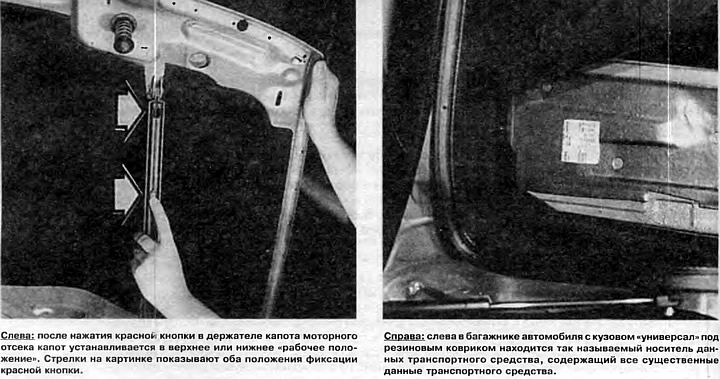
In order to make it easier to inspect and perform routine repairs in the engine compartment, the hood of the Audi-100 engine compartment can be raised higher. To do this, with the engine hood open, press the red button inward in the upper part of the stop and tilt the hood up to the stop.
Before closing, the hood must be returned to its normal position.
Under the rubber mat in the trunk there is a white sticker, which contains all the data that is important, for example, when buying spare parts. Such as:
- Vehicle code.
- Vehicle identification number.
- Conventional designation of the engine.
- Conventional designation of the gearbox.
- Paint coating code.
- Internal equipment code.
- Codes of additives used (etc., as well as the type of chassis).
A copy of this sticker is also located in the car owner's service book in the document pocket in the car (operating manual, etc.).
Vehicle Identification Number
Vehicle Identification Number (formerly: chassis number) is important for vehicle registration authorities and insurance companies. It is also necessary for purchasing spare parts. To help you understand what lies behind the letters and numbers, we have included a short explanation below. The combination of numbers/letters means: