Note: On models equipped with ABS, refer to Chapter 28 before starting work.
1. The brake pressure regulator is located on the left side of the rear axle and is controlled by moving the rear axle up and down.
2. To check the operation of the adjuster, press the brake pedal sharply and quickly release it. The weight of the car presses on the suspension and the adjuster arm should move, indicating that the unit is not seized.
3. To check for a leak from the regulator, connect a pressure gauge to the left front caliper and the right rear wheel cylinder or caliper. Since special equipment is usually not available to a home mechanic, leave this work to an Audi dealer. The procedure is as follows. Press the brake pedal so that the pressure in the left front caliper is 100 bar. Record this pressure for 5 seconds, the pressure in the right rear wheel cylinder or caliper should differ by no more than 10 bar.
4. To adjust the regulator, connect the pressure gauge as described in step 3, the car must be with a net weight, a full fuel tank and a driver. Shake the rear suspension several times, then press the brake pedal so that the pressure in the left front caliper is 50 bar - the pressure in the rear wheel cylinder or caliper should be 32.5-42.5 bar. With a front caliper pressure of 100 bar, the pressure in the rear wheel cylinder or caliper should be 54.0-71.5 bar.
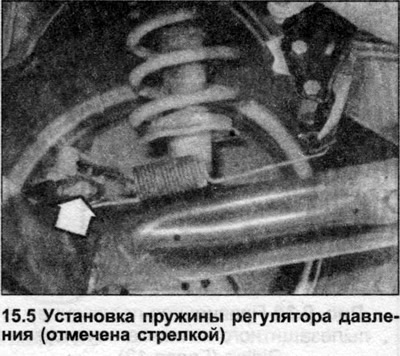
5. If the rear wheel cylinder or caliper pressure is too high, loosen the spring mount to the rear axle and move the unit forward to loosen the tension. If the pressure is too low, move the unit rearward to increase the tension (photo).