
Repair Chevrolet Repair Toyota Repair Honda Repair AvtoVAZ Repair Mercedes-Benz Repair BMW Repair Opel
Home  |  Contacts  |  Sitemap  |    
English Русский
Български
Беларускі
Український
Српски
Hrvatski
Română
Polski
Slovenský
Magyar
AudiManual.ru


  • AUDI 80
  • AUDI 100
  • AUDI A3
  • AUDI A4
  • AUDI A6
  • AUDI A8
  • AUDI Q
  • OTHER
  • ARTICLES
C4 (1990-1994) C4 (1990-1994, petrol) C3 (1982-1990) C3 (1982-1990, petrol) C3 (1982-1990, diesel)

Anti-lock braking system (ABS) — general description (Audi 100 C3)

  • Home
  • Audi 100
  • C3 (1982-1990, diesel)
  • Chassis
  • Brake system
  • Anti-lock braking system (ABS) — general description
            0
Some models covered in this manual are equipped with an anti-lock braking system (ABS) as standard or as optional equipment. The system is used in conjunction with the normal braking system to provide greater stability, improved steering control and shorter stopping distances.

Each wheel has a wheel speed sensor that measures the rotational speed of the wheel. The sensor consists of a magnetic core and winding and is installed at a certain distance from the toothed rotor. The rotors for the front wheels are mounted on the outer CV joints of the drive shafts, the rotors for the rear wheels are mounted on the hubs. When the hub rotates, the magnetic field of the sensor changes, causing an alternating voltage, the frequency of which changes depending on the speed of the wheel.

The signals from the sensors are sent to an electronic control unit that can accurately determine whether the wheel is accelerating or decelerating relative to the recommended speed. The information from the electronic control unit is sent to a hydraulic modulator that contains four traction relays, each acting on one valve for one brake, all of which operate independently of each other in three different modes:

Pressure increase stage:The solenoid inlet valves are open, brake pressure from the master cylinder is applied directly to the brake calipers.

Constant pressure stage: The solenoid inlet and outlet valves are closed, the brake system pressure in the calipers is maintained at a constant level, even if the master cylinder pressure increases.


Pressure reduction stage:The solenoid inlet valve is closed to prevent further brake system pressure from reaching the caliper and, in addition, the outlet valve is opened to relieve existing pressure and release the brake. Fluid returns to the master cylinder through the return, pumping the hydraulic modulator.

The braking cycle is described for one wheel, the systems of all four wheels work in a similar way, although independently.

The wheel speed is measured by wheel speed sensors and processed by the electronic control unit. By comparing the signals received from each wheel, the control unit can determine the recommended speed and detect any deviation from this speed that could lock the brake. If locking is detected, the control unit switches to the constant pressure stage, and no further increase in pressure in the brake system will affect this brake. If locking is still present, the pressure reduction stage is switched on to unlock the wheel. The control unit again switches to the constant pressure stage until the wheel speed increases to a certain value, then the cycle is repeated, the control unit again switches to the pressure increase stage. This control cycle is continuously and quickly repeated until the brake pedal is released or the vehicle stops.

An additional circuit in the electronic control unit monitors the system's operation and alerts the driver to damage via a warning light. If damage occurs, the system must be switched off, allowing normal braking without ABS.
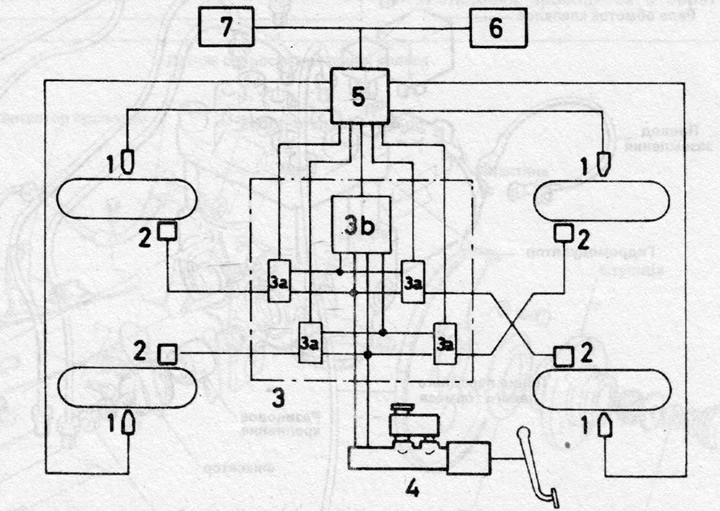


Fig. 9.38 Schematic layout of the anti-lock braking system (Chapter 27)

Fig. 9.38 Schematic layout of the anti-lock braking system (Chapter 27)
1 - Wheel speed sensors
2 - Brake calipers
3 - Hydraulic modulator
3a - Solenoid valves
3b - Return pump
4 — Master brake cylinder
5 — Electronic control device
6 — Control lamp
7 — ABS switch
The article was checked by auto expert Nikita Rudakov
This article is available at russian, bulgarian, belarusian, ukrainian, serbian, croatian, romanian, polish, slovak, hungarian

Share information:
Previous articles
Audi 100 C3: Brake system
Next articles

Pressure accumulator — removal and installation
Hydraulic booster unit — removal and installation
Hydraulic booster unit — description and testing
Vacuum servo — removal and installation
ABS — precautions
ABS Components — Removal and Installation


Similar articles on other Audi car models:
Anti-lock braking system (ABS) — general description Audi 80 B3 (1986-1991, petrol)
Anti-lock Brake System ABS and Control Unit Connector Audi A3 Type 8L (1996-2003)
Anti-lock braking system ABS — general information Audi A4 B5 (1994-2001)
General description of the anti-lock braking system (ABS) Audi A6 C4 (1994-1997)
General recommendations for operation and repair of anti-lock… Audi A8 D2 (1994-2002)
Keys, remote control, single lock, Advanced Key system Audi Q7 Typ 4L (2005-2015, diesel)
Cooling system pump — design description Audi A2 (1999-2005)
Link to this page in different formats


Visitor comments

No comments yet


How much will 38 + 49 =


100(C4, 1990-1994) 
  • General information
  • User manual
  • Power unit
  • Engine repair
  • Ignition system
  • Fuel system (gasoline)
  • Fuel system (diesel)
  • Lubrication system
  • Cooling system
  • Exhaust system
  • Transmission
  • Clutch
  • Car gearbox
  • Drive shafts
  • Chassis
  • Car suspension
  • Steering
  • Wheels and tires
  • Brake system
  • Body
  • Ventilation and heating
  • Body repair
  • Electrical equipment
  • Power devices
  • Lighting and appliances
  • Electrical circuits
 
100(C4, 1990-1994, petrol) 
  • General information
  • Operation and maintenance
  • Power unit
  • Engine repair
  • Exhaust system
  • Cooling system
  • Supply system
  • Air filter
  • Mono-Motronic injection system
  • Digifant injection system
  • KE-III-Jetronic and KE-Motronic
  • MPI and MPFI injection system
  • Transmission
  • Clutch
  • Car gearbox
  • Chassis
  • Suspension and steering
  • Brake system
  • Wheels and tires
  • Body
  • Exterior
  • Interior
  • Electrical equipment
  • Fuses and relays
  • Power devices
  • Ignition system
  • Lighting and signaling
  • Equipment and devices
  • Electrical circuits
 
100(C3, 1982-1990) 
  • General information
  • User manual
  • Maintenance
  • Specifications
  • Power unit
  • Engines 4-cylinder
  • Engines 5-cylinder
  • Diesel engine
  • Cooling system
  • Power system (carburetor)
  • Power system (injector)
  • Fuel system (diesel)
  • Transistor ignition system
  • Electronic ignition system
  • Transmission
  • Clutch
  • 4 speed gearbox 014
  • 5 speed gearbox 013 and 093
  • 5 speed gearbox 016 and 012
  • Shift mechanism KP 016
  • Automatic transmission
  • Front wheel drive
  • Chassis
  • Front suspension
  • Rear suspension
  • Steering
  • Brake system
  • Body
  • Body elements
  • Electrical equipment
  • Lighting and appliances
  • Power devices
  • Electrical circuits
 
100(C3, 1982-1990, petrol) 
  • General information
  • Maintenance and operation
  • 4 cylinder engine
  • Engine repair
  • Cooling and lubrication system
  • Supply system
  • Ignition system
  • 5 cylinder engine
  • Engine repair
  • Cooling and lubrication system
  • Supply system
  • Ignition system
  • Transmission
  • Clutch and drive shafts
  • 4 speed gearbox 014
  • 5 speed gearbox 013 and 093
  • 5 speed gearbox 016 and 012
  • Automatic gearbox
  • Chassis
  • Steering
  • Front suspension
  • Rear suspension
  • Brake system
  • Body
  • Body elements
  • Doors, locks and windows
  • Body repair
  • Electrical equipment
  • Equipment and devices
  • Power devices
  • Electrical circuits
 
100(C3, 1982-1990, diesel) 
  • General information
  • User manual
  • Maintenance
  • Troubleshooting
  • Power unit
  • Engine in a car
  • Engine removed
  • Cooling system
  • Fuel system
  • Exhaust system
  • Starting and charging
  • Preheating
  • Transmission
  • Clutch
  • Mechanical gearbox
  • Automatic gearbox
  • Drive shafts
  • Chassis
  • Brake system
  • Suspension
  • Steering
  • Body
  • Exterior
  • Interior
  • Electrical equipment
  • Equipment and devices
  • Electrical circuits
 
AudiManual.ru © 2017-2026 · Mobile version · Feedback · Sitemap: EN BG BY UA RS HR RO PL SK HU · Site search · News and articles
80 B2 · 80 B3 petrol · 80 B3 · 80 B4 · 100 C3 diesel · 100 C3 petrol · 100 C3 · 100 C4 petrol · 100 C4 · A3 Type 8L · A4 B5 petrol · A4 B5 · A4 B6 petrol · A4 B6 · A4 B7 · A4 B8 · A6 C4 · A6 C5 · A6 C5 Allroad · A8 D2 · Q5 Type 8R · Q7 Typ 4L · Audi A2 ·
This site uses cookies 🍪. Click the button to accept this fact.