



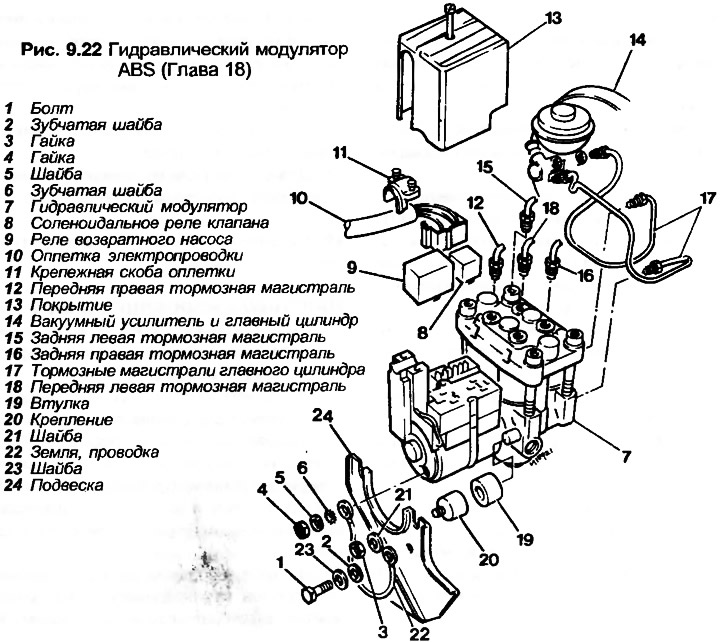
Anti-lock braking system (ABS) is factory-installed on some models upon request. The system is maintenance-free.
The system prevents the wheels from locking, even under sudden, strong braking on slippery roads, thus providing the driver with complete control of the steering.
Speed sensors monitor the rotational speed of each wheel. Once a wheel reaches the locking point, pressure regulators reduce the hydraulic pressure on that wheel until it starts to rotate again. This process is repeated many times every second, ensuring maximum braking force.
When the system is activated, the driver feels vibrations through the brake pedal and is notified by an acoustic signal. This is done to warn the driver about the potential full braking of the wheel during braking, when the speed of movement should be reduced accordingly.
The system is automatically activated when the engine is started, there is a control lamp. This lamp usually goes out when the engine is running. If not, or if it lights up while driving, check the system by switching it off and on with the main control switch. If the lamp remains lit, this indicates damage to the ABS system - in this case, only normal braking is available.
The main control switch on the dash allows the ABS system to be switched off at the driver's discretion. Normally, the system should not be switched off unless a brake test is being performed.
Precautions
On vehicles equipped with ABS, observe the following precautions.
- (a) Before performing electric welding on the body, disconnect the connector from the electronic control unit of the system
- (b) If the body must be heated (for example after painting), a temperature of 85°C is allowed for up to two hours, or 95°C for a shorter period
- (c) Always disconnect the battery before removing the modulator