



You should not give "full throttle", if there is an automatic transmission, you should avoid driving with "full throttle" and in "kickdown" mode. The highest speed should be 4200 rpm.
In the mileage range from 1000 to 1500 km, the engine can be gradually accelerated to maximum speed, and accordingly, to maximum revolutions.
Please note: Everything that has been said about a new engine also applies to a reconditioned power unit, which is even more sensitive to improper operation.
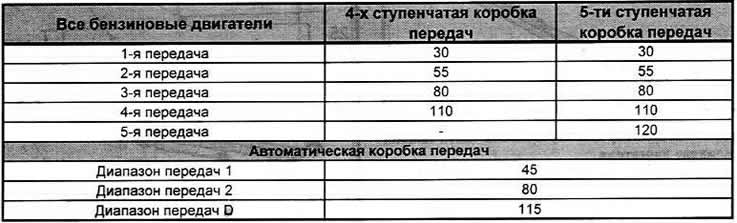
When the engine is warm, the following gear shifting instructions should be followed: (when the engine is cold, gears should be shifted earlier).
Engine life
The mileage listed below is a guideline. Depending on driving conditions and maintenance, both the upper and lower limits may be reached.
Four-cylinder engine: 100,000-150,000 km.
Other engines: 120,000-180,000 km.
The driver must decide for himself whether the critical wear point has already arrived or whether he can continue driving until the mileage reaches 150,000 km or more. The decisive factor here is the temperature of the engine oil. If the coolant temperature indicator signals relatively quickly that the operating temperature has been reached, then the engine oil will have fully acquired its lubricating properties after about 10 minutes of driving.
After driving short distances for a week, it is not recommended to fully press the accelerator pedal. When stopped for a long time at a traffic light while idling, a deposit forms in the combustion chambers and valves, which, when the engine is fully warmed up and running fast, (but not too much) burns out slowly while driving. For cars equipped with a tachometer, this is 4000-5000 rpm.
Nominal speed
An internal combustion engine operates at maximum power at a certain speed, the so-called nominal speed. Increasing the speed above this value does not increase the power. However, under certain conditions, by increasing the engine speed and accelerating the rotation of the wheels, it is possible to achieve a higher speed. Faster rotation in any case makes it easier to shift to the next gear.
Speed limitation
The absolute limit of revolutions is close to the value of 6700 rpm. Even before reaching this value, the valve springs begin to vibrate so much that the valves are no longer fully opened and closed. The valve springs can break, which will lead to the corresponding valve hitting the piston, and this will cause serious damage.
Most engines are equipped with a rev limiter, which stops the revs from increasing further at a certain speed. The device functions differently depending on the engine type.
On injection engines without a catalytic converter (early models), a centrifugal device on the distributor rotor interrupts the passage of ignition pulses to the engine so that they do not reach the spark plugs.
On other injection engines with a catalytic converter, engine speed is limited by a control unit that switches off the electric fuel pump using a fuel pump relay.
On engines with the Mono-Motronic system, the fuel supply is shut off at the inlet valve.
Engine speed limitation does not apply to carburettor engines with a catalytic converter.
If, despite the spark interruptions, you want to accelerate the engine to very high revs, you will not have any interference except for the installed engine protection.
This article was previously published on the resource: AudiManual