



Fuel Pump Troubleshooting
First of all, check the fuse (chapter "Body electrical system").
If he is okay, we need to look further.
Sometimes you can determine whether the fuel pump is working by listening: listen under the car at the height of the fuel tank to see if the fuel pump is turning on while an assistant turns on the ignition.
If you can hear the sound of the pump running, it is probably OK. If you can't hear anything, you should check if the fuel is coming in:
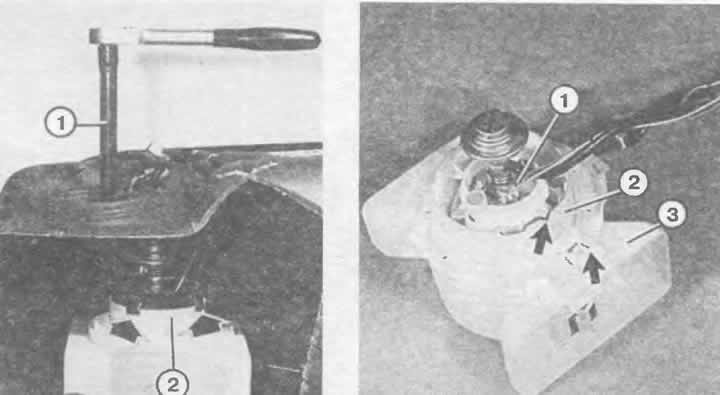
Left: To remove the fuel pump, you need a special tool (1) that turns the inner part of the fuel intake housing (2) slightly to the left. The tool should get its paws (arrows) into the recesses on the inner part.
Right: To install the fuel pump (1) with the inner part of the fuel intake housing (2) into the outer part (3), it is necessary to observe the correct installation position: the mark on the inner part of the fuel intake housing must be opposite the mark on the outer part (arrows).
Models with 6-cylinder engine and 4-cylinder engine and Mono-Motronic or Digifant injection system: disconnect the pipe leading to the fuel mixture preparation unit at the union nut. Attach an extension to the hose coming from the fuel tank and lower its end into some container.
The assistant should turn on the starter at this time. Now the fuel should flow.
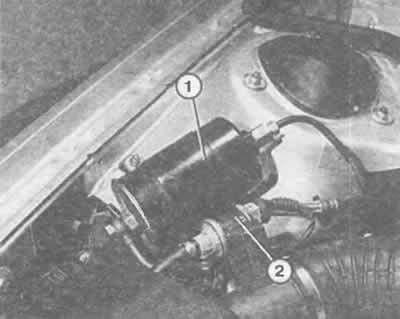
The fuel filter (1) is located on the right rear of the engine compartment in all Audi 100 engine models. In the 6-cylinder engine shown here, the solenoid valve for the activated carbon tank (2) is also located nearby.
Models with 4-cylinder engine and KE-Motronic injection system and with 5-cylinder engine and KE-III-Jetronic injection system: Loosen the screw connection on the fuel supply line - have a rag ready to clean up any leaking petrol.
Even with the engine not running, some gasoline should now come out because the fuel supply system is under pressure thanks to the fuel accumulator.
If nothing appears, the assistant should turn on the starter.
The fuel pump should now start delivering gasoline.
All models: If the pump does not work, you need to check the multi-pin plug at the top of the fuel tank protective flange to see if the pump is receiving power:
Unfold the luggage compartment mat.
Remove the black metal cover.
Remove the multi-pin plug.
Check with a voltmeter or test lamp whether there is continuity between plug contacts 1 and 4 (brown and yellow-green wires) voltage of approximately 12 V. To measure this, the assistant must turn on the starter (gear lever in neutral position, car on parking brake).
If the pump does not work despite receiving power, it is faulty.
If there is no power supply, then the pump relay in the central switchboard is suspect. Its testing is described in the chapter "Body electrical system".
Other causes may include: faulty wiring to the relay or pump, a clogged or kinked fuel line, a clogged coarse filter or fuel accumulator.
Removal the fuel pump
This is already one of the types of work that a workshop should perform, because the fuel pump is removed together with the inner part of the fuel intake housing, and it can only be removed from the outer part of the fuel intake with a special key 3214. Anyone who can rent such a key should proceed as follows:
Remove the fuel sensor.
Install special key 3214 on the inside of the fuel intake housing and turn it to the left until it stops.
Remove the fuel pump with the internal part and the fuel sensor from the tank.
Remember (mark) the exact installation position of the pump, tubes, wires and wire bandages, because during installation all the elements must be reassembled in exactly the same order.
Once the delivery line is disconnected, the fuel pump can be disconnected from the inside of the fuel intake housing. Depending on the pump version:
Option I: turn the mesh located at the bottom on the inside of the fuel intake housing to the left, remove the fuel pump. When installing, the protrusion on the side of the pump should enter the groove. Watch the sealing ring.
Option II: Press the locking bracket at the top on the inside of the fuel intake housing, remove the pump. When installing, the pump can only be installed in one position.
The pump can be reinstalled on the outside of the fuel tank intake housing.
The marking on the outside of the case must be opposite the single notch (mark) on the inside.
Tighten the inner part again using wrench 3214. Install the remaining parts.
Monitor the installation position of the fuel sensor (as will be described below).
Replacing the fuel filter
The fuel filter in the Audi-100 is of such a volume that it does not need to be changed during the service life of the engine. Replacing the fuel filter can only be recommended in case of malfunctions in the fuel filter or when installing a new engine.